

September 24, 2025
3 min read
Infections of Drug-Resistant ‘Nightmare Bacteria’ Are Surging in Hospitals
The infection rate of one type of carbapenem-resistant Enterobacterales bacteria has risen by more than 460 percent in recent years. Scientists say people receiving treatment in hospitals are at highest risk
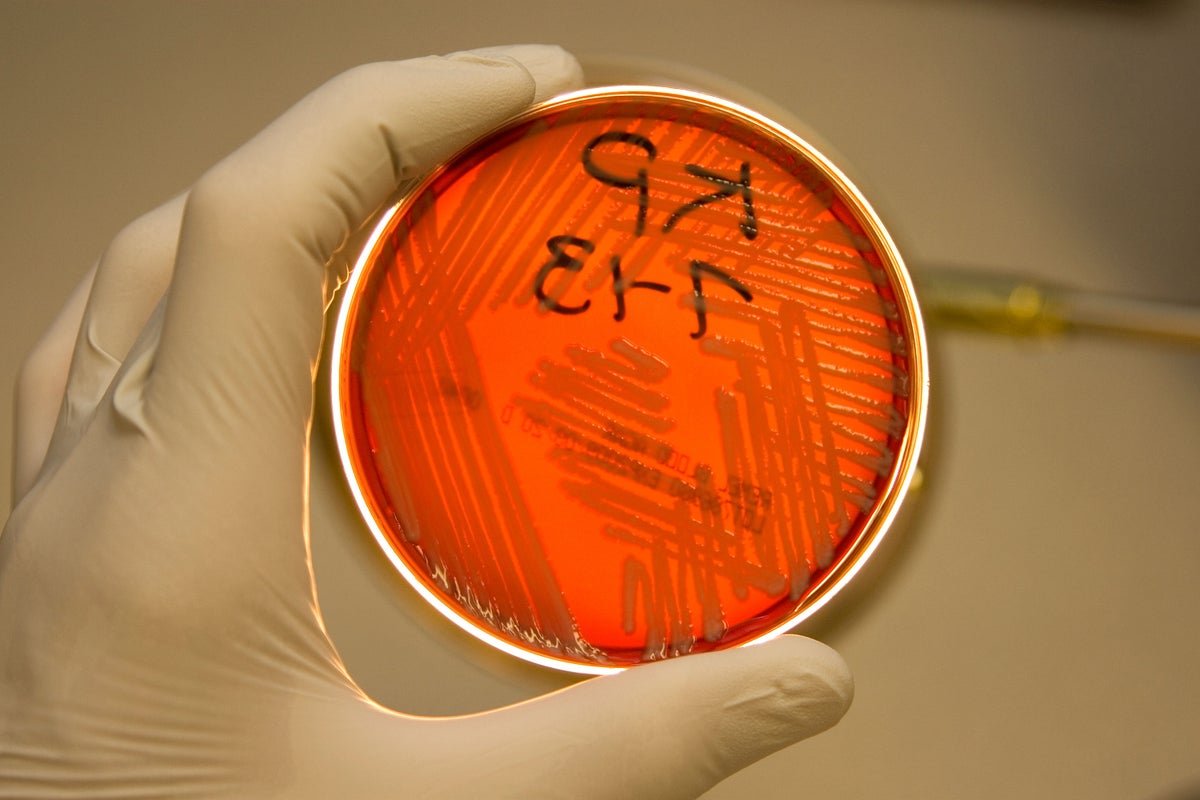
Microbiologist holds a petri dish growing bacteria, Klebsiella pneumoniae, one species that can become resistant to last-resort antibiotics.
Eric Carr/Alamy Stock Photo
The U.S. Centers for Disease Control and Prevention is raising alarm about a sharp spike in infections from dangerous bacteria that are resistant to some of the strongest antibiotics.
A report released on Tuesday by CDC scientists found that, between 2019 and 2023, there was as much as a 461 percent increase in the infection rate of certain bacteria in the group Enterobacterales that can thwart many antibiotic treatments, including a powerful class of drugs known as carbapenems. Carbapenems are used to treat severe multidrug-resistant bacterial infections, including pneumonia and bloodstream, bone and urinary tract infections. These carbapenem-resistant Enterobacterales (CRE) infections are notoriously difficult to treat and can be fatal: In 2020 alone, CRE caused about 12,700 infections and 1,100 deaths in the U.S. Former CDC director Tom Frieden once called CRE “nightmare bacteria.”
The report’s authors note that CRE infections are still considered rare and mostly occur in hospital settings. Still, the rise in infections highlighted in the new study is cause for some concern.
On supporting science journalism
If you’re enjoying this article, consider supporting our award-winning journalism by subscribing. By purchasing a subscription you are helping to ensure the future of impactful stories about the discoveries and ideas shaping our world today.
“It was shocking to see how large of an increase it was,” says Danielle Rankin, a co-author of the new report and an epidemiologist at the CDC’s Division of Healthcare Quality Promotion. “The biggest thing for us is that we understand where this is happening because we want to ensure that this does not go outside of health care settings [and] into the community and cause more difficult to treat infections.”
What Did Researchers Find?
The group Enterobacterales encompasses a wide number of common germs, including Escherichia coli and Klebsiella pneumoniae. One way bacterial species turn into CRE is by picking up specific genes that allow them to evade antibiotics, such as by giving them the ability to make carbapenemases, enzymes that inactivate carbapenems.
The study’s authors analyzed cases in 29 states that require hospitals to report and send CRE samples to local public health departments for testing. They looked at overall changes in CRE infection rates, as well as the prevalence of five different types of genes that code for carbapenemases. Overall, the researchers found a 69 percent increase in the rate of CRE infections that involved carbapenemase-producing genes between 2019 and 2013. “We saw this increase in at least every region,” Rankin says.
Among CRE with these genes, those with a gene that codes for an enzyme called New Delhi metallo-β-lactamase, or NDM, had the largest jump in infection rate—461 percent. Such so-called NDM-CRE bacteria are known to spread easily through health care facilities via medical equipment such as ventilators and intravenous tubing. People receiving treatment in these care settings are currently at highest risk, but Rankin says it’s not out of the realm of possibility for NDM-CRE infections to occur in other environments.
“The antibiotics we have that are effective against NDM-CRE are only available through IV. They are not an oral antibiotic you can take,” Rankin says. “We are concerned because there is risk that this could spread into communities, meaning that common infections like urinary tract infections that are usually treated with the oral antibiotics may increasingly need to be treated with the IV antibiotics and require hospitalization.”
Rankin notes that the situation with NDM-CRE also plays a part in the larger antimicrobial resistance crisis. “These are genes that can transfer resistance across different bacterial species,” she says.
What’s behind the Increase in Infections?
CDC scientists are still investigating, but they suspect several factors are involved. NDM-CRE can spread from improper hand hygiene among health care providers or inadequate cleaning and disinfection of equipment. Other key factors are insufficient testing and limited access to detection tools. “When NDM-CRE infections are not identified quickly, earlier treatment with effective antibiotics and infection control interventions may be delayed, which can then create more opportunities for transmission from patient to patient,” Rankin says.
She hopes the report shows the importance of using specialized testing to detect these drug-resistant genes so that health care providers can deliver effective—and potentially lifesaving—treatments.
It’s Time to Stand Up for Science
If you enjoyed this article, I’d like to ask for your support. Scientific American has served as an advocate for science and industry for 180 years, and right now may be the most critical moment in that two-century history.
I’ve been a Scientific American subscriber since I was 12 years old, and it helped shape the way I look at the world. SciAm always educates and delights me, and inspires a sense of awe for our vast, beautiful universe. I hope it does that for you, too.
If you subscribe to Scientific American, you help ensure that our coverage is centered on meaningful research and discovery; that we have the resources to report on the decisions that threaten labs across the U.S.; and that we support both budding and working scientists at a time when the value of science itself too often goes unrecognized.
In return, you get essential news, captivating podcasts, brilliant infographics, can’t-miss newsletters, must-watch videos, challenging games, and the science world’s best writing and reporting. You can even gift someone a subscription.
There has never been a more important time for us to stand up and show why science matters. I hope you’ll support us in that mission.
