

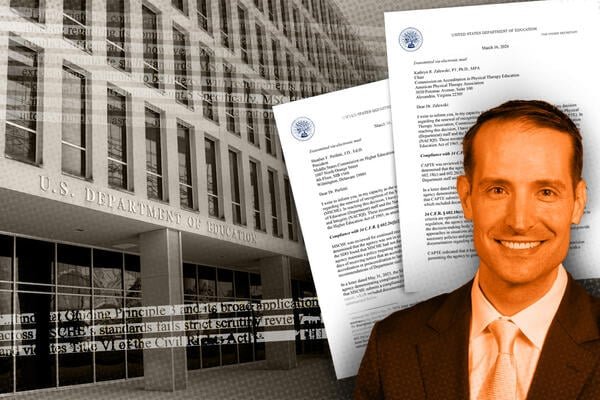
The Department of Education has taken aim at two accreditors, warning them that diversity, equity and inclusion efforts built into their current standards are in conflict with federal law.
Education Under Secretary Nicholas Kent sent letters Monday to the Middle States Commission on Higher Education and the Commission on Accreditation in Physical Therapy Education. ED ultimately renewed the accreditors’ federal recognition, but the letters warned them over their existing DEI standards.
While both have suspended enforcement of their DEI standards, the Trump administration is pushing the two accreditors to abolish such practices altogether. Kent indicated neither are currently noncompliant, but he noted in both letters that he was concerned about noncompliance since neither has “formally rescinded any and all agency standards that violate federal law.”
Kent also alleged that DEI standards for both organizations violate Title VI of the Civil Rights Act of 1964. (He did not find either Middle States to be noncompliant with accreditation-recognition criteria but raised one non-DEI related compliance concern with CAPTE.)
Now both must submit two monitoring reports describing “what actions the agency has taken to eliminate standards that violate federal law,” according to Kent’s letters. Initial monitoring reports from both accreditors are due within six months, while the second is to follow within 12 months.
Kent’s letters follow concerns raised over DEI in accreditation standards by GOP-appointed members to the National Advisory Committee on Institutional Quality and Integrity at its December meeting. At the time, both organizations noted DEI efforts had already been paused.
Pause Not Enough
Starting in the early days of the second Trump administration, numerous accreditors, including Middle States and CAPTE, quickly backtracked on DEI—suspending such requirements in their standards or offering broad flexibility to institutions. Kent noted those changes in his letters.
Still, hitting pause on enforcement of DEI standards is not enough, he said.
While the under secretary wrote that he appreciated MSCHE’s “commitment to update its standards to avoid these conflicts of federal law,” Kent argued that the accreditor’s standards “continue to be littered with requirements that institutions take racial diversity into account.”
Specifically, he pointed to Guiding Principle Three in the standards, which calls on institutions to “reflect deeply and share results on diversity, equity, and inclusion (DEI) in the context of their mission.” The currently suspended standard urges institutions to weigh such efforts in their policies and processes, curriculum and services, assessments, and resource allocations.
But MSCHE officials pushed back in a Monday night statement, noting that the accreditor has launched a review of its standards, “which will include changes to our already-suspended DEI criteria,” among other changes. The accreditor expects to launch its new standards in July.
Middle States disputed the notion that its DEI standards violate Title VI.
“The Title VI analysis seemingly stems from misplaced reliance on language that is not reflective of our immediate steps to suspend any and all criteria within our standards reflecting diversity, equity, and inclusion following President Trump’s Executive Orders,” Middle States president Heather Perfetti said in the statement. “I am surprised because we have demonstrated unequivocally and repeatedly that institutions are expected to follow federal and state law.”
CAPTE standards call on accredited programs to promote “a culture of justice, equity, diversity, inclusivity … belonging, and anti racism” [sic]. That suspended requirement and related compliance details are struck through in the accreditor’s current standards.
Kent argued in his letter that the policy, “which calls for institutions to promote diversity, would lead to students being treated differently on the basis of their race” and therefore violate Title VI.
CAPTE did not respond to emailed questions from Inside Higher Ed.
‘Contorted Logic’
Kent’s letters are part of a broader effort by the federal government to strip DEI practices and to assert more control over accreditors, as President Donald Trump promised to do before he was elected; he accused such organizations of failing in their mission to hold colleges accountable.
Trump said in 2023 that he would “fire the radical Left accreditors” that he claimed “have allowed our colleges to become dominated by Marxists, maniacs, and lunatics.” He promised at the time he would open the door to new accreditors who will impose “real standards on colleges.” Such standards would include “defending the American Tradition and western civilization,” he said.
Part of that push would include “removing all Marxist [DEI] bureaucrats,” he said.
Since then the federal government has taken steps to overhaul accreditation, including an executive order Trump issued in April that sought to hold such organizations accountable for alleged unlawful discrimination “under the guise of ‘diversity, equity, and inclusion’ initiatives.”
More recently, the Department of Education said it will rewrite accreditation policies later this spring.
That move comes as Kent has taken on accreditors directly. Speaking at the Council for Higher Education Accreditation’s annual conference in January, the under secretary argued that such organizations have become a monopoly and have failed in their accountability missions. Kent also warned accreditors in the room, “It’s better to be at the table than on the menu,” adding, “We’d much rather have you grabbing a seat than getting served.”
NACIQI chair Jay Greene, a prominent DEI critic, did not respond to a request for comment on Kent’s letters to Middle States and CAPTE. But Bob Shireman, a Democratic appointee to the bipartisan, 18-member board, voiced objections to how ED handled concerns on DEI.
“The contorted logic in the letters is appalling: the Administration threatens accreditors and they respond by suspending their policies to allow for review, and then the Department treats that as an admission of guilt?” Shireman wrote in a text message to an Inside Higher Ed reporter. “This feels like an abuse of authority, not to mention an abuse of the process.”
This story was corrected to reflect that ED found CAPTE out of compliance on one criterion.
