

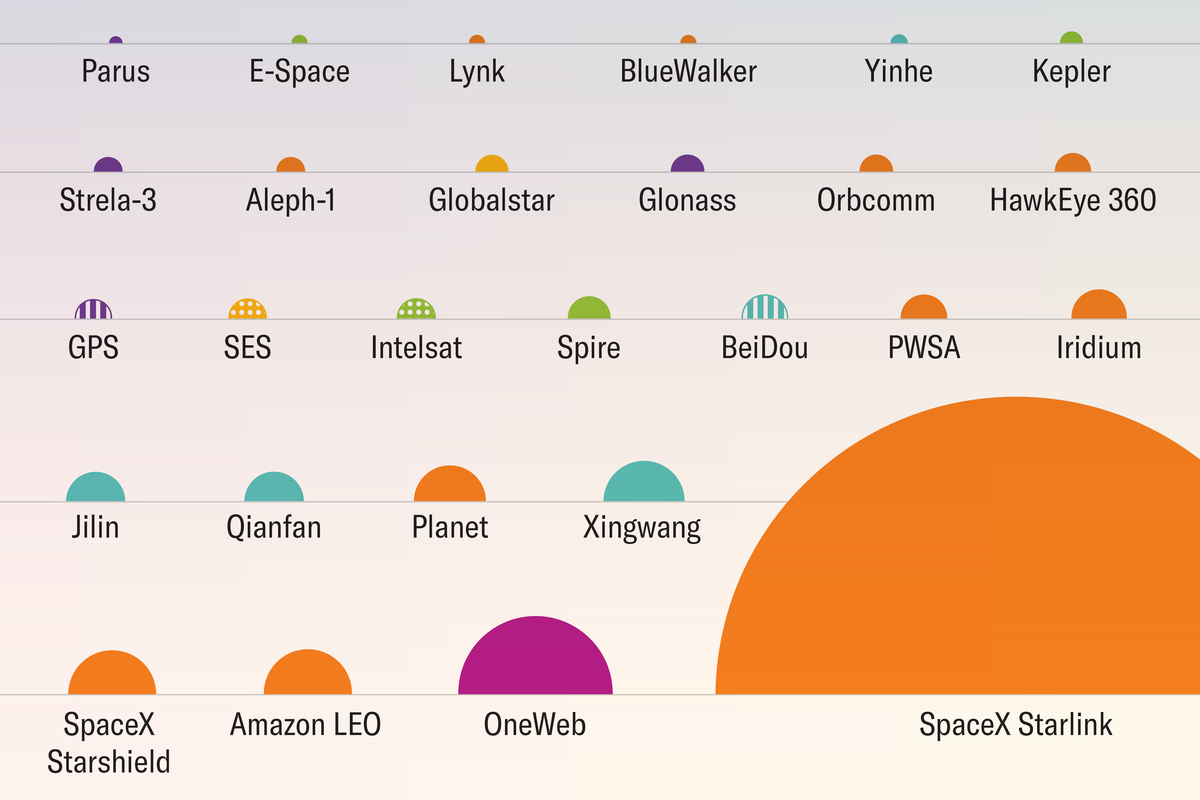
For most of the space age, our presence in Earth orbit has been relatively modest. Until the beginning of the 21st century, only a few hundred satellites operated around Earth at any one time, and the number grew to a few thousand by the 2010s. But in 2019 everything changed. That was the year one company—SpaceX—launched the first satellites for its Starlink Internet constellation. SpaceX has been relentlessly hurling Starlink satellites into orbit ever since and just hit a huge milestone that cements this daunting new era.
As of today, more than 10,000 active Starlink satellites are in space, constituting about two thirds of all satellites that are currently in orbit. That’s a number that would have seemed unbelievable just a decade ago—and a rate of growth that experts are still struggling to comprehend. “Starlink has changed our relationship with space,” says Hugh Lewis, a space debris expert at the University of Birmingham in England. “The character of the night sky is no longer the same as it once was, and I’m not sure it will ever be again.”
Shortly after 10:30 P.M. EDT on Monday, March 16, a Falcon 9 rocket launched from Space Launch Complex 4 East at Vandenberg Space Force Base in California with 25 Starlink satellites onboard. That takes SpaceX’s total number of Starlink satellites in orbit to 10,021, according to statistics compiled by Jonathan McDowell, an astrophysicist who tracks global space launches. The company has only now reached that five-figure operational number: it has launched 11,527 Starlink satellites in total since May 2019, but some of these have been replacements for defunct, deorbited spacecraft.
On supporting science journalism
If you’re enjoying this article, consider supporting our award-winning journalism by subscribing. By purchasing a subscription you are helping to ensure the future of impactful stories about the discoveries and ideas shaping our world today.
The scale of Starlink is difficult to overstate. What began as a speculative project to beam the Internet to Earth from space has become much more. Around the world, Starlink is utilized by 10 million users and counting, from rural communities to Ukrainian battlefields to remote Amazonian tribes. That gives SpaceX, and its CEO Elon Musk, unprecedented geopolitical power: the ability to switch the Internet on and off for entire regions at a whim.
And that power hasn’t gone unnoticed by competitors seeking to rival Starlink’s dominance. In the U.S. the Jeff Bezos–backed Amazon Leo constellation has launched about 200 of more than 7,500 planned satellites. In China the government-backed Qianfan and Guowang constellations are aiming for 15,000 and 13,000 satellites, respectively. “If there are more players in the market aside from SpaceX, this monopoly they have on satellite Internet is definitely going to degrade,” says Mustafa Bilal, a researcher at the Center for Aerospace & Security Studies (CASS) in Islamabad, Pakistan.
For the time being, however, Starlink reigns supreme, representing its status as a marvel of SpaceX’s world-leading logistics, manufacturing and launching capabilities. The company’s reusable Falcon 9 rocket, now with more than 600 launches to its name, has given SpaceX the means to deploy Starlink at extraordinary speed, with up to 60 satellites lofted into orbit per launch. In contrast, the next largest constellation in space, Europe’s OneWeb, numbers a paltry 654 satellites.
Starlink dominates the altitudes at which it operates: around 480 to 550 kilometers (300 to 340 miles) above Earth. Around the clock, the satellites autonomously dodge one another—and other satellites as well—to avoid collisions that could produce thousands of pieces of space debris. If such satellites did collide, this could trigger a cascade of collisions that could render regions of Earth orbit temporarily unusable in a scenario called the Kessler syndrome.
In December 2025 SpaceX submitted a report to the Federal Communications Commission that, coupled with a prior report that it submitted last June, showed its Starlink constellation performed about 300,000 collision avoidance maneuvers in 2025 alone. That translates to nearly 40 maneuvers per satellite over 12 months. The number is astonishing, considering that, pre-Starlink, a given satellite might perform only a handful of avoidance maneuvers each year.
So far, so good; despite the astronomically surging figures, the number of Starlink satellite collisions is zero. But some worry it is only a matter of time before such a smashup occurs, particularly as other mega constellations gather apace. “Our ability to keep using orbit depends on Starlink continuing to operate perfectly,” says Samantha Lawler, an astronomer at the University of Regina in Saskatchewan. “It makes me nervous, for sure.”
It has not all been smooth sailing. In July 2024 a 2.5-kilogram piece of a deliberately deorbited Starlink satellite survived reentry into the atmosphere and plummeted onto a farm in Canada. In December 2025 China reported a near miss between one of its satellites and a Starlink satellite. That same month, a Starlink satellite exploded in orbit, ejecting dozens of pieces of debris, although no in-space collision was to blame. In its December 2025 report to the FCC, SpaceX said it had identified the cause of the explosion and removed the parts that were responsible from subsequent Starlink satellites. The climatic effects of multiple Starlink satellites burning up in our atmosphere every day also remain poorly understood and could be changing the temperature of the stratosphere.
Aside from the sheer challenge of managing so many satellites in orbit, there is the major issue of mega constellations having an ongoing effect on astronomy. Interference from Starlink and other satellites has already become frustratingly routine for astronomers, hampering science as celestial objects are obscured, and the problem is only going to get worse. A study that was led by Alejandro Borlaff at NASA’s Ames Research Center in California and published last December found that adding half a million satellites to Earth orbit would result in at least one of them disruptively photobombing almost every image taken by every telescope on Earth—and many images from telescopes in space. For stargazers, the prognosis is chilling: “There is no place in the sky that won’t have any satellites,” Borlaff says. Even putting all future astronomical observatories in orbit, as some have suggested, offers no escape.
Such numbers are not just speculative; Starlink’s milestone of 10,000 satellites actively in orbit is only the beginning of our new relationship with Earth orbit. From Internet mega constellations alone, there are tens of thousands of satellites planned to launch in the coming years, while Musk recently announced plans to launch an eye-watering one million satellites for a new orbital artificial intelligence data center using SpaceX’s huge new Starship rocket. In total, there are 1.7 million satellites currently proposed to launch worldwide.
Exactly how many satellites Earth orbit can accommodate before collisions become inevitable is unclear. A study in 2022 suggested that millions of satellites could be achievable, but other experts believe the number is closer to 100,000. Such numbers might seem beyond belief, but so did 10,000 satellites not so long ago. “I never would have thought we’d have constellations with thousands of satellites,” says Victoria Samson, chief director of space security and stability at the Secure World Foundation in Washington, D.C. “So I don’t want to say ‘never.’”
Today it is more than 10,000 satellites from SpaceX and counting. Next week alone there are five planned Starlink launches. Earth’s orbit, once free of human-made machinery just 70 years ago, is getting busier and busier. Can we cope?
