

In August 1941, the British government received a very unwelcome piece of analysis from an economist named David Miles Bensusan-Butt. A careful review of photographs suggested that the Royal Air Force’s Bomber Command was having trouble hitting targets in Germany and France; in fact, only one in three pilots who claimed to have attacked the targets seemed to have dropped their bombs within five miles of the sites. The Butt report is a landmark in the history of “bomb damage assessment,” or, as we now call it, “battle damage assessment.”
This recondite term has come back into public usage because of the dispute over the effectiveness of the June 22 American bombing of three Iranian nuclear facilities. President Donald Trump said that American bombs had “obliterated” the Iranian nuclear program. A leaked preliminary assessment from the Defense Intelligence Agency on June 24 said that the damage was minimal. Whom to believe? Have the advocates of bombing again overpromised and underdelivered?
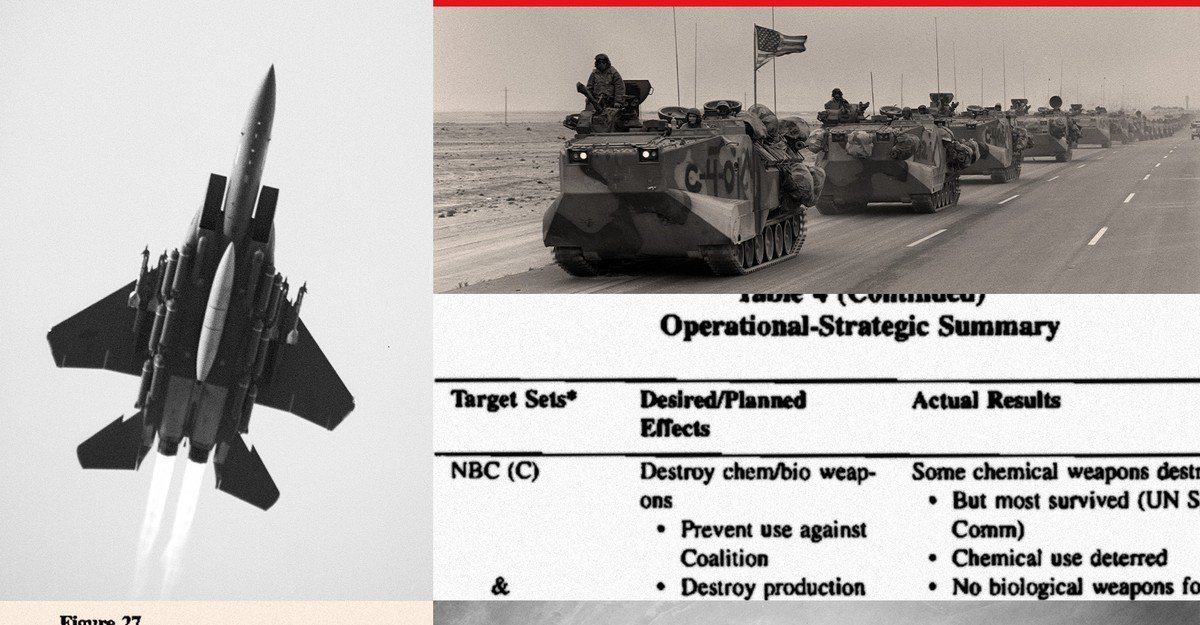
Some history is in order here, informed by a bit of personal experience. From 1991 to 1993 I ran the U.S. Air Force’s study of the first Gulf War. In doing so I learned that BDA rests on three considerations: the munition used, including its accuracy; the aircraft delivering it; and the type of damage or effect created.
Of these, precision is the most important. World War II saw the first use of guided bombs in combat. In September 1943, the Germans used radio-controlled glide bombs to sink the Italian battleship Roma as it sailed off to surrender to the Allies. Americans developed similar systems with some successes, though none so dramatic. In the years after the war, precision-guided weapons slowly came to predominate in modern arsenals. The United States used no fewer than 24,000 laser-guided bombs during the Vietnam War, and some 17,000 of them during the 1991 Gulf War. These weapons have improved considerably, and in the 35 years since, “routine precision,” as some have called it, has enormously improved the ability of airplanes to hit hard, buried targets.
Specially designed ordnance has also seen tremendous advances. In World War II, the British developed the six-ton Tallboy bomb to use against special targets, including the concrete submarine pens of occupied France in which German U-boats hid. The Tallboys cracked some of the concrete but did not destroy any, in part because these were “dumb bombs” lacking precision guidance, and in part because the art of hardening warheads was in its infancy. In the first Gulf War, the United States hastily developed a deep-penetrating, bunker-busting bomb, the GBU-28, which weighed 5,000 pounds, but only two were used, to uncertain effect. In the years since, however, the U.S. and Israeli air forces, among others, have acquired hardened warheads for 2,000-pound bombs such as the BLU-109 that can hit deeply buried targets—which is why, for example, the Israelis were able to kill a lot of Hezbollah’s leadership in its supposedly secure bunkers.
The aircraft that deliver bombs can affect the explosives’ accuracy. Bombs that home in on the reflection of a laser, for example, could become “stupid” if a cloud passes between plane and the target, or if the laser otherwise loses its lock on the target. Bombs relying on GPS coordinates can in theory be jammed. Airplanes being shot at are usually less effective bomb droppers than those that are not, because evasive maneuvers can prevent accurate delivery.
The really complicated question is that of effects. Vietnam-era guided bombs, for example, could and did drop bridges in North Vietnam. In many cases, however, Vietnamese engineers countered by building “underwater bridges” that allowed trucks to drive across a river while axle-deep in water. The effect was inconvenience, not interdiction.
Conversely, in the first Gulf War, the U.S. and its allies spent a month pounding Iraqi forces dug in along the Kuwait border, chiefly with dumb bombs delivered by “smart aircraft” such as the F-16. In theory, the accuracy of the bombing computer on the airplane would allow it to deliver unguided ordnance with accuracy comparable to that of a laser-guided bomb. In practice, ground fire and delivery from high altitudes often caused pilots to miss. When teams began looking at Iraqi tanks in the area overrun by U.S. forces, they found that many of the tanks were, in fact, undamaged.
But that was only half of the story. Iraqi tank crews were so sufficiently terrified of American air power that they stayed some distance away from their tanks, and tanks immobilized and unmaintained for a month, or bounced around by near misses, do not work terribly well. The functional and indirect effects of the bombing, in other words, were much greater than the disappointing physical effects.
Many of the critiques of bombing neglect the importance of this phenomenon. The pounding of German cities and industry during World War II, for example, did not bring war production to a halt until the last months, but the indirect and functional effects were enormous. The diversion of German resources into air-defense and revenge weapons, and the destruction of the Luftwaffe’s fighter force over the Third Reich, played a very great role in paving the way to Allied victory.
At a microlevel, BDA can be perplexing. In 1991, for example, a bomb hole in an Iraqi hardened-aircraft shelter told analysts only so much. Did the bomb go through the multiple layers of concrete and rock fill, or did it “J-hook” back upward and possibly fail to explode? Was there something in the shelter when it hit, and what damage did it do? Did the Iraqis perhaps move airplanes into penetrated shelters on the theory that lightning would not strike twice? All hard (though not entirely impossible) to judge without being on the ground.
To the present moment: BDA takes a long time, so the leaked DIA memo of June 24 was based on preliminary and incomplete data. The study I headed was still working on BDA a year after the war ended. Results may be quicker now, but all kinds of information need to be integrated—imagery analysis, intercepted communications, measurement and signature intelligence (e.g., subsidence of earth above a collapsed structure), and of course human intelligence, among others. Any expert (and any journalist who bothered to consult one) would know that two days was a radically inadequate time frame in which to form a considered judgment. The DIA report was, from a practical point of view, worthless.
An educated guess, however, would suggest that in fact the U.S. military’s judgment that the Iranian nuclear problem had suffered severe damage was correct. The American bombing was the culmination of a 12-day campaign launched by the Israelis, which hit many nuclear facilities and assassinated at least 14 nuclear scientists. The real issue is not the single American strike so much as the cumulative effect against the entire nuclear ecosystem, including machining, testing, and design facilities.
The platforms delivering the munitions in the American attack had ideal conditions in which to operate—there was no Iranian air force to come up and attack the B-2s that they may not even have detected, nor was there ground fire to speak of. The planes were the most sophisticated platforms of the most sophisticated air force in the world. The bombs themselves, particularly the 14 GBU-57s, were gigantic—at 15 tons, more than double the size of Tallboys—with exquisite guidance and hardened penetrating warheads. The targets were all fully understood from more than a decade of close scrutiny by Israeli and American intelligence, and probably that of other Western countries as well.
In the absence of full information, cumulative expert judgment also deserves some consideration—and external experts such as David Albright, the founder of the Institute for Science and International Security, have concluded that the damage was indeed massive and lasting. Israeli analysts, in and out of government, appear to agree. They are more likely to know, and more likely to be cautious in declaring success about what is, after all, an existential threat to their country. For that matter, the Iranian foreign minister concedes that “serious damage” was done.
One has to set aside the sycophantic braggadocio of Secretary of Defense Pete Hegseth, who seems to believe that one unopposed bombing raid is a military achievement on par with D-Day, or the exuberant use of the word obliteration by the president. A cooler, admittedly provisional judgment is that with all their faults, however, the president and his secretary of defense are likely a lot closer to the mark about what happened when the bombs fell than many of their hasty, and not always well-informed, critics.
*Photo-illustration by Jonelle Afurong / The Atlantic. Sources: Alberto Pizzoli / Sygma / Getty; MIKE NELSON / AFP / Getty; Greg Mathieson / Mai / Getty; Space Frontiers / Archive Photos / Hulton Archive / Getty; U.S. Department of Defense.
