

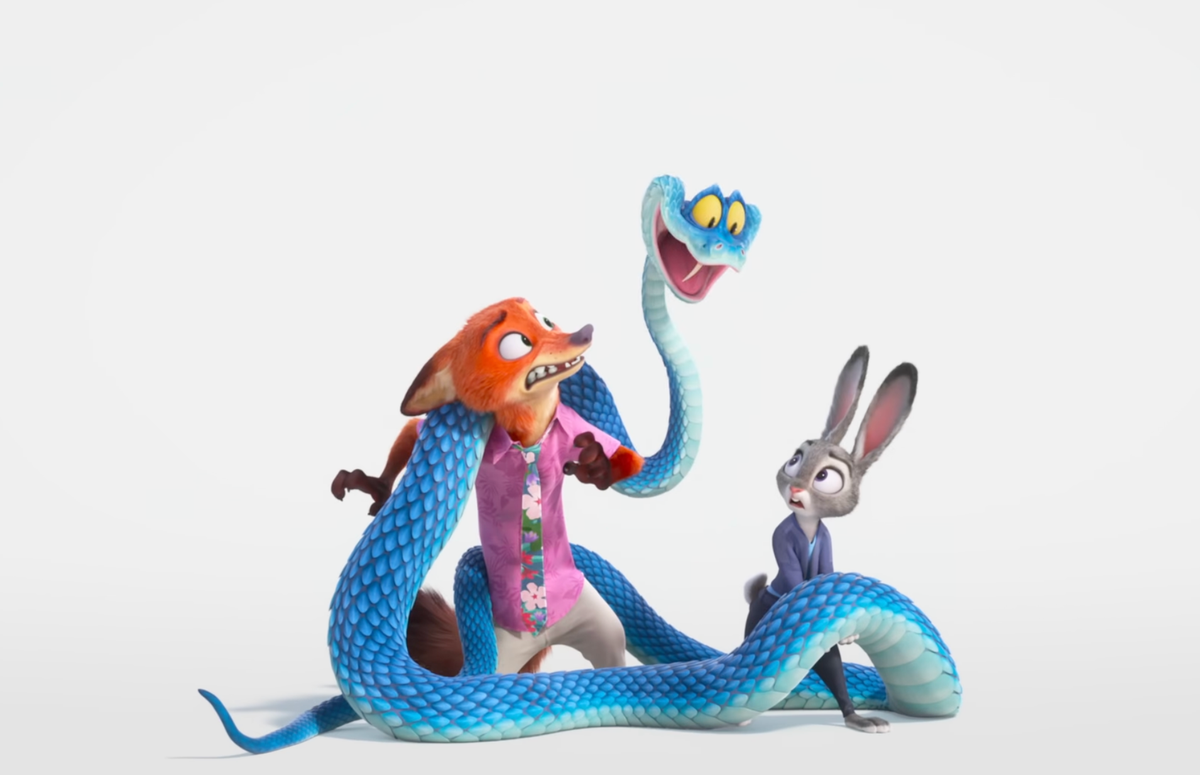
At its core, Zootopia 2 is a defense of snakes. The Oscar-nominated sequel to Zootopia centers on an unlikely pair of animal police officers—Judy Hopps, a rabbit, and her fox partner, Nick Wilde—who together work to solve the mystery surrounding the family of a surprisingly lovable pit viper called Gary De’Snake. Along the way, they discover why snakes like Gary were driven out of the city of Zootopia.
In the world of the film, reptiles—but especially snakes—are outcasts from mammal-centric society. But the stigma, Gary (voiced by Ke Huy Quan) tells Hopps, is misplaced: “Snakes never hurt anyone,” he explains to the rabbit (Ginnifer Goodwin). “We aren’t the bad guys.” Gary inspires Hopps and Wilde (Jason Bateman) to try to prove snakes aren’t so bad and bring them back to Zootopia.
Gary’s story is quite a change of pace from the usual villainous role of snakes in Hollywood (see The Jungle Book, the Harry Potter franchise, Snakes on a Plane, Anaconda) and the perception of them in human societies more broadly (see the Book of Genesis). But from a scientific standpoint, there are extremely good reasons to keep snakes around: they’re a critical piece of the ecosystem.
On supporting science journalism
If you’re enjoying this article, consider supporting our award-winning journalism by subscribing. By purchasing a subscription you are helping to ensure the future of impactful stories about the discoveries and ideas shaping our world today.
If snakes were somehow excluded from the animal world, as they were from society in Zootopia 2, that would almost certainly have disastrous consequences. “If they were to disappear, we’d be in big trouble,” says Emily Taylor, director of the Physiological Ecology of Reptiles Laboratory (PERL) at California Polytechnic State University, San Luis Obispo.
Snakes are “mesopredators,” which means that they eat small rodents, such as squirrels and mice, but are also themselves eaten by other predators, such as hawks, owls, badgers and coyotes, Taylor says. “Because of that, they play a doubly important role in ecosystem health.” In other words, eliminating them from the animal kingdom would be like yanking an entire tier of Jenga blocks out of the middle of the tower.
The larger effect is perhaps on snakes’ prey: eliminating the reptiles would mean that rodents would be left without a key predator, enabling rats and mice to reproduce unchecked, Taylor says, “and they would overrun the planet.”
“That would lead to a massive denuding of vegetation, including everything from our native plants out there to our crops,” she adds.
This fear is backed by science: In one 2024 study, a group of Australian researchers estimated that, every year, a single adult eastern brown snake consumes approximately 50 mice, possibly more. At their regular density levels in Australian farmlands, the researchers estimated that brown snakes alone might remove thousands of mice annually for every square kilometer of farmland.
By extension, snakes also help to keep diseases carried by rodents—hantaviruses, bubonic plague, Lyme disease, and more—under control. Snakes may occasionally carry Salmonella, but in general, snake diseases don’t pose nearly as much risk to humans as rodents do, Taylor says.
Snakes can also act as “ecosystem engineers” by aiding in seed dispersal, more recent research shows. In January a team of scientists found that western diamondback rattlesnakes that eat small mammals that consume and digest seeds can “rescue” the seeds by pooping them out. This process also provides “a little pile of fertilizer,” Taylor explains, helping the seeds to germinate.
Despite all these benefits, snakes are among humans’ top phobias. In one 2001 Gallup poll, for example, Americans said they were more afraid of snakes than anything else they were asked about, including “being closed in a small space,” “needles and getting shots,” “heights” and “public speaking.”
Our fears aren’t entirely without merit. Gary’s claim that snakes “never hurt anyone” isn’t entirely true: snake bites kill an estimated 81,410 to 137,880 people globally every year, according to the World Health Organization. And climate change is going to make snake bites much more likely, recent research suggests. In the U.S., snake-bite deaths are much lower, representing around five people per year, in part because we have better access to medical treatment, Taylor says.
But portraying snake exclusively as “villains” in pop culture only serves to exacerbate people’s fear of the reptiles, Taylor says, which she believes is unfortunate.
“When people can see that snakes are actually gentle and they want nothing to do with people—and can appreciate them from a distance—then I think that that can lead to an appreciation of snakes and not fear of snakes,” she says.
