

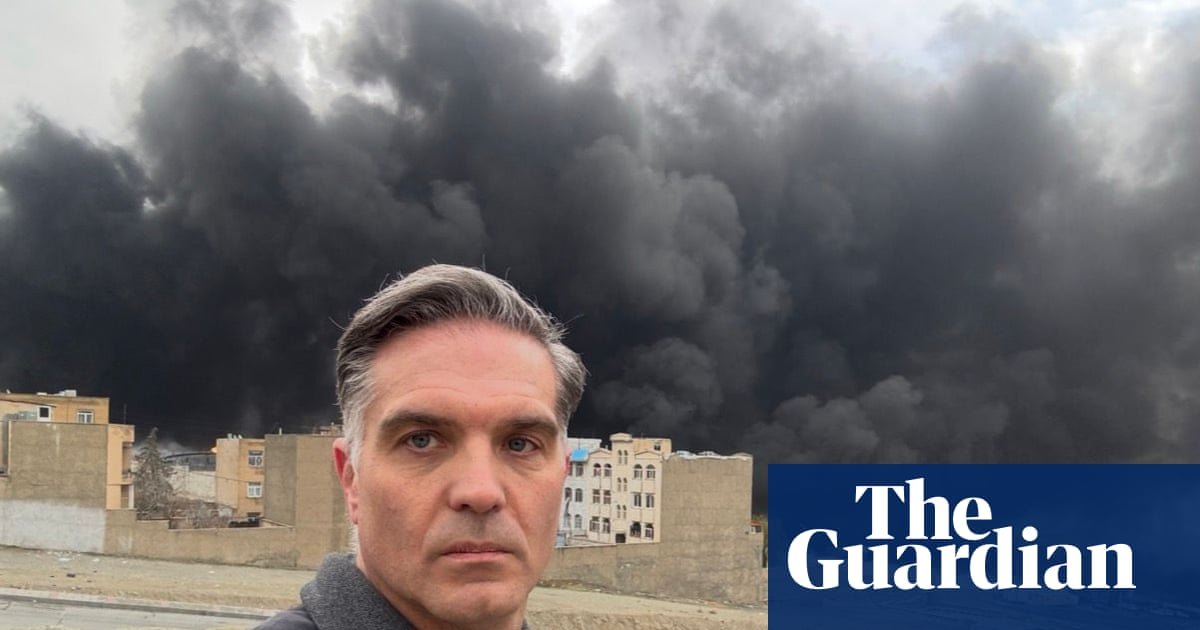
Frederik Pleitgen, CNN’s senior international correspondent, had a pretty normal Thursday evening – at home in Berlin with his family, he walked his two Rhodesian Ridgeback dogs and spent some time with his two teenagers.
That return to normalcy came after spending a week in war-torn Iran as the only western television correspondent given a visa to report from the country.
While Pleitgen is no stranger to reporting from hostile territories such as Iran and Russia, where he also serves as a Moscow correspondent, the 49-year-old journalist said his wife had a “bad feeling” about this particular trip to Iran.
But, ultimately, he said it was too great of an opportunity to pass up – though he did have a close call on Tuesday, when he and his producer, Claudia Otto, were forced to flee a site after hearing anti-aircraft fire and an explosion.
At a time of immense media scrutiny and clear hostility from the White House, CNN faced some snide remarks and suggestions that Pleitgen was doing propaganda for the Iranian regime – including a dismissive tweet from a member of the Trump administration – because he was in the country with the permission of the government, something CNN reminded viewers when he appeared on air.
“I can take the criticism. I think it’s fine,” he said.
Pleitgen spoke to the Guardian about the experience from Germany.
This interview has been edited for clarity and conciseness.
How did it feel to be the only Western TV network journalist in the entire country during a war?
It’s obviously a big responsibility, and the government there knows that you’re the only ones there, so they try to take you to places where stuff’s happened or to things they want to show. But on the other hand, I was keeping an eye also internationally – you obviously get trash-talked a lot as well by people who don’t want you to be there, or who don’t like your coverage.
Frederik Pleitgen. Photograph: Courtesy of CNN
Why do you think Iran granted you a visa?
I’ve been going there for a long period of time, so I have known these people for years, and the moment it started, I put in a visa request and I contacted the culture ministry, which is responsible for foreign media and I told them that we really want to come in, and I told them that it’d be important to have international media there. And then they granted the visa.
Did you have a minder? Were you taken around by someone?
No, we didn’t. So, we don’t have a minder. We have a translator who’s a guy that we hire and we pay, but he obviously – the culture ministry asks him to not take us to places that are sensitive. And they also told us that when we go around this time, we needed to inform them before we went anywhere because if you go to strike sites, the aftermath of strike sites, there’s a lot of Revolutionary Guard Corps security officials there. And if they don’t know that you’re coming or if you don’t have someone who will mitigate the fact that you’re there or mediate between you and them, then that can be a big problem pretty quickly. And then also for larger events and stuff like that, you had to sign up before going there. It was more restrictive this time than it had been in the past, but still, by and large, we could do everything that we wanted to do.
Were you surprised by the online discourse – and criticism from some – about your presence in the country with the government’s permission and decision to interview the supreme leader’s foreign policy adviser?
I wasn’t. I was sure that that was going to happen. I think right now, especially in the US, the debate about almost anything that the Trump administration does usually falls along party lines, and so you’re going to get trashed by people who don’t like “liberal media” or whatever. So I wasn’t really surprised about that. And quite frankly, I don’t take offense to it, either. I think it’s a natural thing that happens, and I think a lot of it is more words than anything else anyway … Even if there are restrictions, it’s always better to be on the ground than to not be on the ground …
One of the things that I always have in mind is that this is a particularly high-stakes thing for a lot of people. This is not just about the Trump administration, this is about the Iranian diaspora and things that they’ve been hoping for for decades … I can take the criticism. There was a lot of stuff that was over the top. But I can understand people are charged up.
Frederik Pleitgen and Claudia Otto in Iran. Photograph: Courtesy of CNN
Do you feel like your coverage was truly independent, considering the limitations?
I felt good about the coverage. I think that as far as the ongoing war was concerned, we definitely did what we’d set out to do and what we wanted to do. One of the things I would like to delve into more, which we didn’t get to do to that extent, was to what extent the government still has the support of the people. Because there were very few people who were still out on the streets, and a lot of people are afraid to speak to you.
Amid the bombing campaign by the US and Israel, how did you know where was safe to report from?
We stay in a hotel in Tehran that’s sort of in the northern part of the city. It’s in a fairly safe area now because all of the police stations and stuff there have already been bombed. So, the only thing that you can really do is whenever we heard jets overhead, when there was bombing going on close to us, which happened several times a day, we would go to the bottom floor of the hotel to bring as much hotel between us and anything that might drop on it. That’s really all you can do. They don’t have any air raid sirens. They don’t really have any hardened shelters. So, that’s basically it. And then we tried to stay out of areas that frequently saw bombing ….
The difference that you have here between this war and the war in Ukraine is that this war is one where the US and Israel have the strongest and most modern air forces in the world. They use precision munitions and gigantic precision munitions. So, if something goes wrong, there can be two reasons in my mind: one of them is they put in the wrong coordinates, or the coordinates are old, and the other one is that they use gigantic munitions and create collateral damage.
Would you say your family has fully acclimated to you working from war zones?
I’ve been doing this for 18 years now, so they’ve gotten used to it. I was in Ukraine a lot. I was in Iraq, Afghanistan, Syria, so they’re kind of used to it. This time my wife told me she had a bad feeling when I went, which doesn’t happen very often, but I think a lot of that was just because it was so unclear what the situation was on the ground. But once we got there and I was still able to communicate, it was OK.
Would you have stayed longer than eight days if you could have?
Yeah, sure. Absolutely.
Are you planning to go back or put in another visa request?
Yeah, definitely going to try to go back. I’m going to put in another visa request as soon as possible and try to go back. Definitely. I think it’s important to be there and to see what’s going on.
