

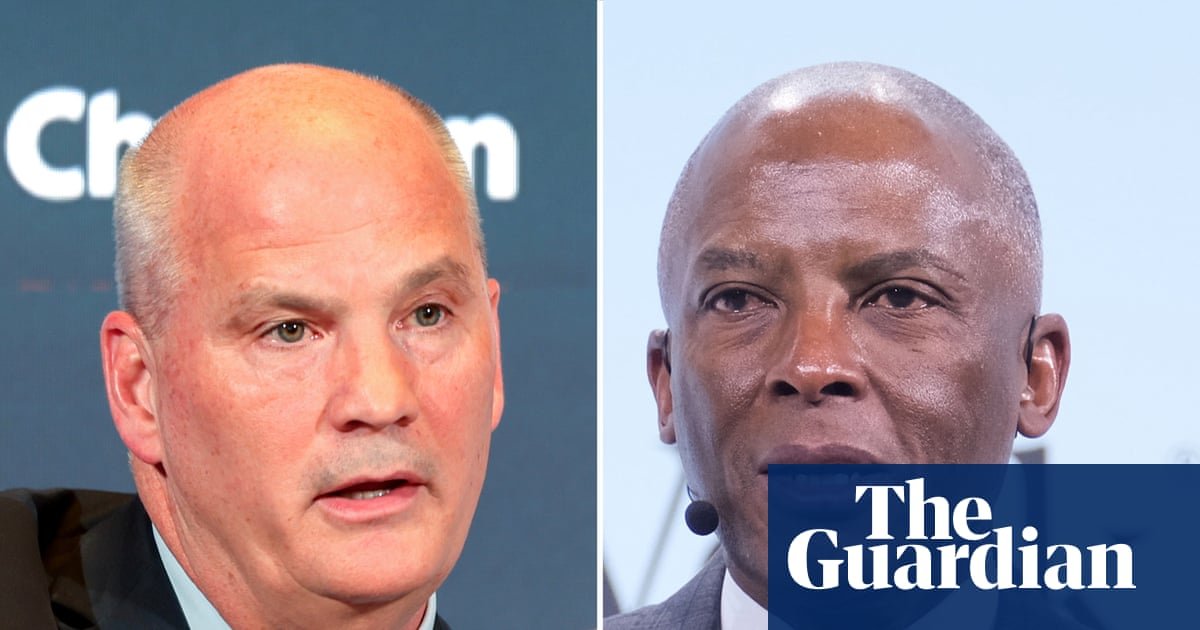
The US’s top utilities’ CEOs enjoyed a 16% pay raise last year – to an average of $12.3m – even as consumers shoulder the pain from high bills spurred by continuing inflation, the Iran war and datacenter growth, a new review of industry financial documents shows.
Utility bills are up as much as 40% in some regions since 2021, and, nationwide, utilities shut off power to customers 13m times last year, federal data shows.
Amid the difficulties, CEO pay increased at 38 of 51 top utilities, industry watchdog Energy and Policy Institute (EPI) found in its review of companies’ financial records.
EPI also detailed how some executives received pay raises despite failing to meet performance standards, including for outages. Many executives were also provided private jets, condominiums and other perks for which customers often paid the costs.
The issues “feel unjust at face value”, said Jonathan Kim, a research associate with EPI, who authored the report. “It’s the idea that we should be footing the bill for these people’s grotesquely large salaries,” Kim added.
The analysis found 38 CEOs received pay raises, and those collectively tallied $82m.
Utility prices are a main driver of continuing inflation. Consumers have paid as much as 6.7% more on their electric bills between 2024 and 2025. Since 2017, utility CEO compensation has risen 47%, on average, outpacing inflation and worker pay, according to the analysis. Customers for the utilities examined in the report collectively paid more than $5bn for CEO compensation during that period.
Donald Trump promised to slash utility bills in half during his 2024 campaign but has failed to follow through, an April Guardian analysis found.
Bill Ferhman, the American Electric Power CEO, received the largest pay increase as his compensation package spiked by $23m, or 176% to $36.6m.
Ferhman was followed by ConEd’s Tim Cawley, whose compensation jumped by $4.9m, or 33% to about $20m. Meanwhile, Southern Company’s Chris Womack received a $4.3m, or 18%, increase to $28m.
Ferhman’s pay shot up even as the Ohio-based company turned off customers’ service 173,000 times.
A ConEd spokesperson said: “Executive compensation is designed to attract and retain the leadership required to operate one of the most complex energy systems in the world, drive Con Edison’s nation-leading reliability and deliver on New York’s clean energy goals. The majority of executive compensation is performance based and paid by shareholders.”
Southern Company said: “Our performance-based executive compensation program is directly tied to what matters most to our business – delivering clean, safe, reliable and affordable energy while running our business efficiently and keeping costs down.”
An AEP spokesperson said the compensation is largely dependent on the CEO meeting five-year performance targets. “This compensation structure aligns leadership incentives with the long-term interests of customers, communities, and shareholders,” the spokesperson added.
Most CEOs also received increases as they tried to hike prices. John Ketchum, NextEra Energy CEO, was the nation’s third highest-paid CEO in 2025, with a $24m compensation package. NextEra subsidiary Florida Power & Light last year requested approval from state regulators to saddle customers with a record-breaking $6.9bn rate hike.
The situation is in part driven by utility structure – many are regulated monopolies, and their customers often cannot choose to buy electricity or gas from a different company. There is often no direct way for customers to hold the companies accountable. Public energy utilities are typically regulated by state-level utility commissions that are run by political appointees. These commissions are often viewed as industry-friendly.
The cost of CEO pay does not have a major impact on an individual customer’s bill. The compensation packages are complex and typically include incentives, bonuses, stocks and other performance payments directly tied to profits and shareholder returns. With little meaningful regulatory oversight, the utilities’ CEOs aim to boost profits to please shareholders, who then reward the CEOs with bonuses.
“The justification for these huge bonuses and pay is that it’s an incentive to increase shareholder profits, and that’s at the core of everything here,” said Chris Gilmer-Hill, policy manager with the Michigan Environmental Justice Council, which does regulatory battle with utilities in the state.
Meanwhile, many utilities have cut CEO incentives aimed at improving customer service, reliability, affordability and sustainability, Kim said.
Some executives even got raises despite their companies failing to provide reliable service or meet customer satisfaction metrics. Jason Wells, the CenterPoint Energy CEO, received a $2.6m compensation bump in 2025 even though he failed to meet the reliability standard for the number of customers with four or more outages longer than five minutes, the report found.
In Minnesota, the Xcel CEO Bob Frenzel received a maximum bonus for customer satisfaction after apparently changing the threshold, the report notes. The award came amid an influx of customer complaints in recent years that drew regulatory scrutiny in Colorado and Minnesota. His overall pay climbed $3.1m, or 23%, last year.
“They’re lowering the bar for customer outcomes – it’s essentially being replaced with ‘Are we making more profits?’” Kim said. “People aren’t getting reliable customer service, and customers are not happy about it, but profits went up, so CEO pay also went up.”
The high bills, poor service and lavish bonuses in Michigan encapsulate much of the problem. Customers of DTE Energy, which serves Detroit and the surrounding region, paid for a raise for outgoing CEO Jerry Norcia, who received $14m. Customers also paid for a raise for his replacement, Joi Harris, who was compensated nearly $7m. Customers paid for Norcia’s full salary, even though he did not helm the company for the entire year. The company’s CEOs also receive sports and concert tickets and access to a company condominium.
“DTE seems to see exorbitant bonuses and CEO pay as an incentive to maximize profits, and they’re always going to have an incentive to funnel ratepayer money into maximizing profits however they can,” Gilmer-Hill said.
DTE shares service territory with Consumers Energy. Its CEO, Garett Rochow, failed to meet performance standards for the “customer experience index” and worker safety, but his pay still went up by $132,000.
The revelations also come as new federal data shows Michigan had the highest utility disconnection rate in the midwest in 2024, the last year for which data is available.
Regulators and governments can take action to rein in utility executives. Dana Nessel, the Michigan attorney general, in 2024 successfully fought against a DTE proposal to include executives’ personal private jet travel in rate increases.
Maryland recently passed legislation that protects customers from paying CEOs more than 110% of what the chair of the public utility commission makes, and similar legislation was proposed last session in Minnesota, but it died, Kim said. A similar proposal has been discussed in Michigan, Gilmer-Hill said.
“More policymakers are thinking about this,” Kim added.
The headline of this article was amended on 29 April 2026. An earlier version said the CEOs received an average pay raise of $12.3m; this should have said an average pay raise of 16% to $12.3m.
