

March 13, 2026
3 min read
Add Us On GoogleAdd SciAm
Raccoons will solve puzzles just for fun
Raccoons might want to break into your trash can even without delicious leftovers inside
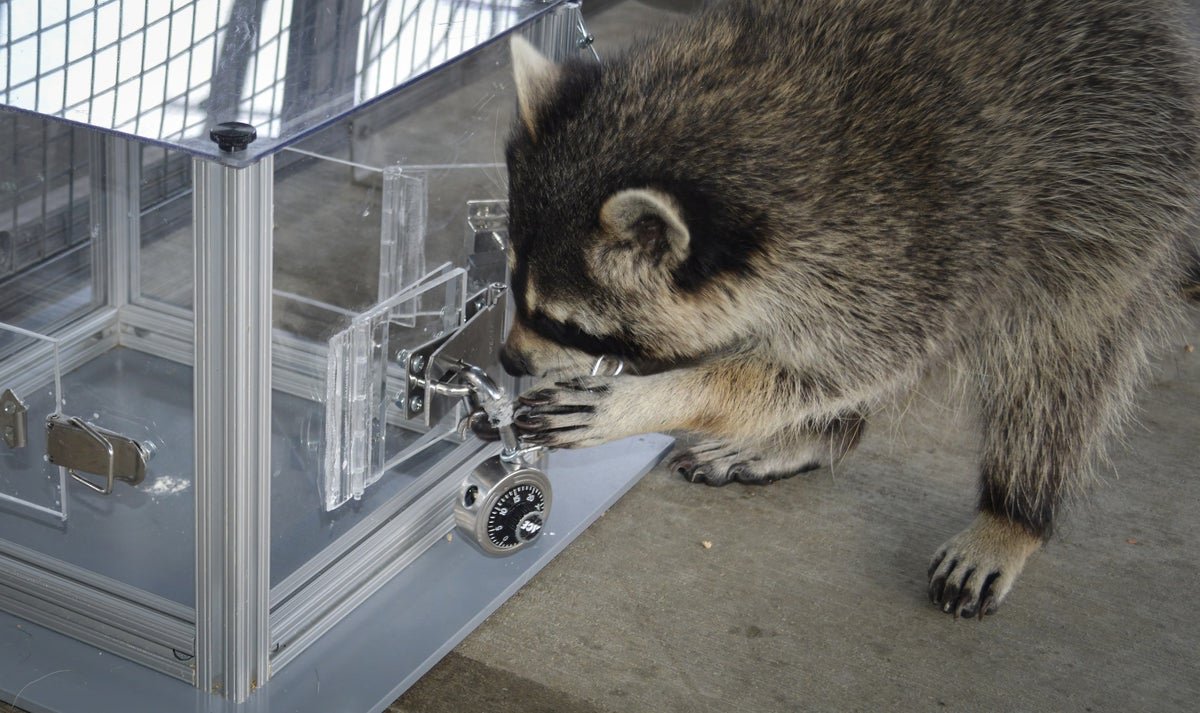
A raccoon interacts with a lock hanging off one side of the multiaccess puzzle box used in the research, one of the most challenging access strategies tested.
For a raccoon, breaking into your garbage might be just as satisfying as cracking a crossword puzzle or a Sudoku is for you, according to new research.
These meddlesome “trash pandas” have dexterous paws and considerable brain power that have helped them thrive in a human-dominated world—even showing early signs of domestication—constantly thwarting attempts to keep them from ransacking waste bins for tasty morsels. “Raccoons have very dense brains, and that likely explains their heightened ability to solve problems and to be behaviorally flexible,” says Lauren Stanton, a cognitive ecologist at the University of California, Berkeley.
But new research published in Animal Behaviour suggests raccoons will try to solve problems even when they don’t expect a food reward for the work. The scientists describe the behavior as foraging for information, rather than food, in preparation for facing future challenges.
On supporting science journalism
If you’re enjoying this article, consider supporting our award-winning journalism by subscribing. By purchasing a subscription you are helping to ensure the future of impactful stories about the discoveries and ideas shaping our world today.
The study relied on what researchers call a multiaccess puzzle box, a clear plastic box that has multiple doors and windows—sometimes equipped with locks and latches of various levels of difficulty—that an animal must opento get at a treat inside. (The scientists let the captive raccoons they were working with pick between marshmallows, sardines and dates dipped in sardine juice as their reward; marshmallows were far and away the most popular choice.)
Usually, scientists give the puzzle box, see what solution the animal finds and then give them the box again, this time with the first solution disabled. They want to see if the critter will find a new way to access their treat. In the new study, the researchers turned this formula on its head and gave the raccoons the unmodified (but refilled) box for multiple trials to see what the raccoons did.
A raccoon taking part in the experiment solves one of the easy levels of the multiaccess puzzle box researchers tested. The experiments took place at night, when raccoons are most active, and researchers watched their exploits via video footage rather than in person to reduce stress on the animals.
“Going into it, I was expecting they’ll open one solution, they’ll get the marshmallow out, and then they’ll leave the box alone, and then, when I give it back to them in their next trial with another marshmallow, maybe they’ll open another solution,” says study co-author Hannah Griebling, a Ph.D. candidate in cognitive ecology at the University of British Columbia.
But the raccoons went above and beyond, nosing into the alternative solutions practically as soon as they’d nommed their marshmallow, not waiting for a refill. The continued investigations became less common as the solutions to the puzzle box became more complex, but they never fully stopped.
Griebling and her colleagues call that continuing work on the puzzle boxes “information foraging”—essentially positing that the raccoons are taking advantage of the opportunity to investigate the additional entry mechanisms in case they run into the same situation in the future.
Of course, “we can’t know what they’re thinking; we can only measure their behavior,” Griebling says. But the finding is striking proof that something besides their taste for marshmallows is driving the animals’ continued examination—and that it could be not too different from the kind of curiosity and satisfaction humans experience when problem-solving masquerades as puzzles. “We think there could be some sort of intrinsic motivation for that behavior,” Griebling says.
Both Griebling and Stanton note that it would be valuable to repeat the work with wild raccoons, which may be more attuned to the risks of wasting time fiddling around with a lock they can’t figure out how to open. (Stanton has worked with the researchers before but was not involved in this experiment.)
And plenty of humans would appreciate a better understanding of how to convince trash pandas a puzzle isn’t worth investigating any more. If you’re one of them, Griebling’s advice is simple: “Really ensuring that they can’t get into something, instead of potentially giving them more challenges to solve, is probably important.”
It’s Time to Stand Up for Science
If you enjoyed this article, I’d like to ask for your support. Scientific American has served as an advocate for science and industry for 180 years, and right now may be the most critical moment in that two-century history.
I’ve been a Scientific American subscriber since I was 12 years old, and it helped shape the way I look at the world. SciAm always educates and delights me, and inspires a sense of awe for our vast, beautiful universe. I hope it does that for you, too.
If you subscribe to Scientific American, you help ensure that our coverage is centered on meaningful research and discovery; that we have the resources to report on the decisions that threaten labs across the U.S.; and that we support both budding and working scientists at a time when the value of science itself too often goes unrecognized.
In return, you get essential news, captivating podcasts, brilliant infographics, can’t-miss newsletters, must-watch videos, challenging games, and the science world’s best writing and reporting. You can even gift someone a subscription.
There has never been a more important time for us to stand up and show why science matters. I hope you’ll support us in that mission.
