

March 13, 2026
5 min read
Add Us On GoogleAdd SciAm
Have astronomers found a runaway monster black hole or just a very weird galaxy?
Despite years of debate and follow-up studies, an odd streak of cosmic light still defies a final explanation. Is it a giant black hole screaming through intergalactic space?
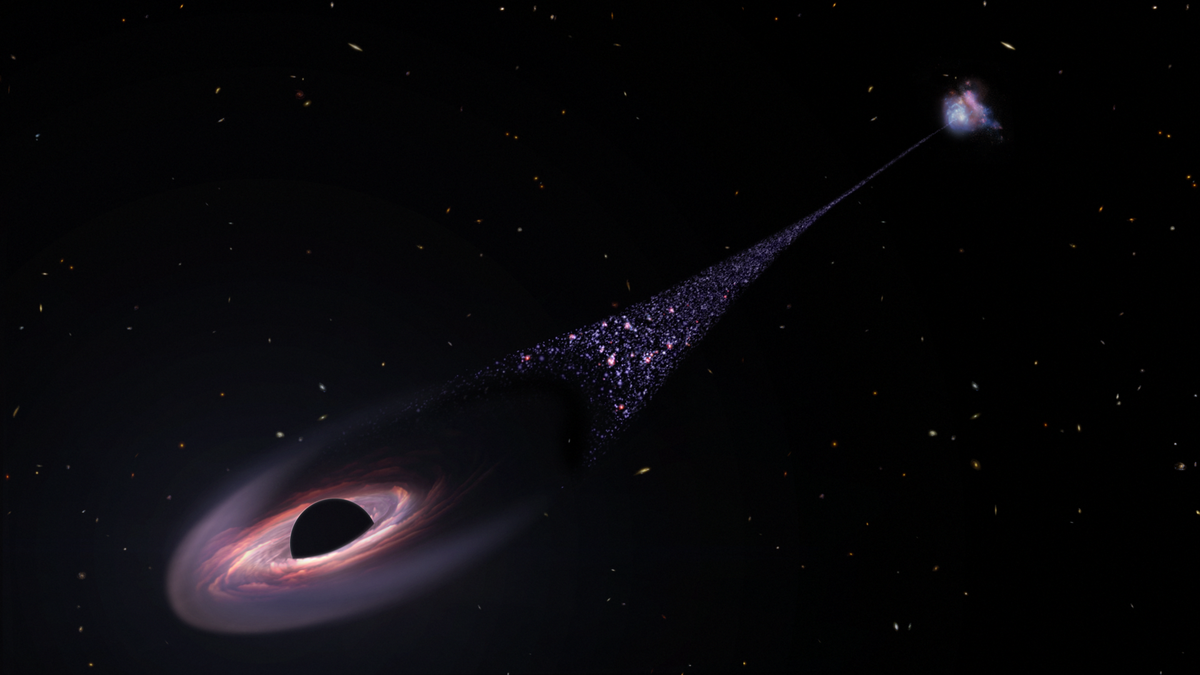
This artist’s concept shows a runaway supermassive black hole plowing through intergalactic space. Newborn stars trail in its wake, formed from the black hole’s compression of tenuous gas in front of it.
NASA, ESA, Leah Hustak (STScI)
There is something inherently terrifying about a supermassive black hole hurtling through space at an excess of three million kilometers per hour.
Normally these behemoths squat at the centers of galaxies and for good reason; they’re usually the single most massive objects in their host galaxy and thus aren’t easily budged.
But then there’s RBH-1. As a hint, the acronym “RBH” stands for “runaway supermassive black hole,” and this object may be just that: a monster some tens of millions of times the sun’s mass hauling astronomically through intergalactic space at mind-crushing speed.
On supporting science journalism
If you’re enjoying this article, consider supporting our award-winning journalism by subscribing. By purchasing a subscription you are helping to ensure the future of impactful stories about the discoveries and ideas shaping our world today.
Or it may just be a weird galaxy. This uncertainty may be the oddest part of the whole story: not that a runaway giant black hole might exist but that the data are so ambiguous that we can’t be sure what we’re really seeing.
Even more fun, astronomers discovered RBH-1 by accident! They were examining routine Hubble Space Telescope observations of a nearby dwarf galaxy when they spotted something peculiar: a long, linear streamer of light aligned with a distant galaxy. Follow-up observations that obtained and analyzed this structure’s spectrum—its brightness versus color, which can reveal a host of information about the emitting object—revealed it to be about 7.7 billion light-years away from Earth. This means it’s quite large, approximately 200,000 light-years in length—about twice the width of our Milky Way galaxy. The spectrum also shows the structure is a mix of gas and stars and suggests that the far end is a bright knot of gas glowing as bright as nearly 50 million suns.
The discovery team came up with several interpretations for the structure, including debris from a galaxy collision, gas stripped from a high-velocity galaxy moving through the tenuous intergalactic medium, and more. But the researchers concluded the best explanation was that the object is a runaway supermassive black hole that was ejected from the nucleus of a galaxy and has been trailing a wake of material as it plows through space.
This may seem far-fetched, given that giant black holes aren’t known for going on walkabouts. Amazingly, however, there are several ways to eject a black hole, even one so gargantuan. For example, when two galaxies collide, their black holes can fall toward each other and eventually merge. When this happens, a truly staggering amount of energy is released as gravitational waves in a pulse so powerful that it can briefly be thousands of times more energetic than all the stars in the observable universe combined.
If that energy is not released symmetrically—for example, if the colliding black holes’ spins aren’t aligned with the plane of their mutual orbit—it can give a ridiculously strong kick to the resulting merged black hole, which is then ejected from the galaxy at high speed. It’s also possible that, during a particularly complex three-way galaxy collision, all three black holes interact gravitationally, resulting in two forming a tight binary system while the third is flung away.
So this idea isn’t as goofy as it initially seems. The astronomers presented evidence supporting their conclusion as well.
Almost immediately, that finding was called into question, however. Another team of astronomers published a different conclusion: the structure is actually an exceptionally flat “bulgeless” galaxy; that is, a disk galaxy that is similar to our Milky Way but lacks a central bulge of old stars. Such galaxies are rare but not unknown. Seen edge on, such a galaxy would appear as a thin line, and it could have the same mix of gas and stars implied by the spectrum.
That team pointed out that a supermassive black hole ramming through space would have a difficult time raising a sufficiently strong wake to collapse gas into stars. Further, the researchers said the time line was too short; given the speed of the supposed black hole and distance from the assumed host galaxy, the ejection event happened about 39 million years ago—a relatively short time, cosmically speaking, to form so many stars.
The back-and-forth between different astronomers over these observations is still ongoing, with some falling in the “black hole” camp and others siding with team “flat galaxy.”
To be clear, this is good science! Everyone involved is using solid, if limited, data and knowledge built up over decades to try to explain them. Supporting some positions while picking apart others is how we learn; scientists want to be right, of course. But by and large, they want to know what’s right.
So which is it?
Recent observations have put a new twist on this. Members of the original discovery team used the James Webb Space Telescope (JWST) to obtain infrared spectra from the object to see if the structure’s tip was consistent with it being a massive shock wave from a black hole slamming into intergalactic material. In a paper published in the Astrophysical Journal Letters, they concluded that the observations did indeed support this conclusion. For example, looking along the length of the structure, there’s a huge change in the velocity of the gas: it drops by about 600 kilometers per second at the tip, which is about what you’d expect for a hypersonic black hole sending shock waves through surrounding gas.
But the original dissenting team of astronomers also analyzed that same JWST spectrum and came to a different conclusion. In a paper published in Research Notes of the AAS, these researchers found that the data were more consistent with light emitted from fairly standard star-forming galactic gas clouds than they were with gas that had been heavily shocked. Again, that points toward the structure being an edge-on disk galaxy, not the wake from a stampeding black hole.
So what can we make of all this? Despite the confidence exhibited by both sides, I think it’s still premature to declare this case closed. I’d love to be able to say this object is a steamrolling colossus creating newborn stars in its wake because that would be thrilling. On the other hand, such an extremely elongated flat galaxy would also be pretty dang weird and, although less flashy, still of considerable interest to astronomers. At this point, though, we still just don’t know.
But again, this is good science! Controversy like this is grist for the mill of astronomy and offers a chance to push the consensus one way or the other through further clever observation and analysis. This is how we learn what the cosmos is telling us.
We don’t know what RBH-1 is—but we can also add my favorite word in all of science to the end of that statement: “yet.”
