

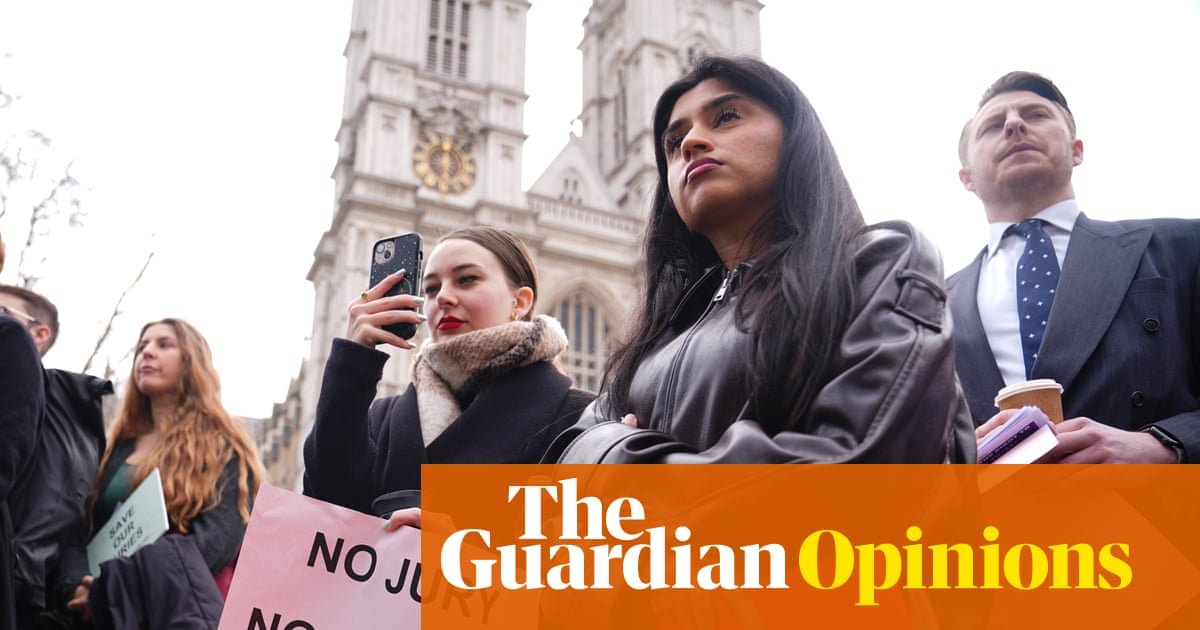
Hyperbolic cliches fly back and forth in the debate about the abolition of jury trials. The dispute will never be resolved and it distracts from the problem facing us today: how to reduce the current disastrous backlog of cases?
The controversy is not new. If you are in favour, you recite Lord Devlin in 1956: trial by jury is “the lamp that shows that freedom lives”. If you are against, you quote GK Chesterton: “Our civilisation has … very justly decided that determining the guilt or innocence of men is a thing too important to be entrusted to trained men” – cited by Prof Glanville Williams in his challenge to the superstitious reverence for juries in 1963’s The Proof of Guilt.
Don’t be surprised that the debate has never been resolved. Governments have been reluctant to restrict trial by jury: if you favour juries, you appear to be hoisting the flag of democracy and freedom. Public perception is important, because there is no means of measuring whether juries or judges are more likely to reach a “true verdict according to the evidence” (the terms of the jury oath taken publicly at the outset of the trial).
This is because, in the eyes of the law, there is no truth other than that which is established by the evidence. To draw a distinction between “Did they really do it?” and “Does the evidence establish that they did it?” is legally meaningless.
Those in favour of the restriction of juries seek a reasoned verdict to which the judge or the new “bench division” courts (featuring a judge and two magistrates instead of a jury for certain cases) – proposed by Brian Leveson, the investigatory powers commissioner – are driven by the evidence. In their eyes, a trial is no more than an exercise in proof.
Those in favour of juries believe that public confidence in the criminal justice system requires something more, a notion of justice that exists beyond the limits of arid jurisprudence – something more human. And that requires the public’s participation in the process.
The proposals for a partial abolition of trial by jury gives the game away. Leveson avoids having to come down on either side of the debate; he nails his colours firmly to the fence. If he believed that a trial should be no more than a process in which a reasoned conclusion is reached on the evidence, why did he not recommend the abolition of juries altogether?
But he recognises that the form of trial in which the public will have the greatest confidence is trial by jury, since he recommends such a trial for the most serious type of offence. For lesser offences, trial by jury is to be removed.
But there are problems: if justice requires more than cold analysis in the most serious cases, what about lesser offences, where the impact of a conviction will change the life of a defendant for ever? Better to take your chance before a jury than a judge notorious for being irredeemably prosecution-minded? Nor are judges likely to refuse to convict because they think the prosecution oppressive or unfair (remember Clive Ponting, whom the jury refused to convict for disclosing official secrets about the sinking of the Belgrano).
It should not be assumed that substitution of a bench for a jury will speed up trials. Not all judges are known for the speed with which they draft judgments. They will presumably set out the evidence, the arguments, the analysis and then the conclusions. They will be encouraged to be short and to the point. Forgive my scepticism. For more than 50 years, judges have been asked to shorten their summings-up to juries, confine their remarks to the essence and indicate with precision the path to a verdict. Many have dismally failed.
Worst of all, the rival arguments about juries divert focus from the problem we face now. The reforms are for the future but we are already faced with the catastrophe of a backlog of 80,000 cases, which is still growing. How is the waiting list to be shortened now?
We should deploy the important judicial skill of winnowing. Judges have daily experience of distinguishing between grain and chaff. They look through piles of paper, sometimes 20 cases a day – to determine, for example, which cases are fit for appeal, or for judicial review. I suspect there is a significant proportion of husks in the stacks of cases waiting for trial. I propose that retired judges volunteer to winnow the backlog. Thirty judges could do 1,800 a week. My prediction is that about a third would be revealed as not worth pursuing, and the backlog would be dramatically reduced in six months. Leveson identifies a number of ways in which cases can be diverted from the trial process – by mediation, a plea-bargain or some other compromise. Any of these could be proposed during the winnowing process.
Although the retired judges’ proposals would lack the force of law, they could be adopted by someone with authority (magistrate, judge, attorney-general) without the need for further scrutiny. I would expect the retired winnowing judges to work for free, save for expenses. In that way they could make some recompense for the pride and enjoyment they experienced, in their youth, of tickling the jury like a trout.
