

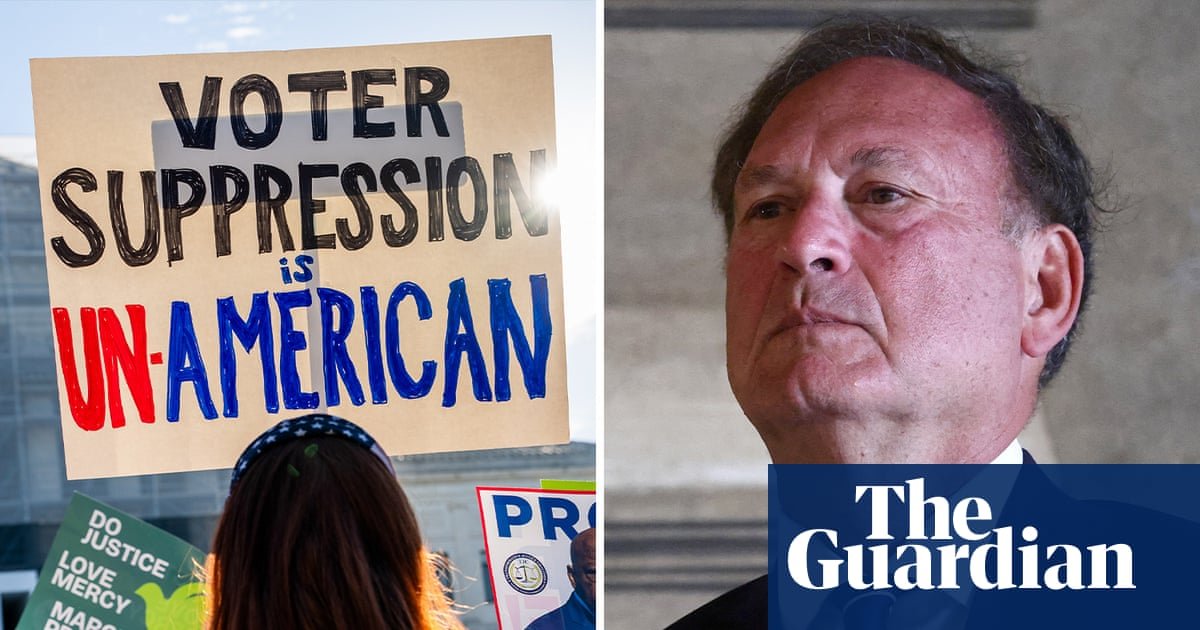
The claims Samuel Alito, a supreme court justice, made about voter turnout in Louisiana in a landmark Voting Rights Act case were based on a misleading data analysis, a Guardian review has found.
In his opinion gutting section 2 of the Voting Rights Act last week, Alito said that Black voter turnout had exceeded white voter turnout in two of the five most recent presidential elections, both nationally and in Louisiana. Alito’s claim was copied almost verbatim from a friend-of-the-court brief filed by the justice department. It was a critical data point Alito used to make the argument that the kind of discrimination that once made the Voting Rights Act necessary no longer exists.
“Vast social change has occurred throughout the country and particularly in the South, where many Section 2 suits arise,” Alito wrote in a majority opinion in the case, which concerned Louisiana’s congressional map, joined by the five other conservative justices on the court. “Black voters now participate in elections at similar rates as the rest of the electorate, even turning out at higher rates than white voters in two of the five most recent Presidential elections nationwide and in Louisiana.”
But a review of turnout and racial data in Louisiana reveals that assertion relies on an unusual methodology. The justice department brief that Alito cited calculated Black and white voter turnout in Louisiana as a proportion of the total population of each racial group over the age of 18. Such an approach is not preferred by experts in calculating statewide turnout because the general over-18 population may include non-citizens, people with felony convictions and others who cannot legally vote. But it does yield Alito’s conclusion that Black voter turnout exceeded white voter turnout in the 2012 and 2016 presidential elections in Louisiana.
The widely accepted approach is to consider voter turnout as a proportion of the citizen voting age population or the voter eligible population, the latter of which excludes non-citizens as well as people who cannot vote because of a felony conviction or because they have been deemed mentally incapacitated. When the Guardian analyzed turnout numbers in Louisiana using the citizen voting age population, it found that Black voter turnout in Louisiana only exceeded white voter turnout in the 2012 presidential election.
A graphic showing Black v white voter turnout using different methods of calculations.
“[The DoJ approach] is misleading because they’re including ineligible voters in the denominator,” said Michael McDonald, a political science professor at the University of Florida who is one of the nation’s leading experts on voter turnout. “If I wanted to manipulate the numbers in a way that was favorable to the government’s interest, I would be using voting age population.”
McDonald also said that the survey DoJ’s analysis was based on, the Census Bureau’s current population survey, is known to produce misleading turnout statistics.
“They had to fudge how they’re calculating the turnout rate to get there, and they’re not even taking into account margin of error, and all these other methodology issues about the current population survey to arrive at that number,” he said. “Someone knew what they were doing.”
A justice department spokesperson acknowledged that the agency used total voting age population and not the citizen voting age population to compute turnout figures. The spokesperson did not respond to a question asking why the department used that approach. A supreme court spokesperson did not return a request for comment about the methodology.
The Guardian also reviewed data from the Louisiana secretary of state’s office, which calculates voter turnout a third way, as a percentage of registered voters. Using that methodology, Black turnout has not exceeded white turnout in any of the last five presidential elections in Louisiana.
Alito’s claim about national turnout also misses the more recent picture that the turnout gap is actually widening, according to a Guardian review of election data. Barack Obama was the first Black US president on the ballot in 2008 and 2012, the two elections where Black turnout was higher than white turnout. In the three most recent presidential elections since then, Black voter turnout has lagged white voter turnout.
Line chart showing the increasing gap between Black and white voter turnout in both the US and Louisiana specifically
“In zero out of the last three presidential elections, did Black turnout come anywhere close to parity,” said Kevin Morris, a researcher at the Brennan Center for Justice, who has studied the turnout gap extensively. The overall national turnout gap has “exploded” over the last 15 years, he added. Alito’s claim is “simply not factual”, Morris wrote in a post last week.
“They’re both cherry picking a particular year, they’re cherry picking a particular method and they’re ignoring this long term more concerning trend in the data,” said Christopher Warshaw, a professor at Georgetown University who studies elections.
When the Voting Rights Act was enacted in 1965, there were ugly racial disparities in voting across the southern US. Black voter registration rates were 50 percentage points behind the voter registration rates of white people in states such as Louisiana, Mississippi and Alabama. Once the Voting Rights Act went into effect, that gap narrowed, in part because of federal examiners deployed to southern states to register voters. There was also a surge in Black people elected to office. In 2012, Black voter turnout reached an all time high and exceeded that of white people for the first time, at least since the passage of the Voting Rights Act.
After 2012, Black voter turnout dropped and has trailed white voter turnout in every presidential election since. That drop happened amid the supreme court’s 2013 decision in Shelby county v Holder, which gutted a requirement that places with a history of voting discrimination get election changes pre-approved by the federal government before they went into effect. The case was a major blow to the Voting Rights Act and freed up states to pass voting restrictions.
Arrow chart showing the movement of the racial voting turnout gap towards white voters after the Shelby county v Holder decision
“Shelby county directly increased the racial turnout gap,” Morris said.
Kareem Crayton, a vice-president at the Brennan Center for Justice, also said it was misleading for Alito to argue the Voting Rights Act was no longer needed because disparities had decreased.
“We could have stopped the project in 1970 because things did get immediately a lot better,” he said. “It’s a bit of a ruse to say that the assessment simply is ‘if things have gotten better then the project is over.’”
