

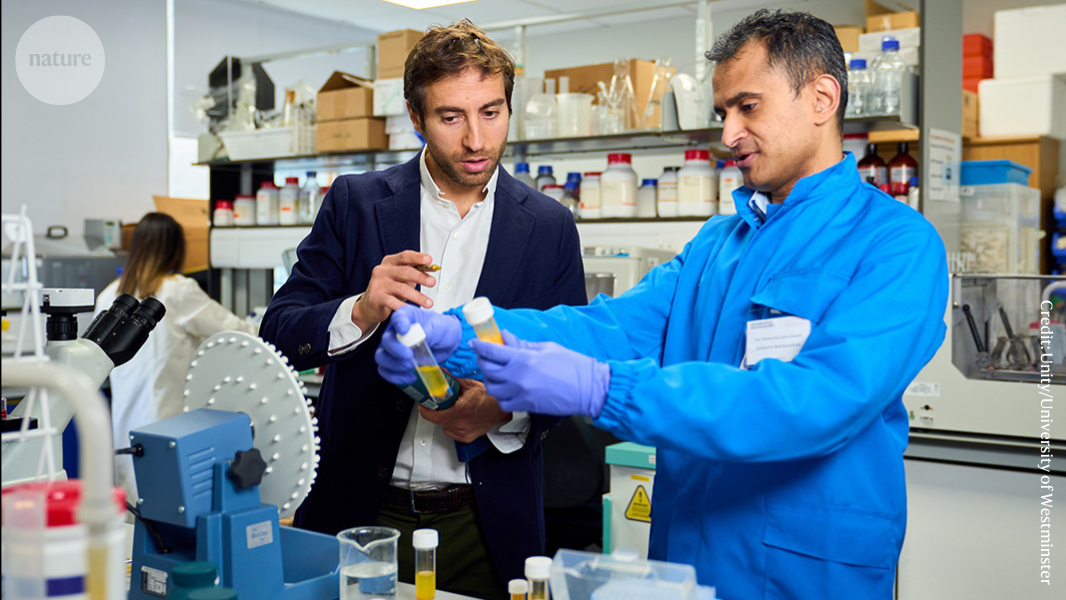
Mohammed Gulrez Zariwala (right) thinks that clearer communication from researchers working on supplements will benefit the public.Credit: Unity/University of Westminster
The roots of the shrub Withania somnifera have been used in the traditional Indian practice of Ayurvedic medicine for millennia. In ancient texts, dating from around the second century bc, the herbal extract — which is more commonly known as ashwagandha today — is described as a powerful tonic that can help the mind and body to build resilience.
In the past few years, ashwagandha supplements have exploded in popularity, with worldwide use estimated to have quadrupled since 2020. In keeping with its traditional use, the plant is best known for its ability to calm and soothe. However, social-media platforms are awash with posts saying that the root not only reduces stress and improves sleep, but also boosts energy and testosterone levels, supports cognitive health and lowers inflammation. Companies marketing the supplements often say that the products improve metrics such as emotional balance, energy or immunity.
Nature Spotlight: Nutrition
Although ashwagandha’s rise has been buoyed by numerous studies supporting its benefits, the evidence is not clear cut. A systematic review of 22 trials showed that the herb significantly improved stress, depression and anxiety (S. A. Alsanie et al. Complement. Ther. Med. 97, 103325; 2026). However, the authors also noted that the studies were generally low in quality and varied in what they measured, stating that “ashwagandha should not yet be regarded as a definitive treatment option but rather as a promising complementary strategy that warrants further investigation”.
Ashwagandha’s new-found fame has also drawn the attention of regulators. The French Agency for Food, Environmental and Occupational Health and Safety issued a warning advising against its use by pregnant people, children and individuals with various medical conditions. The UK Food Standards Agency is also reviewing its safety. Supplements containing the compound were banned in Denmark in 2023.
However, the Indian government’s Ministry of Ayush, which is responsible for traditional medicine, published a report in 2024 that reaffirmed ashwagandha’s safety and criticized the Danish regulator’s assessment, stating “like any other medicinal preparation, be it paracetamol or antibiotics, there could be adverse events with herbal products in some individual [sic]” (available at go.nature.com/4asa2yk).
Ashwagandha is not the only supplement to have surged in popularity in the past decade. Previously niche wellness products, such as collagen, lion’s mane mushroom and probiotics have become mainstream, and sales of long-standing supplements such as magnesium, omega-3 and vitamin D have also increased. By some estimates, at least 60% of all US and European adults take supplements regularly. In the first half of 2025, one-fifth of adults in the United Kingdom took a wellness supplement, including collagen, ashwagandha and a mushroom powder. The value of the global dietary-supplements market was estimated at nearly US$152 billion in 2021. According to one 2022 estimate, it is expected to be worth $300 billion by 2028 (O. Djaoudenne et al. Nutrients 15, 3320; 2023).
Much of this growth is driven by products that promise ‘science-backed’ benefits. But as supplements become more popular, issues of scientific ambiguity similar to those that surround ashwagandha are likely to grow. Mohammed Gulrez Zariwala, a translational physiologist at the University of Westminster, in London, says that regulators are already trying to catch up, tasked with ensuring that new products are safe and can achieve the bigger and better benefits that their makers promise. “It’s become a bit of a wild west,” he says. “Companies and marketeers go to extremes with their claims, and then the regulators rein them in.” At this murky confluence of industry, advertising and governance, can science help to bring some clarity?
Routes to remedies
To understand the sprawling modern supplement industry, and science’s role in it, it’s useful to look at when it all began. Cod liver oil was one of the first dietary products to be used for its health benefits rather than its nutritional value, becoming popular around the early 1800s as a way to improve general health and protect against rickets. In 1928, German chemist Adolf Windaus won the Nobel Prize in Chemistry for his work on the nutrient needed to prevent rickets — vitamin D — becoming the first in a series of Nobel laureates recognized for their research on vitamins. Less than a decade later, vitamin C was mass-produced as a pill, becoming the first essential nutrient available outside of a food source.
“That was like opening Pandora’s box,” says nutritional scientist Paul Coates at Indiana University in Bloomington, who from 1999 to 2018 was director of the Office of Dietary Supplements, the arm of the US National Institutes of Health responsible for supplement research. After the Second World War, the market expanded beyond vitamins and minerals to include a range of compounds identified in food and thought to be beneficial to health. By the 1970s, many companies in the United States and beyond “were making lots of money manufacturing these things”, says Coates.
This shift — from compounds formulated for treating nutrient deficiencies to products that optimize well-being — presented fresh challenges for regulators and researchers, and they still persist today. Compared with research on vitamins and minerals that aid in treating nutrient deficiencies, “the science is rather more sketchy”, says Coates. “It’s done by good people, often in model systems, but the effect sizes are pretty tiny.”
Paul Coates likens the first mass-production of vitamin pills to opening Pandora’s box.Credit: EPNAC.com
Supplements are also hard for regulators to classify. They can be considered foods because they are derived from dietary sources, but are marketed as having therapeutic effects, in the same way as drugs. “Globally, supplements are most often governed by the food standards,” explains Zariwala, which means that they generally have to be proven not to cause harm at the doses they are sold at. Europe is generally strict on safety, requiring products to be manufactured at traceable factories, he says. In the United States, supplements are regulated in their own category — as neither food nor drug — and new products can enter the market with less oversight, he adds.
Although standards for food safety are well established, supplements can differ in dose and even the specific compound that they contain. This complicates the evidence. Danish regulators’ decision to ban ashwagandha was based mainly on a risk assessment by the Technical University of Denmark in Kongens Lyngby, which warned that the herb could disrupt hormone levels and induce abortions. However, other researchers criticized the conclusions, pointing out that they were based partly on animal and in vitro studies that used much higher doses than most supplements would contain (A. Morandi Int. J. Ayurverda Res. 5, 144–147; 2024). Zariwala notes that the assessment included research that investigated extracts of the whole plant, rather than just the root.
When assessing whether a supplement can actually achieve its advertised effects, the available evidence can be similarly murky. The task is made harder by the wide-ranging, often ambiguous health benefits that many supplements now promise, which is partly a result of the regulations themselves. In the United States, manufacturers do not require prior approval for claims that are related to biological structure or function, provided they do not mention disease. Companies cannot advertise that their product ‘prevents heart disease’, for example, but can say that it ‘promotes heart health’. Such claims do not have to be evaluated before a product enters the market. Manufacturers are required to let the FDA know that they are making the claim and are expected to have evidence that the claim is truthful and not misleading, should the regulator ask.
In the European Union, supplement manufacturers can make health claims only if they have been approved by the European Food Safety Authority (EFSA). For a claim to be approved, applicants must submit a dossier of evidence proving a causal relationship between the compound and the health benefit in question. When coming to a final decision, Alfonso Siani, the Chair of the EFSA working group on health claims who is based in Naples, Italy, says that he and his colleagues often have to judge conflicting evidence by examining the sample size, risk of bias or statistical-analysis methods of studies.
He says that he and his colleagues are usually in agreement about whether a claim should be approved, but he acknowledges that a conclusive outcome is, in some ways, incompatible with the ever-evolving science. “We weigh the high-certainty data against the low-certainty data to form a conclusion that reflects not the truth, but the most-probable truth,” says Siani.
