

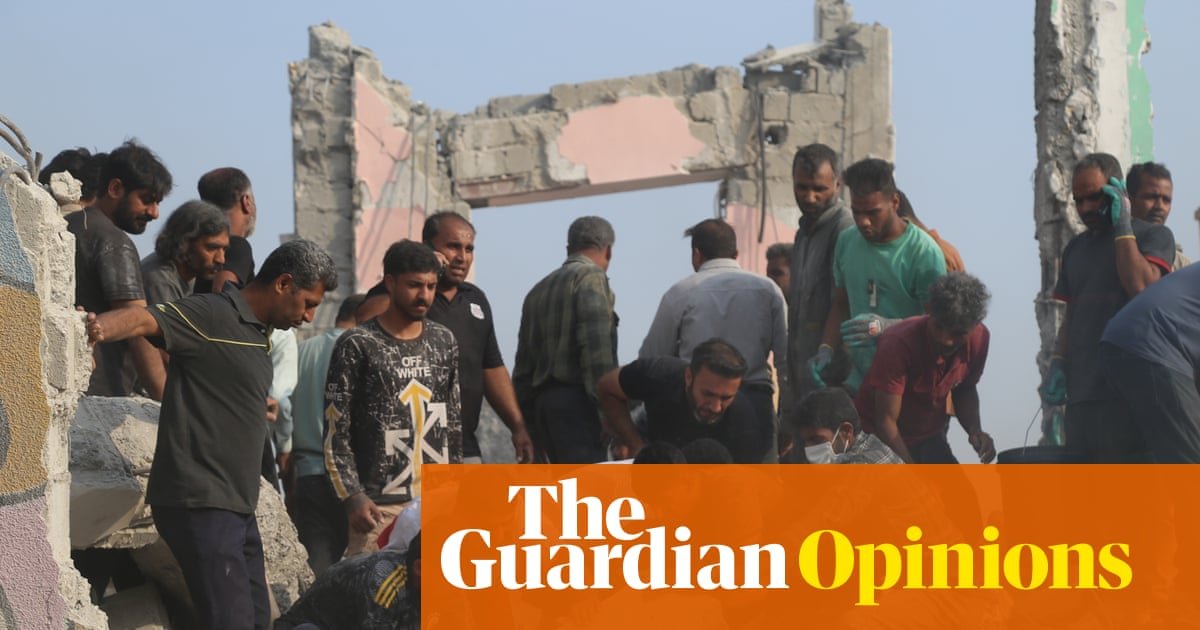
The killing of a reported 168 people, primarily schoolgirls, in the bombing of the Shajareh Tayyebeh school in Minab in Iran has shaken to its very core the conscience of the world.
The attack, carried out nearly two weeks ago when classes were under way, reduced the school building to rubble. Parents who had sent their daughters to school discovered minutes later that classrooms had become mass graves.
One mother, whose daughter Zeinab had memorised the Quran and was due to compete in a national recitation contest, wept as she said: “My dream died with her.” A UN human rights panel has already demanded that the killings must be “Urgently, independently and effectively investigated, with accountability for any violations”.
Which country is responsible for the massacre has been disputed. Over the weekend Donald Trump disclaimed any culpability on the part of the US. “We think it was done by Iran, because they’re very inaccurate with their munitions” he said on Air Force One.
But on Monday, a BBC investigation produced evidence of multiple US Tomahawk missiles fired and landing in the vicinity of the school, hitting, they believe, the school itself, as well as a medical clinic reportedly belonging to the Islamic Revolutionary Guard Corps (IRGC). The BBC found no evidence of a separate Iranian-fired missile landing at the site. Despite this, Trump doubled down, saying: “Numerous other nations have Tomahawks. They buy them from us.” But according to provisional and as yet unofficial reports on Wednesday, US Central Command may have created target coordinates for the strike from outdated information.
On whoever the blame finally lies, the school massacre is no isolated event. Reportedly, on the same day, the bombing of another school, the Hedayat high school in the Narmak district in Tehran, left two students dead.
No child should ever become collateral damage in a conflict. Yet we know that more than 200 children have been killed by Iranian security forces in their recent crackdown. And not only have 740,000 Palestinian students been denied their right to education in Gaza and the West Bank, according to a University of Cambridge study, 90% of Gaza’s schools have been razed to the ground or damaged, and at least 18,069 students and 780 teachers have lost their lives. And Unicef has reported that since 2 March at least another 83 children have been killed in Lebanon.
The school bombing exposes how thin the protective international legal framework becomes when tested by great power rivalries and terrorist acts. Schools, which should be safe havens, are increasingly being drawn into war, with pupils and teachers easy targets who cannot fight back. According to the Global Coalition to Protect Education from Attack, more than 10,000 students and educators were reportedly killed or otherwise harmed by attacks on education in 2022 and 2023. The increased tendency to fight wars in built-up areas means that it has become almost as dangerous to be a child on the streets or at school as a soldier on the front.
The Geneva conventions and international humanitarian law, and the 1989 Convention on the Rights of the Child, unequivocally prohibit assaults on children and schools. Attacks on educational buildings are war crimes listed in article 8 of the Rome statute, which constituted the international criminal court (ICC). Arrest and prosecution should face leaders who order, authorise or knowingly permit such attacks. Precedent for this comes in the ICC warrant issued against Joseph Kony, leader of the Lord’s Resistance Army, which cited his attacks on schools in Uganda.
While schools are, like hospitals (until recent violations), accepted to be protected places, in practice they are treated more as part of civilian infrastructure. This has undermined what should be a simple principle: that schools exist for learning, and must never become theatres of war or staging grounds for military operations. No child should die for trying to learn, and those who attack innocent girls and boys should be subject to the same degree of judicial accountability as those who commit other crimes against humanity. Equally, when armies occupy classrooms, store ammunition in gymnasiums or launch rockets from playgrounds, they erase the distinction between combatant and civilian at the heart of humanitarian law and should be prosecuted.
We cannot afford to stand by as yet another established international law governing the conduct of war is broken, apparently with impunity. Now is the time for every combatant to be warned in no uncertain terms that schools deserve the same moral status as hospitals – protected places – and the same protection under international law.
It is also right to expose those countries who use two get-out clauses to claim impunity: first, to deny an attack was “intentional” or “deliberate” and second, to claim that the school they attacked was being used for military purposes. It is these waivers that have allowed so many perpetrators of attacks on children to claim a defence that is still recognised in international law. But on any plausible interpretation of humanitarian law, those who attack a school are manifestly failing to act on their legal responsibility to avoid all known risks to children and to shelter and protect them as innocent civilians.
Strengthening our protection of children starts with all countries implementing the 2005 UN security council resolution 1612, which established the monitoring and reporting mechanism for children caught up in armed conflict. This followed the landmark work of Graça Machel, who helped to identify six “grave violations” of children’s rights that include not only the forced recruitment of child soldiers and the abduction of girls, but also attacks on schools.
The “Lucens guidelines” and the safe schools declaration, which built on these principles, warned that countries should keep military forces away from education facilities. But the world will now need stronger mechanisms to ensure accountability. One option that would emphasise the seriousness of the crimes would be the creation of a dedicated international criminal court for crimes against children. Such a body would complement the jurisdiction of the ICC, focusing its attention on the bombing of schools, abductions of pupils and militias that enslave boys and girls. A parallel track could run through the European court of human rights and other judicial systems, which could adopt special protocols for prosecuting attacks on education facilities, and it would now make sense to enunciate a special protocol consolidating the various threads of criminal and humanitarian law protecting children.
Keeping schools open and safe in the midst of war means something more than the hours children spend in a classroom; it is the promise of something beyond the rubble. For children, classrooms mean stability; for parents, they signal that life, however fragile, will go on. Even in a conflict’s darkest hours, to continue the education of children is to maintain hope amid devastation. And when a school manages to reopen after an attack, it becomes a visible act of defiance against those who would allow war-torn communities to descend into endless despair.
But whatever else we do, we must send an unequivocal message: regardless of where they operate or under whose orders they act, there will be no hiding place for those leaders who permit attacks on children.
