

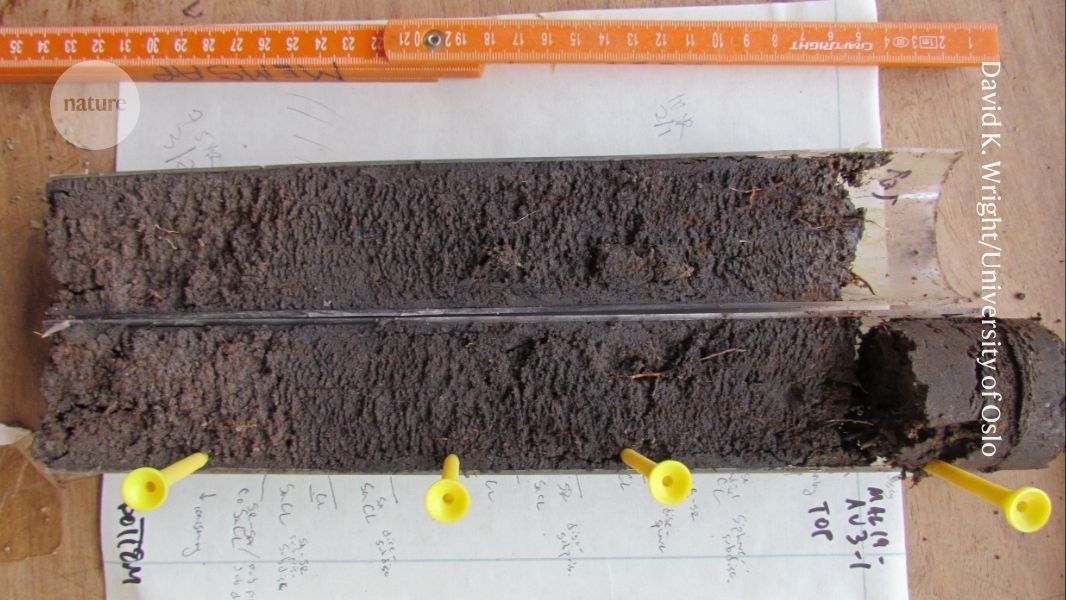
In 2019, environmental archaeologist David Wright at the University of Oslo visited what was, at first glance, an extremely unappealing field site: a cluster of leech-infested swamps in northern Malawi. At times ankle-deep in the grassy water, he and his colleagues set up a percussion auger — an instrument used in the extraction of cylinders of mud by hammering a long plastic tube into the ground. The hard part was getting the cores back out again. With his knees bent, Wright would brace the auger against his shoulder and push against the ground. In one swamp, the sediment was so sticky that the auger snapped in half. “It’s pretty tough work,” Wright says, and the leeches settling around the team’s ankles were an added bonus.
Neanderthals mastered fire — 400,000 years ago
Why all the effort over mud? These swamps surround Mount Hora, a granite hill located about 60 kilometres west of Lake Malawi, which separates the country from Mozambique and Tanzania. The site has a rich history, from the oldest-known human cremations roughly 9,500 years ago to 2,000-year old iron-smelting sites. The muddy layers of accumulated organic material, Wright hoped, would hold further clues about ancient groups of people. Pieces of preserved charcoal might reveal fire-making habits, while fossilized pollen could help researchers to understand the environment in which people lived.
But Wright’s particular interest was more scatological: coprostanol, a molecule in human faeces that could shine a light on human population trends. “They’re durable little suckers,” Wright says of such biomarkers. Combined with other evidence, “you get a much clearer picture of what there was in the past”.
Archaeologists have long focused on bones and other relatively macroscopic artefacts, but they are now teaming up with geochemists, palaeoecologists and biologists to unearth molecular lines of evidence. Technological and methodological advances over the past few decades have made it possible to detect minute traces of organic compounds in ancient sediments, complementing conventional pollen and charcoal studies. Such molecular fossils include leaf waxes and fats from bacterial membranes that contain clues about past climates, while coprostanol and pollutants from fires can help to reconstruct ancient human activities. DNA lingers in sediments, too, revealing rich detail about plants, animals and humans. Although the methods used to detect these molecules are complex — and each marker has its limitations — they’re already providing valuable clues about times long gone.
One of Wright’s swamp cores, for instance, revealed an increase in coprostanol around Mount Hora that began at least 1,000 years ago, suggesting an influx of farming and herding communities that brought a new way of life to the region, Wright’s team reported in 20241. For researchers who learn to dissect ancient sediments, Wright says, “it’s a really powerful tool”.
Scrolling back in time
Many sediments — from permafrost to cave floors — are biological archives of the past. Lakes and swamps can be particularly useful to researchers because they gradually accumulate material that washes down from a wide area and contains deep, oxygen-deprived layers that slow the breakdown of organic matter. To reach those sediments, scientists can cut profiles into cave floors or extract cores using hand-held tools, such as Wright’s auger or even specialized drilling platforms for deeper sediments. A 380-metre-long core from Lake Malawi recorded 1.3 million years of history2.
Assistants on the edge of a pit that was dug to retrieve a broken auger at a sampling site near Mount Hora.Credit: David K. Wright/University of Oslo
In the laboratory, scientists first scrutinize a core’s layers, which can help to pinpoint time intervals at which, say, sediment is missing because a lake dried out or experienced an uneven deposition of material. Taking care not to contaminate samples with modern material — by wearing gloves and extracting sediment from inner parts of a core, for instance — plant macrofossils from different layers are sent to specialized labs that use techniques such as radiocarbon dating to estimate their age.
Oldest DNA reveals 2-million-year-old ecosystem
Fossilized pollen and charcoal can last for millions of years inside such sediments. Palaeoecologist Rahab Kinyanjui at the National Museums of Kenya in Nairobi extracts pollen using strong acids and salts to remove organic matter, carbonates, sand and silts, and charcoal with salts to coax particles apart and allow the material to float to the surface. Studying the species-specific morphology of pollen under a light microscope can help researchers to reconstruct a region’s flowering plants, whereas charcoal concentration patterns can reveal periods of human-caused fire.
Pollen studies have led Wright to conclude that, after farming communities arrived around Mount Hora at least 1,000 years ago, its forested landscape became grassier. A concurrent rise in charcoal concentrations suggests that those people might have burned the forests to clear land for agriculture. “They brought a whole new way of interacting with the landscape,” he says.
Reconstructing ancient climates
A region’s ancient vegetation can provide hints about its climate. But molecular biomarkers can reveal more detail. The waxes that protect leaf surfaces, for example, contain long-lasting organic molecules called n-alkanes. Variation among the individual carbon and hydrogen atoms of these molecules hold climatic clues. For hydrogen atoms, the ratio of heavy versus light hydrogen isotopes can indicate the strength of rainfall that plants experienced in their lifetime. Heavy rains are generally enriched with a light hydrogen isotope because heavier ones are the first to condense into water droplets. The heavier it rains, “there’s less and less of the heavy isotope left and more and more of the light isotope”, explains geochemist James Russell at Brown University in Providence, Rhode Island.
Organic geochemist Kate Freeman at Pennsylvania State University in University Park, says that some colleagues have jokingly called leaf waxes the ‘Honda Civics’ of biomarkers because — like the popular car — they are relatively straightforward to work with. Analysing these isotopes begins by extracting fats from sediment samples, often using an accelerated solvent extractor followed by liquid chromatography to separate the leaf waxes from other lipids.
Mount Hora in Malawi.Credit: David K. Wright/University of Oslo
The sample is then injected into a gas chromatograph coupled to an isotope ratio mass spectrometer. The chromatograph separates each n-alkane according to its boiling point. One at a time, each batch of molecules undergoes pyrolysis — a reaction that breaks them down into hydrogen gas. The mass spectrometer then uses magnetic fields to separate heavy isotopes from light ones and measures their concentrations.
Some palaeoclimatologists also mine sediments for bacterial membrane components called branched glycerol dialkyl glycerol tetraethers (brGDGTs). Bacteria can adjust the abundance of these forked molecules to prevent them from packing too closely together as temperatures change. By studying the composition of membrane lipids in different climates, scientists have effectively created a ‘palaeothermometer’ that can estimate past temperatures to within 2 °C.
First known Neanderthal family discovered in Siberian cave
Because brGDGTs aren’t volatile enough to be vaporized in a gas chromatograph, they’re usually separated using ultra-high- performance liquid chromatography, which separates molecules, in part, on the basis of their polarity. This is coupled to a quadrupole mass spectrometer, which can be set to selectively analyse molecules with specific mass-to-charge ratios, allowing scientists to quantify the 15 brGDGTs that are currently used for environmental reconstructions, says palaeoclimatologist Tobias Schneider at the Swiss Federal Institute of Aquatic Science and Technology in Dübendorf.
Membrane lipid compositions and leaf-wax hydrogen isotope ratios must be interpreted cautiously, Russell says, because they’re also influenced by other factors, such as the number and distance of a region’s moisture sources. But they can help to answer important questions — such as why Norse settlers left southern Greenland 500 years after arriving there in ad 985. In a 2022 lake-core analysis3, Schneider and his colleagues concluded that it wasn’t solely colder weather that drove the settlers away, as some had suggested. Rather, a decline in rainfall might have contributed to the settlers’ decision, because this would have hampered the production of the hay they needed to get their sheep through winter.
Investigating past human activity
Other molecular markers can also reveal clues to ancient people’s activities. Scientists are finding small, multi-ring molecules known as polycyclic aromatic hydrocarbons (PAHs) — which arise from the incomplete combustion of organic matter — to be useful complements to charcoal in studying ancient fire activity. Because PAHs are also used to assess modern-day atmospheric pollution, “there is a lot of science about them”, says organic geochemist Elena Argiriadis at the Institute of Polar Sciences in Venice, Italy.
PhD student Anneke ter Schure collects an ancient-DNA sample in southern Armenia in 2019.Credit: Andrew Kandel
For instance, the precise make-up of PAHs can indicate the origin, intensity and sometimes even the source of a given fire; the PAH retene, for example, originates only from soft-wooded trees such as conifers. In a study published in December4, scientists used PAHs alongside 400,000-year old stone tools from a UK field site as the earliest evidence for human-made fire, probably stemming from early Neanderthals. An analysis of sediments didn’t reveal charcoal, which had probably washed away, but it did show a lot of heavy PAHs. This suggested that fire burned at that location and was intense enough to create heavy molecules. Finding higher concentrations of lighter, wind-carried PAHs would have indicated there was a lower-temperature wildfire farther away, the authors concluded.
An important consideration, says Tyler Karp, a palaeoecologist at the University of Chicago in Illinois, is that PAHs are also produced through the gradual heat- and pressure-driven transformation of carbon into fossil fuels. “That can actually confound your palaeo-fire interpretations,” Karp says. To correct for this, Karp compares the concentrations of alkylated forms of PAHs — which are preferentially produced by slow and low-temperature processes — with the non-alkylated forms that arise from fire.
Coprostanol, the biomarker that Wright used as a proxy for people in the study in Malawi, presents similar complexities.
Geneticist who unmasked lives of ancient humans wins medicine Nobel
