

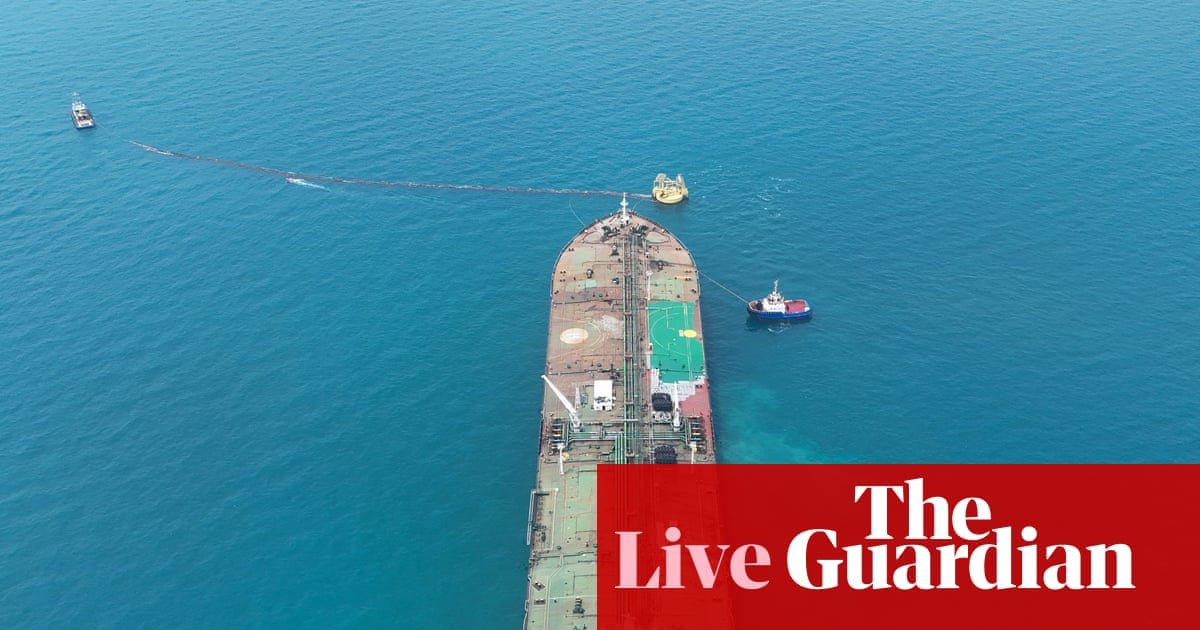
Goldman Sachs raises oil price forecast as war disruption hits production
The deadlock in the Middle East confict has prompted Goldman Sachs to raise its oil price forecast.
Goldman Sachs now estimate that Brent crude will trade at about $90 a barrrel in the last quarter of this year, up from an earlier projection of $80. US crude is forecast to average $83 in October-December, up from $75 before.
Goldman blames “lower Persian Gulf production” for the upgrade, telling clients:
double quotation markWe now assume a normalisation in Gulf exports by end-June (v mid-May prior) and a slower Gulf production recovery. The economic risks are larger than our crude base case alone suggests because of the net upside risks to oil prices, unusually high refined product prices, products shortages risks, and the unprecedented scale of the shock.
Goldman’s analysts estimate that 14.5m barrels a day of Persian Gulf crude production has been lost, leading to a record drawdown of global oil inventories of 11m-12m barrels a day this month.
The jump in oil prices will lead to ‘softer demand’, they explain:
double quotation markWe assume that global oil demand falls on a year-over-year basis by 1.7mb/d in 2026Q2 and 0.1mb/d in 2026 given the jump in refined product prices. Because extreme inventory draws are not sustainable, even sharper demand losses could be required if the supply shock persists longer.
Goldman also warns that the risks to its forecasts are to the upsides, and lay out three scenarios for how events could unfold:
Adverse scenario: Brent 2026Q4 would average just over $100 assuming Gulf exports only normalise by end-July.
Severely adverse scenario: Brent 2026Q4 would average at nearly $120 assuming Gulf exports normalise by end-July and 2.5mb/d of persistent reduction to Gulf capacity. This 2.5mb/d of scarring is equivalent to Hormuz flows not recovering above 70% (till pipeline capacity is expanded).
Benign scenario: Brent 2026Q4 would average just under $80 assuming Gulf exports normalise by mid-June, no capacity reduction, and stronger US and core OPEC supply responses.
[Goldman had previously trimmed their forecast for the oil price earlier this month, after the US-Iran ceasefire was announced]
Share
Updated at 05.08 EDT
Key events
Show key events only
Please turn on JavaScript to use this feature
The Bank of England is not expected to follow Pakistan’s lead and raise interest rates on Thursday, after its next meeting.
City economists broadly expect the BoE to leave borrowing costs unchanged, despite the pick-up in inflation from the Iran war.
Last week’s inflation reading of 3.3% sets the tone for “a very interesting Monetary Policy Report” on Thursday, says Professor Costas Milas of the University of Liverpool’s Management School.
He tells us:
double quotation markI am a bit worried about MPC forecasts conditional again on market expectations of interest rates, the latter of course changing all the times as Trump “tweets” his volatile thoughts.
A “cleaner” way of going about that is for MPC members to “bite the bullet” and condition forecasts on their anonymous views. Interestingly, Kevin Warsh [the nominee to run America’s Federal Reserve] argued that once policymakers reveal their economic forecasts, they can become “prisoners” of their own words. This will be music in the ears of MPC members.
But, of course, this is not a binding commitment and MPC members can (should) justifiably change views as events unfold. So, there is no harm to have an indication of what they think about the future, i.e. no …”prisoner’s dilemma” here!!!
Share
Pakistan hikes interest rates to fight inflation
The logo of the State Bank of Pakistan. Photograph: Akhtar Soomro/Reuters
Newsflash: Pakistan’s central bank has raised interest rates, as it tried to fight the inflationary impact of the Iran war.
The State Bank of Pakistan has lifted its key policy rate by 100 basis points (one percentage point) to 11.5%.
Its monetary policy committee warn that the “prolonging of the Middle East conflict has intensified risks to the macroeconomic outlook”, citing global energy prices, freight charges, insurance premiums and supply chain disruptions.
It adds:
double quotation markIn this backdrop, the Committee assessed that inflation is likely to increase and remain above the target range in the next few quarters.
Accordingly, the MPC deemed it necessary to maintain a tighter policy stance to keep inflation expectations anchored and contain secondround effects of the current supply shock to bring inflation within the target range. This will be important to preserve macroeconomic stability, which is necessary for achieving sustainable economic growth.
This decision is something of a surprise, as six of 10 analysts in a Reuters poll had expected rates to remain on hold at 10.5%.
Share
Updated at 08.54 EDT
Shell buying Canada’s ARC for $13.6bn
Oil giant Shell is boosting its crude output by buying Canadian energy company ARC Resources.
Shell has reached agreement to acquire ARC, which is focused on the Montney shale basin in British Columbia and Alberta, in a $13.6bn cash and shares deal.
According to Shell, the deal will add 370,000 barrels a day of oil and gas, increase its exposure to “long-duration, low-cost and top quartile low carbon intensity shale gas and liquids”, and generate double digit returns.
Shell’s chief executive officer Wael Sawan says:
double quotation mark“ARC is a high-quality, low-cost and top quartile low carbon intensity producer operating in the Montney shale basin that complements our existing footprint in Canada and strengthens our resource base for decades to come. We are accessing uniquely positioned assets and welcoming colleagues that bring deep expertise which, combined with Shell’s strong basin level performance, provides a compelling proposition for shareholders.”
“This establishes Canada as a heartland for Shell while furthering our strategy to deliver more value with less emissions.”
Under the deal agreed between the two companies, ARC investors will receive 8.20 Canadian dollars in cash and 0.40247 ordinary shares of Shell for each ARC share. That works out as 25% cash and 75% shares, based on closing prices last week.
Shell will also take on $2.8bn of net debt, giving the deal an enterprise value of $16.4bn.
Share
Shares in Intel are set to rise to a new 26-year high when trading begins in Wall Street in less than two hours.
On Friday, Intel’s shares surged by over 23%, meaning they finally rose above their peak in the 2000 dot-com bubble.
A chart showing Intel’s share price Photograph: Deutsche Bank
The jump came after Intel smashed Wall Street expectations, with revenues bolstered by strong demand from the AI sector.
Its recovery, after so many year, highights “the potential for huge gains and the inherent risks and patience required when investing in individual equities.” says Deutsche Bank’s Jim Reid, who shared the above chart.
He points out that Intel’s share price was still down 70% compared with that 2000AD peak as recently as the third quarter of 2025, but is now up over 120% so far this year.
Reid also has a cautionary word for those invested in high-flying AI stocks today:
double quotation markThe fact that it took Intel 26 years to surpass its record high, during a period when the S&P 500 climbed approximately +370% (over +650% including reinvested dividends), highlights not only the volatility of investing in single stocks but also the perils of picking the wrong entry point in high-beta sectors such as technology.
Imagine waiting a quarter of a century for your investment to break even, while the broader market delivered substantial returns. This raises the question: could a similar fate await today’s high-flyers? Could Nvidia, for instance, only surpass its recent peaks in 2052, a scenario reminiscent of Intel’s journey?
While any tech analyst would likely scoff at such a comparison, citing numerous differences, Intel’s history serves as a powerful reminder of the inherent uncertainty in individual stocks. It was the second largest stock by market cap at its peak in 2000.
Share
Shipping traffic through Hormuz remains muted
Vessels in the strait of Hormuz today Photograph: Reuters
At least seven ships – mainly dry bulk vessels – crossed the strait of Hormuz in the past 24 hours, in line with muted activity in recent days, Reuters reports.
This small flow of traffic is continuing while talks between Iran and the United States remain stalled.
The vessels included ships leaving from Iraqi ports and one dry bulk vessel from an Iranian port, according to ship tracking data from Kpler and separate satellite analysis from data analytics specialists SynMax.
Before the war began, around 140 ships would pass through the strait, to and from the gulf, each day.
Share
Beer stocks could get billion-pint boost from world cup
The men’s football world cup this summer could provide a much-needed boost to Europe’s beer industry.
Analysts at Jefferies have calculated that the world cup – being held in the US, Canada and Mexico in June and July – will lift beer sales globally by roughly one billion pints, which would benefit major brewers such as Anheuser-Busch InBev and Heineken.
Anheuser-Busch InBev make Budweiser, the official beer of the World Cup, so might be in the front line for a sales boost, Jefferies suggest, saying:
double quotation mark“AB InBev is in the sweet spot to benefit from FIFA upside.
We expect all brewers to show sequential improvement versus 2025.”
Bloomberg has more details.
ShareA chart showing the Brent crude oil priceShare
CBI: retail conditions darken in April
Ouch! UK retail conditions “darkened” in April, a new survey has shown.
The latest distributive trades survey from the CBI has found that retail sales volumes were below seasonal norms in April, and by more than in March.
A net balance of 32% of retailers reported that sales were poor this month, perhaps a sign that the Iran war is hitting spending as consumer confidence drops.
Here’s the details:
Retail sales for the time of year were judged to be “poor” in April, to a greater extent than last month (-32% from -23% in March). May’s sales are set to fall short of seasonal norms to a greater degree (-43%).
Share
Moody’s lifts outlook on China’s credit rating
Credit rating news: Moody’s have lifted their outlook for China’s government debt to stable from negative, and affirmed its A1 rating.
Moody’s says this reflects its assessment that economic and fiscal strength will be resilient to ongoing domestic, trade and geopolitical challenges.
Moody’s explains:
double quotation markWhile export growth will likely moderate, the competitiveness and resilience of Chinese exports to rapid changes in the global trade environment supports our expectation that GDP growth will slow only gradually over the medium term.
Meanwhile, government policies that prioritize investment in high-productivity sectors while managing supply imbalances will improve capital efficiency. We expect policy makers will manage the debt resolution process for regional and local governments (RLGs) in a controlled fashion, even as general government debt increases given substantial policy support to the economy.
Share
Drivers across most of the UK are missing out on a drop in wholesale fuel prices, new data shows.
The AA reports that last week, the average pump price of diesel across the country dropped from an average of 192.0p a litre to 191.0p a litre.
That’s just a tenth of a 10p-a-litre fall in diesel costs heading to UK fuel stations, the AA says.
The exception is Northern Ireland, where supermarkets have managed to cut diesel prices by nearly 4p-a-litre.
The AA reports:
double quotation markAcross the rest of the UK, the cheapest area for petrol was Yorkshire and Humber at an average of 156.0p a litre at the pump, with the South East was highest with an average of 158.8p.
Diesel in Yorkshire and Humber stood at an average of 189.7p a litre while in the South East it was 191.8p.
Share
Oil now over $108
The oil price is continuing to rise this morning, now up 2.5% at over $108 a barrel.
The lack of progress towards a peace deal between the US and Iran is weighing on the market, despite Axios’s report that Tehran has made a new proposal to Washington DC to reopen the strait of Hormuz.
Share
Pound at one-week high against the dollar
The pound has hit its highest level against the US dollar in just over a week.
Sterling has gained 0.2% against the dollar to $1.355 this morning, its highest level since Friday 17 April.
The dollar has dropped this morning, as investors anticipate change at the top of the US Federal Reserve.
Yesterday, Republican Senator Thom Tillis said he will allow Federal Reserve chair nominee Kevin Warsh to face a vote in the Senate. That should clear the way for Donald Trump’s choice of Fed chair to take control of the US central bank.
Tillis dropped his opposition to a vote on Warsh after the Department of Justice said on Friday that it would drop its criminal investigation into current Fed chair Jay Powell, whose term ends next month.
Share
Updated at 05.23 EDT
German chemicals giant BASF is raising some of its prices for the second time since the Iran war began.
Bloomberg has the details:
double quotation markThe German manufacturer’s customers will see prices go up by an additional 25% on products in its antioxidant, process stabilizer and light stabilizer portfolio for plastic applications, BASF said Monday. The increase comes on top of a 20% hike announced on March 4 and is effective immediately.
BASF cited “substantial” gains in raw material, energy and logistic costs due to the Middle East conflict.
Share
Emerging markets at record high, but can risk rally last?
Emerging market stocks have hit record highs today, as optimism over the AI sector drove stocks higher in Asia.
MSCI’s gauge of global emerging market shares has risen by 1.3%, having already risen in the previous four weeks.
That underlines how the markets have bounced back from their initial slump when the Iran war began – with the US and Japanese markets also at record highs – even though the conflict is not resolved.
Capital Economics has suggested that the current risk rally is on borrowed time while the strait of Hormuz remains closed
The chief markets economist, Jonas Goltermann, says:
double quotation markIf the diplomatic and military stalemate between the US and Iran continues, and the strait of Hormuz remain largely closed, policymakers and market participants will find it increasingly difficult to keep “looking through” the crisis.
The widespread assumption that the ongoing disruption to energy supply will generate only limited economic damage can probably sustain investors’ optimism for a while yet. But at some point the situation on the ground needs to actually improve, or that optimism will presumably start to fade.
Share
Updated at 05.05 EDT
China blocks Meta’s $2bn acquisition of AI startup Manus
Newsflash: Beijing has decided to block Meta Platforms from aquiring agentic AI startup Manus in a $2bn deal.
China’s state planner has prohibited foreign acquisition of Chinese artificial intelligence startup Manus, ordering involved parties to cancel the transaction, the National Development and Reform Commission said on Monday (via Reuters).
The deal had caused controversy in China, sparking claims that it was an attempt to hollow out the country’s technology base,
Last year, Forbes called Manus’s product “a revolutionary AI agent capable of independent thought and action”, saying:
double quotation markManus is not just another chatbot, nor is it merely an improved search engine dressed in futuristic branding. It is the world’s first fully autonomous AI agent, a system that doesn’t just assist humans — it replaces them.
Share
Updated at 04.40 EDT
