

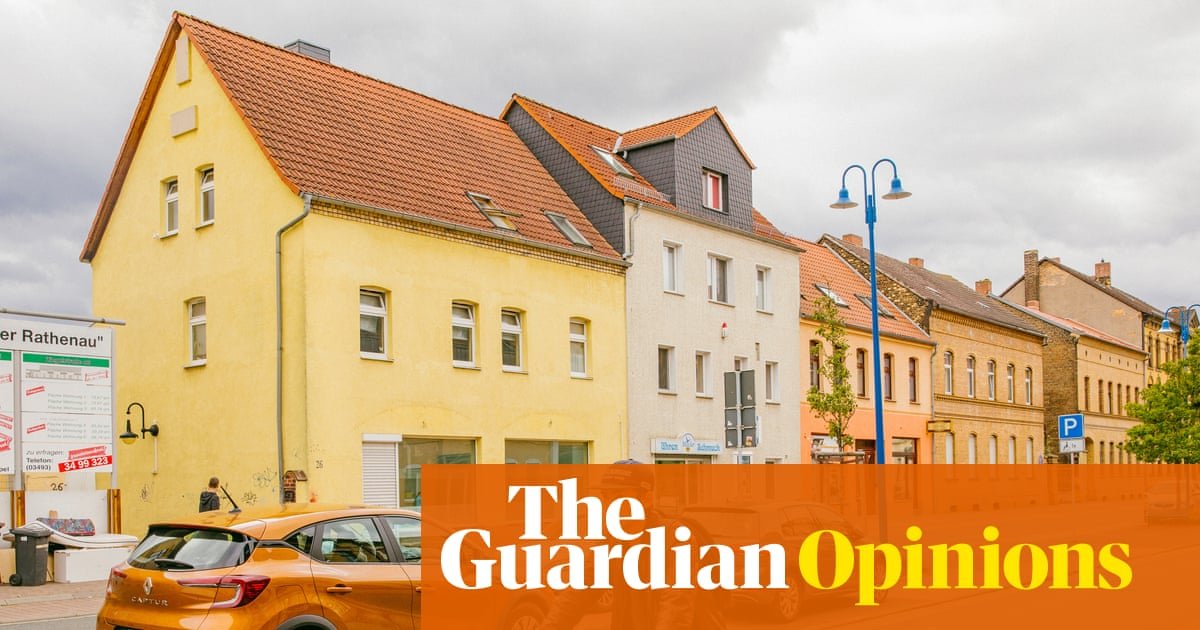
“Bitterfeld, Bitterfeld, where dirt falls from the sky,” went a popular saying. Located in the intensely industrialised Chemical Triangle of the German Democratic Republic (GDR), in the 1980s Bitterfeld became known as the dirtiest town in Europe. Its chemical industry and lignite mines dumped toxic waste in waterways, and the air carried a concentrate of sulphur dioxide some 40 times today’s levels.
Europe would soon be rattled out of its postwar reliance on heavy industry, in favour of cheap imports from abroad. In the last days of the GDR, environmental activism brought the coup de grâce. The 1988 release of the undercover film Bitter Things from Bitterfeld shed light on the appalling living conditions in the Chemical Triangle, and the city’s chemical plants were soon decommissioned.
Since then, it has become an ingrained idea across Europe that the noise, dirt and smoke of heavy industry is an evolutionary stage to be overcome. Disused factory districts and docks have been reinvented as cultural spaces, while tourists clink glasses in urban plazas that were once car parks. Photogenic European cities consistently figure at the top of global livability rankings, and more than 40% of Unesco world heritage sites are located on the continent. Germany’s Chemical Triangle was reborn as Solar Valley in the early 2000s, given a new lease of life as a photovoltaics hub that, for a time, produced world-leading solar cells.
Europe banished much of its industry, but we continue to enjoy its fruits: globalised manufacturing chains provide us with cheap goods that arrive in neat packages. And while our cities are beautified with good intentions, they are being reduced to markets for the consumption of that beauty: streetscapes fill Instagram feeds, as surely as homes become Airbnbs. Meanwhile the average resident, faced with dwindling employment outside the tourism industry, is increasingly priced out of their own home town. When heavy industry was offshored, so was its labour.
Today, a dizzying amount of products that Europe consumes are made elsewhere. China represents upwards of 80% of global solar manufacturing and a majority of global wind turbine installations in figures from 2023. Meanwhile, much of the vital digital infrastructure that enables productivity and leisure originates on the west coast of the US. Bitterfeld’s Solar Valley has sadly fallen on hard times, its start-ups overwhelmed by subsidised competition from abroad. The reality today is that European “quality of life” has become a subscription offered by third parties, fuelled by mountains of coal in Xinjiang and energy-guzzling datacentres in Virginia.
This creates concerning vulnerabilities for Europe, and the warning lights are blinking in the corridors of power. Since Mario Draghi’s 2024 report on European competitiveness, Brussels has been anxiously powwowing about bringing productivity back to the continent. The most significant outcome is the Industrial Accelerator Act, which will set quotas for European-made components in public procurement contracts and subsidies. Alive to environmental concerns as well as self-sufficiency, it aims to support sectors such as solar and wind energy, and battery production. Yet lawmakers hesitate to force businesses to purchase from boutique European suppliers, and there will be significant hand-wringing over whether to endorse “Made in Europe” or settle for “Made with Europe”.
Without the sufficient scale to create efficiency and affordability, European re-industrialisation will be nothing more than a vanity project. Let’s consider how that emblem of sustainability, the solar panel, is made. The largest plant in Europe is located in Catania, Sicily: Enel’s 3SUN Gigafactory. This 24-hectare (60-acre) site opened recently with much fanfare, and is capable of producing 3GW of capacity per year, which would just about power a quarter of London’s buildings. The EU currently aims to produce 10 times this amount: 30GW worth of solar panels per year. Nine more 3SUN-sized plants and the annual quota is reached.
The problem is that a solar panel factory itself is only the final and smallest link in the chain. A photovoltaic panel starts mainly as sand, which needs to be melted down at extreme heat over a few days in order to produce polysilicon ingots. This is an energy-intensive process which now takes place at a laughably small scale in Europe. The ingots must then be sliced into wafers, the wafers cut into PV cells – we don’t do these things either – and the cells finally assembled on to panels.
To get an idea of how much space and resources this requires, look at the JA Solar base in China, which is designed to assemble, sand-to-panel, roughly the EU yearly target of 30GW solar capacity. It covers 172 hectares, seven times the Tango site in Sicily, and roughly half the size of central Amsterdam. It also needs an awful lot of energy, because nine-tenths of the solar value chain’s energy is used in the steps before panel assembly. Coal looms large in China’s electricity provision – 6,300 TWh annually, which is double the EU’s electricity generation. It uses this to feed 60% of its combined solar panel production. Where would this energy come from, if Europe were to forego coal?
So much for solar panels. Similar chains unravel when examining windmills, batteries and GPUs. Behind any product that is “made in Europe” are mazes of mundane intermediaries – whether it is the Russian fertiliser used for Spanish tomatoes, Middle Eastern plastics for German medical devices, or Chinese vitamin B1 to fortify cereals made in France. Our back-of-house has a back-of-house: it is sprawling, massive, located almost entirely outside Europe, and currently far dirtier than we would like to admit.
Faced with a shortage of available land in Europe, reindustrialisation would necessitate new approaches to construction, and some seriously creative thinking. Could tomorrow’s production be enmeshed in novel ways in landscapes and even within our cities? What if a factory could move and mutate to build a product where and when it was needed? What if infrastructure doubled as protective environments for flora and fauna? Could we re-engineer our technologies to run on the overlooked resources around us, such as the kinetic energy created by movement on roads and sidewalks? (Tourist footfall would take on a new significance). There is enough necessity at the moment to mother some significant invention.
Even assuming that new forms such as these are realisable, the sheer scale of industrial areas needed would surely spoil many a postcard. But it is worth remembering that the heritage sites enjoyed in Europe today were often practical engineering solutions to the needs of yesterday. Georges-Eugène Haussmann’s grand Paris boulevards organised transport and sanitation in an insalubrious medieval city; the canals of Venice were originally conduits for goods, as well as production lines for the ships that supported the Republic’s pre-eminence. Designing contemporary industry closer to our livelihoods could well generate real heritage.
Europe is beginning to grapple with the material arithmetic that underlies its way of life. Will we accept that livability is not merely green, but will also need a sizeable helping of grey?
