

You have full access to this article via your institution.
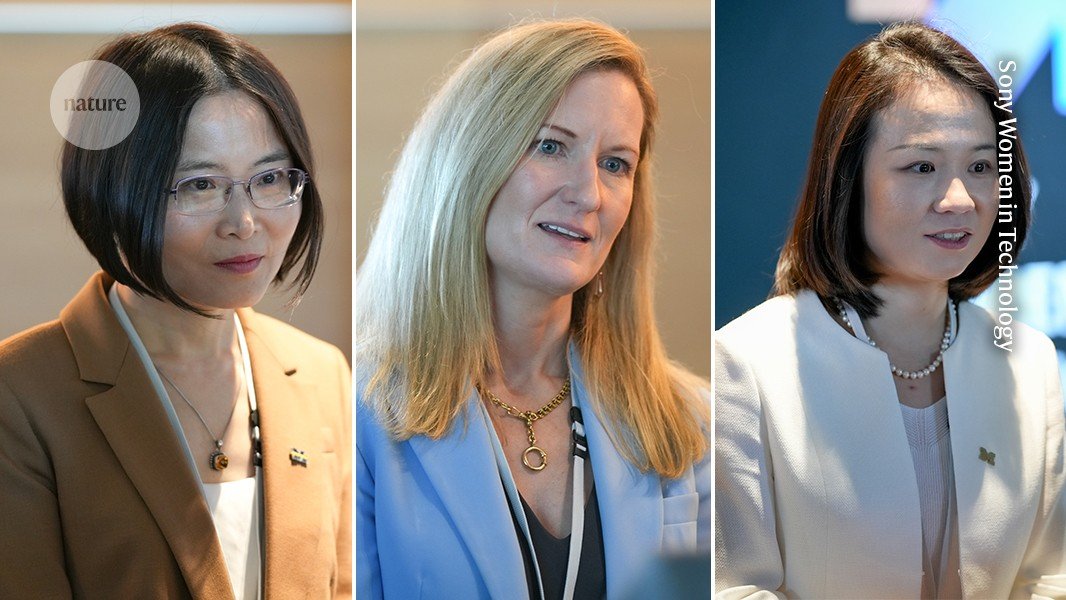
Zhen Xu, Ellen Roche and Xiwen Gong (left to right) are this year’s recipients of the Sony Women in Technology Award with Nature.Credit: Sony
On International Women’s Day (8 March), researchers around the world will honour women’s contributions to research. At Nature, we have launched a special collection of articles recognizing remarkable individuals. We also report on some of the challenges that stand in the way of true gender equality, and feature research developments that could make a difference, especially to women’s health.
International Women’s Day
All women in research deserve recognition for the valuable and varied contributions they make — and not just on International Women’s Day. In this Editorial, we highlight three outstanding researchers. They are the recipients of the 2026 Sony Women in Technology Award with Nature, announced last month at a ceremony in Tokyo. The three prizes recognize outstanding research that benefits society and the planet.
Xiwen Gong, a chemical engineer at the University of Michigan in Ann Arbor, was awarded the early-career prize for her research in materials with uses from renewable energy to health care. One of Gong’s interests is solar cells made from a type of crystalline material called a perovskite. These solar cells work similarly to silicon-based ones: they produce electrons after absorbing light. A key difference, however, is that the main light-absorbing layer is the hybrid organic–inorganic perovskites, rather than silicon.
These perovskites have potential advantages over silicon, because they produce electrons more efficiently and the layers of light-absorbing material can be thinner. This means that they should require less energy to manufacture and, ultimately, will be cheaper to produce. But they are less stable: their structure can change after exposure to factors such as light, heat and moisture, making them less reliable than silicon solar cells.
Women in science are not a ‘problem to be fixed’
Gong and her colleagues have been working to improve perovskite-cell stability in real-world conditions, for instance, by incorporating additives of various shapes and sizes and measuring their effects. In 2024, they found that bulky additives lead to fewer structural defects than less bulky ones do1.
In the mid-career category, the judges recognized biomedical engineer Ellen Roche at the Massachusetts Institute of Technology in Cambridge for her studies in advancing implantable and wearable medical devices. One such device is designed to assist the heart muscle in people with heart failure by mimicking the organ’s physiological contractions2. Another is a proof of concept for a device intended to replace or complement mechanical ventilation in people who have lost the function of their diaphragm as a result of progressive neuromuscular diseases3.
Our second mid-career winner is Zhen Xu, a biomedical engineer and surgeon at the University of Michigan. She has been recognized for co-inventing a technology called histotripsy. It involves using ultrasound to perform non-invasive surgery targeting tumour tissues in organs such as the liver. The technology works by generating controlled clouds of oscillating microbubbles through a process known as cavitation. These microbubbles pulverize cells in a targeted way, without producing heat or ionizing radiation. In 2023, more than ten years after Xu’s discovery4, histotripsy was approved by the US Food and Drug Administration for the treatment of liver tumours.
On the shoulders of giants
Although they are working on diverse problems, these three scientists share a commitment to collaboration and working across disciplines. The fact that today’s pioneers stand on the shoulders of giants is also highlighted in a Nature Careers Feature. In it, we asked female researchers who had previously won the Sony award, or other Nature prizes, to nominate colleagues who bring out the best in them.
‘No one quite like her’: meet the female colleagues who inspire these award-winning women in science
Epidemiologist Chelsea Polis at the Guttmacher Institute in New York City, winner of the 2023 John Maddox Prize, which recognizes science in the face of adversity, writes of her mentor Onikepe Owolabi, the institute’s vice-president of research: “What truly sets Oni apart is how she lifts others up. She is a deep listener who champions other people’s ideas, encourages colleagues to believe in themselves and inspires them with her own bold ideas and encyclopedic knowledge. Oni has changed the course of my life and career in multiple ways.”
Yating Wan — an electrical and computer engineer at the King Abdullah University of Science and Technology in Thuwal, Saudi Arabia, and one of the winners of last year’s Sony awards — writes of her doctoral supervisor Kei May Lau at the Hong Kong University of Science and Technology: “She truly cares about her students’ growth. She often says that her proudest achievement is her students and postdocs, and she has always pushed us to aim higher than we thought we could.”
All of our winners, and those who have mentored and supported them, have advanced cutting-edge science and are working to improve the lives of others. On this International Women’s Day, we celebrate them and recognize that good science comes from generous mentorship, collaboration and mutual support. Without that recognition, we risk failing not only these inspirational researchers, but also science itself.
