

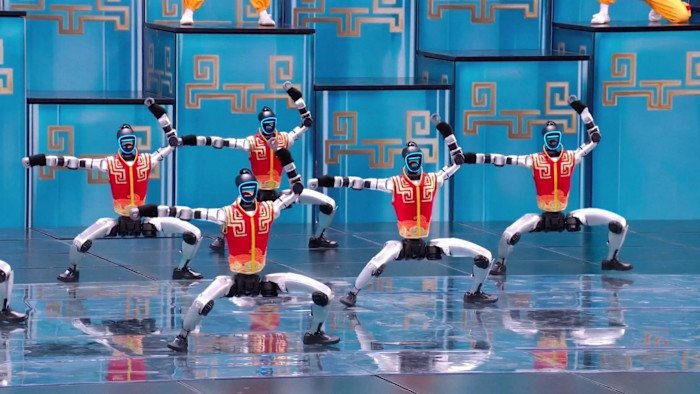
Robots were the most talked-about characters in China’s biggest TV gala of the year — and the businesses behind them are now in the spotlight.
State television ushered in the lunar new year with comedy sketches, choreography and martial arts performed by humanoid robots.
The companies whose products feature in the annual television special — often a showcase for the latest technology — benefit from exposure and the broader perception that they have the backing of Beijing. Within hours of the broadcast, orders of robot-related products on ecommerce platform JD.com had more than doubled, according to analysts at Morgan Stanley.
“The Spring Festival Gala is an amplifier,” Jiang Zheyuan, the 28-year-old founder of Beijing-based Noetix, which exhibited its robots during the gala, told local media. “If you do well you’ll become famous overnight. If you do poorly, you’ll just humiliate yourself.”
Companies are eager to show possible commercial applications for humanoid tech, arguing that as the population ages, robots could be an answer to labour shortages in factories and the service sector.
Analysts caution this may be some way off. Last year, less than 20 per cent of Chinese robot shipments were used in commercial applications such as manufacturing or services, noted Morningstar analyst Cheng Wang. Most were used in entertainment, performance, education and research.
Unitree’s backflips and ‘drunken’ kung fu
At last year’s lunar new year gala, Hangzhou-based producer Unitree’s H1 robot featured in a banner-waving dance display, rocketing the company to national prominence. The company was the second-largest humanoid robot producer by deliveries last year, according to Omdia.
Just one year later, the technology has already hugely advanced. A team of silver, G1 humanoids performed an array of acrobatics, including backflips and — strikingly — a bout of “drunken” kung fu, a fluid fighting style made famous by the monks of the Shaolin Temple.
While analysts stress that robots in the performance, like all of those at the gala, were likely to have been preprogrammed, they agree that the fluidity of the G1’s movement, its coordination with numerous other bots and human performers and its balance were impressive.
“Unitree’s G1 may be the best hardware platform [and] perhaps the robot model with the best dynamic capability in the world,” said Marco Wang, an expert at Interact Analysis, noting that the robot had become the industry standard for researchers of bipedal movement.
The robots, Wang noted, also appeared to undertake more “generalised” tasks, such as correcting their posture.
In an interview with state broadcaster CCTV, Unitree founder Wang Xingxing noted that over the past year “the technology of robots in our company and throughout China improved very quickly”. He added that he hoped these robots could be used to perform dangerous and physically demanding tasks for humans.
Galbot’s multifunctional hands
Galbot’s silvery humanoid folds T-shirts, retrieves a bottle of water from a shelf and rolls walnuts about in its hands.
Developing multifunctional hands has been a major challenge for robot makers, requiring advanced sensitivity and a high density of mechanical components. The Beijing-based company says its robots can be used for household tasks or in retail contexts such as shops and pharmacies.
Wang, at Interact Analysis, said that the pre-recorded nature of the Galbot segment of the gala made it difficult to judge how commercially viable it was or to differentiate it from its competitors.
But Galbot, backed by Chinese battery giant CATL, also showed its humanoid picking up irregular shards of broken glass, suggesting “integration of perception, grasp planning, and controlled force and precision, differentiating the performance from purely staged movement”, according to analysts at Morgan Stanley.
MagicLab’s robot dogs
At the gala, MagicLab’s humanoid robots danced to a pop song titled “the future of intelligent manufacturing”. But the future may yet lie with the army of robot dogs donning panda disguises for a dance routine.
The simultaneous display of hundreds of “MagicDogs” at a separate venue signalled that the robot maker, based in the affluent eastern city of Wuxi, had made strides in co-ordination, the Morgan Stanley analysts said.
MagicLab advertises its larger model robot dogs as having industrial uses, touting their ability to carry heavy loads and navigate difficult terrain. Other companies such as Unitree have promoted robot dogs in hazardous scenarios, including firefighting. State TV has also aired footage of robot wolves used in military beach assault drills.
However, MagicLab sees this model’s main potential use case as emotional support, or caring, much like a pet. Quadrupeds may be rolled out faster than humanoids, the Morgan Stanley analysts said, citing “simpler control, more mature stability, and clearer use cases, particularly . . . companion like devices with emotional value”.
Noetix’s caring grandson
“Anything they can do, I can do!” exclaims an exasperated grandson of the four robot companions his grandmother keeps at home. Two of the smaller robots promptly perform on-the-spot backflips.
But the real star of the Noetix sketch is a robotic reproduction of Cai Ming, a famous Chinese comedian who plays the grandmother, complete with a realistic human face.
In this sketch, the Morgan Stanley analysts note, it is the face that is the real innovation, while the bot signals ambitions to roll out humanoids in caring and service sector roles.
“Realistic facial expression and presence could become a differentiated wedge in household and eldercare scenarios, where perceived empathy, comfort, and companionship can drive adoption as much as task performance.”
