

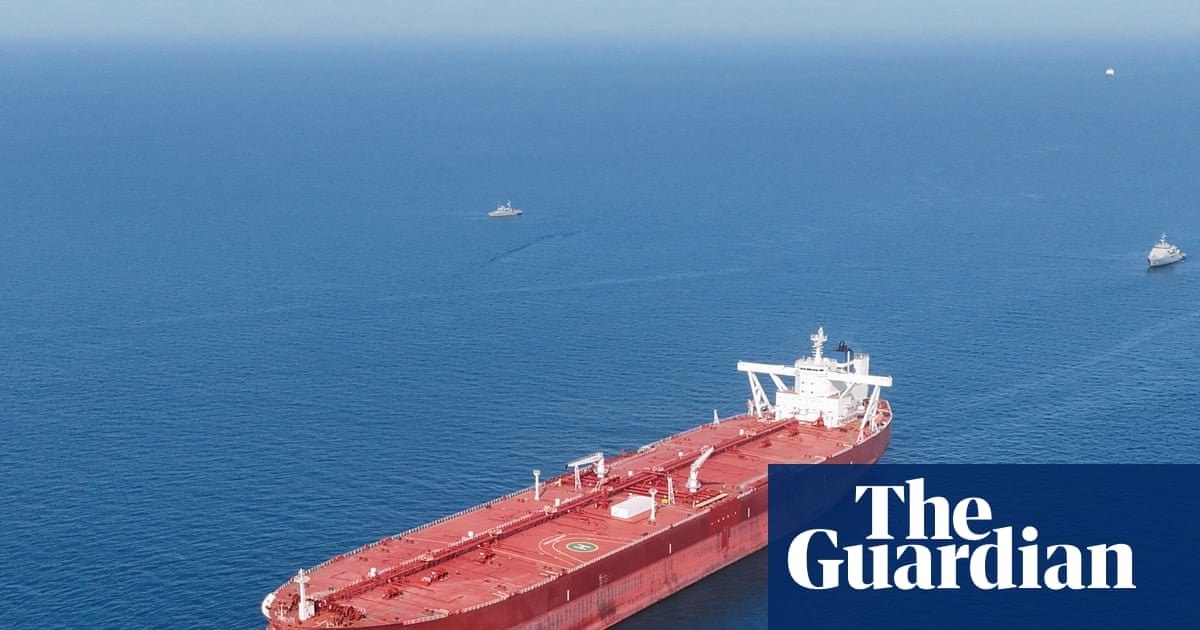
A second round of peace talks between the US and Iran has begun amid renewed attacks on oil tankers in the strait of Hormuz and a US blockade on Iranian vessels through the crucial trade route.
The future of this narrow waterway – and curbs on Iran’s nuclear programme – are at the centre of the talks after Tehran’s de facto blockade on oil and gas tankers via the strait pushed up energy prices.
Iran’s plan to maintain a chokehold on the strait by extracting a payment of $2m from each passing tanker has raised concerns that “Tehran’s tollbooth” for Middle Eastern oil could lead to higher prices for years to come.
Here we look at what the strategy could mean for oil markets and the world economy.
What is Tehran demanding from shipping companies?
Within Tehran’s 10-point peace plan is a requirement that Iran and Oman will be free to charge a fee of up to $2m on each vessel transiting through the strait, according to reports. Iran suggested this money would be used for reconstruction.
The suggestion that safe passage through the narrow waterway would be allowed only under Iranian military management has been roundly condemned by Washington DC and economic commentators.
The plan was trialled by Iran earlier this month. According to reports, Tehran required tankers hoping to pass through to the strait to give details of the ship’s cargo, destination and ultimate owner before paying a toll of at least $1 a barrel.
For oil tankers, which typically carry 2m barrels of oil, the toll for a single transit was $2m, payable in Chinese yuan or a cryptocurrency. Once approved, Islamic Revolutionary Guard Corps (IRGC) boats would escort a tanker through the strait via a narrow designated route close to Iran’s southern coast.
So far, ships from Malaysia, China, Egypt, South Korea and India have been among those allowed to pass. It is not clear whether they paid a toll to Iran to do so.
Is this legal?
This system stands in direct opposition to the UN convention on the law of the sea, sometimes known as Unclos, which provides vessels a right of unimpeded transit passage through more than 100 straits around the world, including the strait of Hormuz.
About 170 countries and the EU have ratified Unclos, which is generally considered customary international law. But Iran and the US have not. Still, the US has made clear that it disputes Iran’s right to control the strait.
There is also the issue of sanctions. Iran has been subject to many complex layers of sanctions from countries including the US and the UK since the 1970s, which would rule out any major western shipping company making payments to the IRGC.
What is the impact on costs?
Adding $1 to the cost of every barrel of crude passing through the strait could add costs of $20m a day to the market, or $7bn a year, based on the pre-crisis flows of oil and gas via this trade route. That’s relatively small in the context of a global market valued at $3tn last year.
In addition, there are also doubts that a return to pre-crisis volumes of traffic would be possible under this regime. But experts have said the financial cost of using the strait is likely to spiral beyond the payment of the toll.
Shipping companies are likely to charge higher rates to use their tankers via a route where the risk of attack is substantially greater. Insurers are likely to charge higher premiums too. The seafarers operating these tankers – who will have seen the hardships of those trapped on stranded vessels – are entitled to double pay while working in an area designated as hazardous.
The greatest impact on energy costs is expected on the global oil markets, which requires flows through the strait to return to normal for pre-crisis prices to return.
How would a toll affect global oil prices?
The de facto closure of the strait, which once saw about 20m barrels of oil and gas transit each day, cut exports from the region by about 10m barrels a day and caused oil prices to surge. The price of Brent crude climbed from just below $70 a barrel last year to highs of $119 a barrel on the futures market, and to record highs of almost $150 a barrel for physical cargoes.
Market analysts suggest that a sustained squeeze on supplies will keep oil market prices higher for longer. Some suggest that prices of about $100 a barrel could remain for most of this year, with higher prices persisting into 2027.
This is because, while some Gulf oil and gas volumes have been redirected using the region’s limited pipelines, there are doubts over whether the Middle East’s petrostates will be able to return to pre-crisis shipping volumes as infrastructure was damaged and it will take time to reopen shut fields.
Meanwhile, higher costs, complicated legal risk and heightened security fears suggest that oil traders would sooner avoid buying Gulf crude, even if transit was allowed under the control of Iran.
What does this mean for Iran?
Fees from the “Tehran tollbooth” would allow the IRGC to rebuild its military and provide a lifeline to Iran’s crippled economy. Controlling the strait would also allow Tehran to resume exports of oil, the lifeblood of the Iranian economy, which have ground to a halt after the US blockade on Iranian ports.
Long-term influence over the strait promises revenues that would help to rebuild its infrastructure and economy. About 2 million people in Iran have lost their jobs as the war has forced factories, retailers and businesses to close, according to Gholamhossein Mohammadi, the country’s deputy work and social security minister. Experts believe this is likely to be a conservative estimate.
Meanwhile, Iran’s internet blackout is costing the economy at least 50tn rials ($35m) a day, according to Sattar Hashemi, the information and communication technology minister.
Does the tollbooth matter for the global economy?
Economists at the Belgian thinktank Bruegel have estimated that the world economy “would barely notice the toll” if Tehran successfully retained control of the strait.
The extra cost would have to be shouldered by the Gulf oil producers, which would probably end up paying roughly 80% to 95% of the total cost, or as much as $14bn a year on oil shipments, according to Bruegel. This would mean the world oil price would rise by only about $0.05 to $0.40 a barrel compared with the prewar level, the thinktank estimates.
But the precedent would raise more troubling concerns if it helped to legitimise Iran’s seizure of an international waterway and prevented flows of crude from returning to pre-crisis norms.
Experts have warned of widespread consequences for the global economy if the strait of Hormuz remains disrupted. Already, the closure has been described as the worst energy supply crisis in history by the head of the International Energy Agency, Fatih Birol, who said the situation was “absurd but real”.
Any further escalation in the Iran war could trigger a global recession, and the International Monetary Fund has said the UK economy is expected to be more affected than any of the other G7 nations.
