

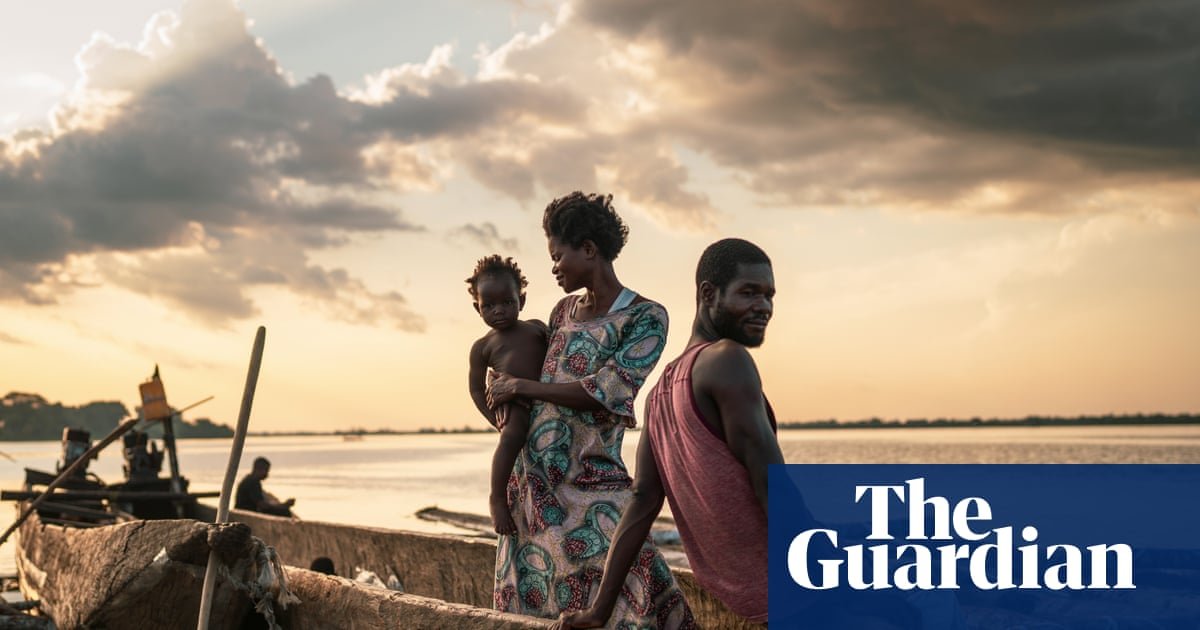
“You can’t be scared of the storms,” says Jean de Dieu Mokuma as the sun sets on the Congo River behind him. “With the current, once your voyage has begun, there is no turning back.” Mokuma, along with his wife Marie-Therese and their two young children, is piloting a cargo of timber downstream lashed on to a precarious raft and tied to a canoe.
They are stranded overnight outside the chaotic trading town of Mbandaka, where port officials have removed components of Mokuma’s outboard motor as assurance that taxes of dubious legality will be paid. If the family overcome the corruption and river currents and arrive with their raft intact, they stand to make $300 (£220) from selling the wood to a lumber mill in Kinshasa.
“I would stay a fisherman,” says Mokuma. “But there is no way to make money. In Kinshasa, I can win what we need to survive.”
Mokuma is one of millions who depend on the waters and resources of the Congo River basin to survive. Stretching from the mountains of the Albertine Rift to the Atlantic coast, the 2,900-mile (4,700km)-long river and its tributaries sprawl into six nations, nourishing vast networks of rainforests and swamps.
The Congo basin is the second largest rainforest on Earth and traps 1.5bn tonnes of carbon emissions a year. It is also one of the most biodiverse ecosystems on the planet and includes more than 10,000 plant species, more than 400 mammal species, 1,000 bird species, and 700 fish species.
Over half of its forests are found in the Democratic Republic of the Congo (DRC), where these ecosystems are vulnerable to the pressures of a rapidly increasing population and poorly regulated exploitation of the land.
Erick Bayo is a ranger at the Bombo-Lumene nature reserve, a protected space that, he says, contains 1,000 hectares (2,500 acres) of the last intact forests in the vicinity of Kinshasa. Venturing into the valleys of the reserve with Bayo and a squad of ragged Congolese army troops reveals clearings of felled trees and swathes of ashen earth blackened from the illegal production of charcoal. Hundreds of bags ready for transport are found abandoned next to the furnace pits.
Aerial views show the Lumene River, which holds some of the last remaining primary forest in the region around the city of Kinshasa, and areas deforested for charcoal production in the Bombo-Lumene reserve
“There was fighting here so the community fled,” says Bayo. “They wouldn’t have left their charcoal otherwise.” The patrol set about destroying the abandoned stocks – exhausting work under the midday sun. Kinshasa, with a population of over 18 million and rising, is a city with an inexhaustible demand for cooking charcoal, a cheap alternative to electricity for the estimated 75% of the Congolese population who survive on less than $2.15 a day.
The discovery in recent years of a vast peatland that lies underneath the swamp forests of the Congo basin has reinforced the need to protect the region. Across DRC and its neighbour the Republic of the Congo on the western bank of the river these peatland swamps, known as the Cuvette Centrale, contain 30bn tonnes of trapped carbon.
Farmers make their way through the dense, lush swamp forest around the village of Lokolama, which forms part of a network that contains the largest tropical peatland in the world
The village of Lokolama, in the DRC’s Équateur province, sits in the middle of this ecosystem, which was extensively mapped in 2017 by researchers from the UK. The Cuvette Centrale drew global attention for a controversial plan by the DRC government to auction oil and gas drilling rights across the basin region.
With the auctions cancelled in 2024, much of the peatland still rests outside legally protected areas.
“It was new for us to discover the word peatland, and learn that our land lets us all breathe clean oxygen,” says Jean-Pierre Ahetoa, Lokolama’s village leader. “We always hunted in the forest for antelopes, and searched for honey.” The village has an informal approach to conservation in the absence of legal guidance. “We know how to divide the land, we have left some for fields and construction, but the rest we leave intact,” he says.
From the banks of the river close to Lokolama, watching the traffic on the Congo makes clear the challenge of conserving this vital resource.
Vast barges, which hold hundreds of logs, motor downstream. The ships resemble floating cities. Traders and boat crew camp out for days and weeks, buying rations and cooking charcoal from riverside communities who paddle their canoes out onto the river to barter.
On arrival in the port of Kinkole, outside Kinshasa, where the vast river narrows into a series of impassable rapids, workers scramble into the water to hitch logs to tractors. Traders in colourful dresses keep a careful watch on the melee as they select which cargo to buy. These supply chains are opaque, with recent research suggesting that most forest concessions in DRC are operating illegally.
Between 2001 and 2024 DRC lost 21m hectares (52m acres) of trees; the future of the “lungs of Africa” rests on whether conservation can outpace this exploitation.
A barge carrying hundreds of logs moves downstream towards Kinshasa. People, including traders, also use log rafts and boats as a means of travelling up and down the Congo River, camping among the cargo for days and weeks at a time
