

Prime numbers are like the atoms of mathematics: they are the indivisible building blocks from which all other numbers are composed. For millennia, these numbers, divisible only by 1 and themselves, have fascinated humankind.
They guard many secrets, including how they are distributed on the number line, and efforts to identify more and more primes have occupied generations of scholars.
Euclid proved some 2,300 years ago that there are infinitely many prime numbers. And yet, some primes seem more interesting than others. I’ve compiled my personal short list of three extraordinary prime numbers and their stories.
On supporting science journalism
If you’re enjoying this article, consider supporting our award-winning journalism by subscribing. By purchasing a subscription you are helping to ensure the future of impactful stories about the discoveries and ideas shaping our world today.
The Sheldon Prime
In episode 73 of the sitcom The Big Bang Theory, physicist Sheldon Cooper asks his friends for the best number. Cooper then shares his pick of 73. His reasons: 73 is the 21st prime number; its reverse, 37, is the 12th prime number; and the product of 7 and 3 is 21.
A few years after the episode aired in 2010, mathematician Christopher Spicer of what is now Morningside University (then Morningside College) wondered if there were more “Sheldon primes” that shared these properties. In 2015 he worked with two of his then students, Jessie Byrnes and Alyssa Turnquist, to search the first 10 million prime numbers; they found no other Sheldon prime among them. The trio shared their findings in an article in Math Horizons called “The Sheldon Conjecture.”
Three years later, in 2019, Spicer and Carl Pomerance, a number theorist at Dartmouth College, showed conclusive proof that the Sheldon prime was unique. First, the researchers showed that there can be no Sheldon prime larger than 10⁴⁵. While 10⁴⁵ is unimaginably large, it is nonetheless a finite value, which means, in principle, a computer can systematically search all prime numbers between 2 and 10⁴⁵ for other Sheldon primes. Of course, today’s computers aren’t quite powerful enough to tackle that task directly. The mathematicians continually narrowed down the possible Sheldon candidates, approximating extremely large prime numbers using integrals and thus gradually eliminating all the Sheldon contenders. Eventually, only the number 73 remained.
When David Saltzberg, a physicist at the University of California, Los Angeles, and scientific adviser for The Big Bang Theory, learned of the evidence, he and the sitcom’s writers paid tribute to this effort by including parts of the proof on a whiteboard in the background of an episode broadcast in April 2019.
“6-7”
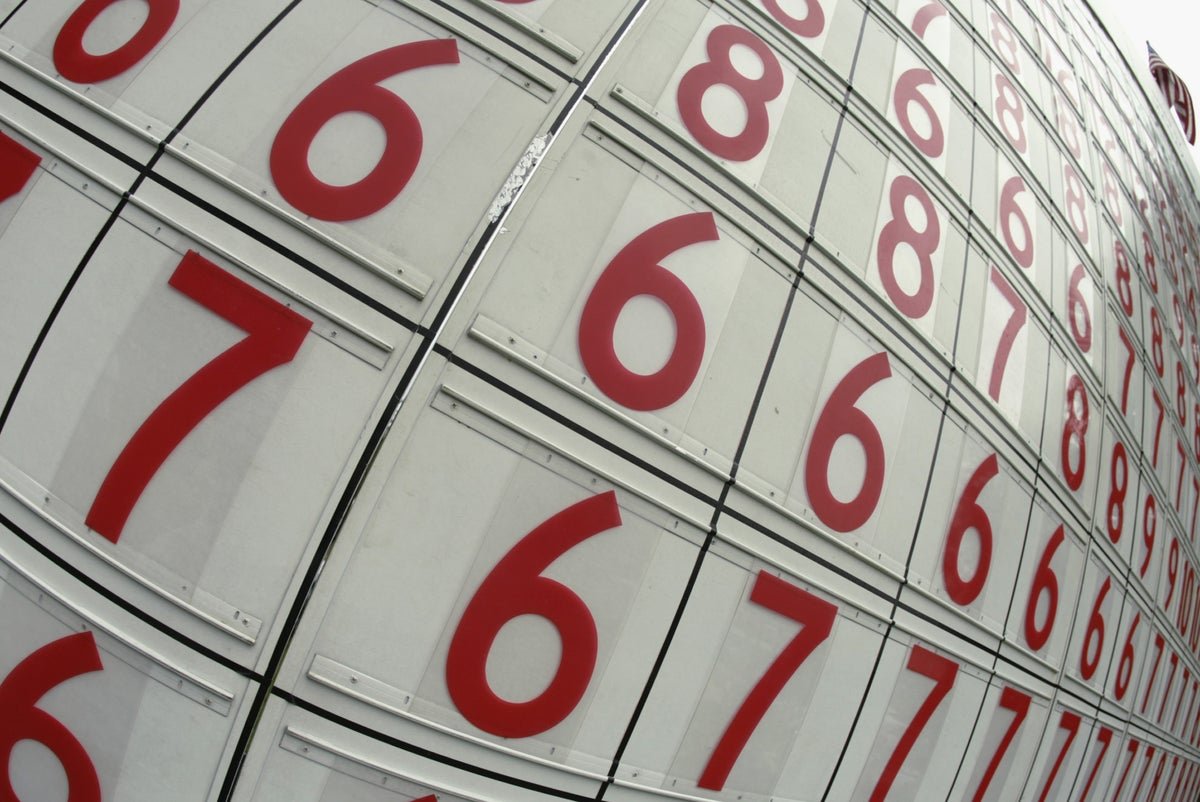
Anyone who was online in 2025 inevitably stumbled across the “6-7” phenomenon. Social media and comment sections flooded with 6-7’s and nobody really knew why. The meme, pronounced “six-seven,” has no deeper meaning; it is not a code for sharing some message or expressing joy or annoyance. Instead 6-7 is simply 6-7.
The precise origin of the meme is also unclear. Sometimes it’s attributed to a boy celebrating a basketball score; sometimes it’s the rap song “Doot Doot (6 7),” by Skrilla. Occasionally people point to the height of basketball player LaMelo Ball: six feet, seven inches.
The number 67 is certainly interesting from a mathematical perspective. It is not only prime but super-prime: it is the 19th prime number, and 19 itself is also prime. Furthermore, 67 is part of two consecutive pairs of “sexy primes,” or pairs of primes that are six integers apart. Together with 61 and the Sheldon prime, 73, 67 creates a sexy prime triplet.
And 67 is part of what mathematicians call the “lazy caterer’s sequence,” which indicates the maximum number of pieces a pancake, pizza or other disk can be divided into with n cuts. One cut produces a maximum of two pieces; two cuts produce four. But if the third cut is cleverly made, the disk can be cut into seven pieces instead of just six. With 11 cuts, a pancake can be divided into up to 67 pieces. The corresponding sequence is 2, 4, 7, 11, 16, 22, 29, 37, 46, 56, 67, 79,.…
Belphegor Prime
Forget 13 or 666. There is one number that truly represents the epitome of evil: the Belphegor prime, 1,000,000,000,000,066,600,000,000,000,001. The late mathematician and avid prime number hunter Harvey Dubner discovered this prime (and many others).
During his research, he came across the prime number 16,661: a palindrome with the “devil’s number” 666 in the middle. You can easily add 0’s between the 1 and the three 6’s to this number for more beastly palindromes, such as 1,066,601, 100,666,001, 10,006,660,001, and so on. Yet none of these palindromes are prime. All have divisors other than 1 and themselves.
Only when there are 13 0’s between each 1 and the 666 do you arrive at a prime number again. In shorter notation, this Belphegor prime number, which was named after a demon, can be written as 1030 + 666 × 1014 + 1.
As it turns out, there are more palindromic primes of this form other than 16,661 and the Belphegor prime with 13 0’s. But none are as devilishly difficult as 1030 + 666 × 1014 + 1, unless the version with 666,666 0’s is also a prime number. That remains to be determined.
This article originally appeared in Spektrum der Wissenschaft and was reproduced with permission.
