

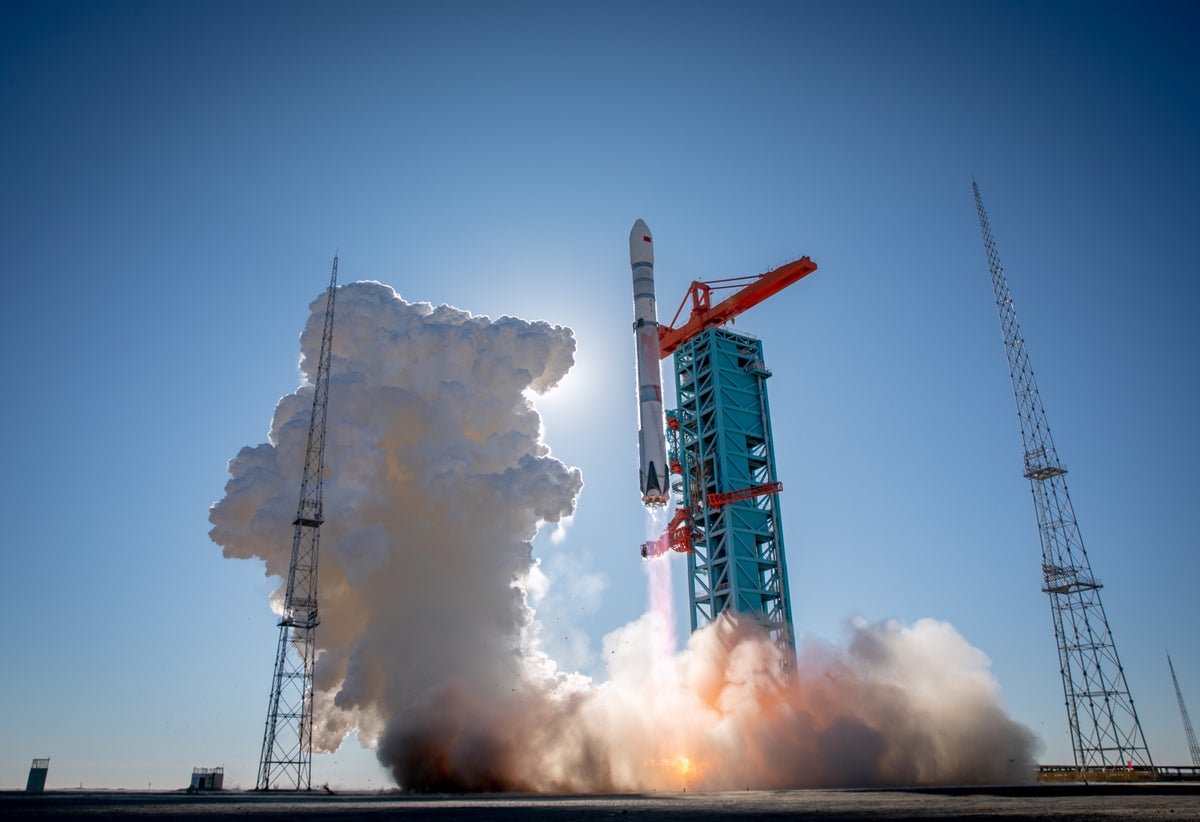
A full decade after SpaceX pioneered reusable rocketry with the first-ever successful landing of its Falcon 9 booster, the rest of the world is finally catching up.
The revolutionary value of rapid, reusable transportation to orbit is indisputable, evinced by SpaceX’s overwhelming dominance of space launch services and its profitable—and disruptive—megaconstellation of Starlink broadband satellites, which now constitute the vast majority of spacecraft in low-Earth orbit. But until very recently, replicating the company’s success had proved elusive: Only one other company, the U.S. aerospace firm Blue Origin, has landed a first-stage booster—that of its New Glenn rocket. And so far Blue Origin has only managed that feat once, in a flight on November 13. Soon, New Glenn should be providing much of the heavy lifting involved in launching satellites for a Starlink competitor, Amazon’s Kuiper megaconstellation (recently rebranded as Amazon Leo).
These few successes aren’t based on others’ lack of trying. On December 3 the first Zhuque-3 rocket from Chinese commercial company LandSpace launched from the Jiuquan Satellite Launch Center in the Gobi Desert in an inaugural flight meant to test the 66-meter vehicle’s partial reusability. About eight minutes after liftoff, once the booster had propelled the rocket’s second stage toward orbit and endured a scorching atmospheric reentry, it attempted a descent onto a landing pad, located some 390 kilometers away from Jiuquan. Instead of soft-landing on target, however, the plummeting stage exploded and crashed to Earth at the pad’s edge, bringing the test to a premature end.
On supporting science journalism
If you’re enjoying this article, consider supporting our award-winning journalism by subscribing. By purchasing a subscription you are helping to ensure the future of impactful stories about the discoveries and ideas shaping our world today.
Despite that failure, China’s first attempt to land a first stage from an orbital launch was a milestone for the country’s spaceflight ambitions. It was also a preview of a world in which China and other nations catch up with U.S. companies to gain their own reusable launch capabilities, deploy their own megaconstellations and challenge American preeminence in space.
Zhuque-3 is just the tip of a much larger spear for China’s push into reusable rocketry. The nation’s next attempt—with an entirely different rocket—is set to fly soon. The Long March 12A, developed by the state-owned Shanghai Academy of Spaceflight Technology (SAST), is already vertical at a newly completed dedicated launch pad at the Dongfeng Commercial Space Innovation Test Zone at Jiuquan. It, too, has its own landing pad, about 250 km downrange in Minqin County in the province of Gansu. This next launch attempt could come within mere days, but as a Chinese state-owned entity, SAST is tight-lipped about its scheduling and plans.
These are far from the only efforts in China. Established commercial Chinese firms, including Space Pioneer, Interstellar Glory Aerospace Science and Technology (iSpace), Galactic Energy, CAS Space, Deep Blue Aerospace and Orienspace, are close to getting their own reusable rockets to the pad. And infrastructure that includes sea drone barges is also being readied to catch returning stages at these companies. Newer entrants, encouraged by clear central government policy statements, also continue to emerge. Many aim to leapfrog the partially reusable Falcon 9–like capabilities the extant companies are reaching for—and instead hope to emulate SpaceX’s audacious megarocket Starship, which is meant to be fully reusable.
According to Ian Christensen, senior director of private-sector programs at the nonprofit Secure World Foundation, China’s push for reusability is primarily motivated by the nation’s pursuit of its own Starlink-like satellite megaconstellations. “Reusable launch is seen as key to both increasing throughput of launch rates and in driving down cost of those launches,” he says. These two factors are crucial for lofting thousands of large satellites—a capability with implications well beyond the market for global broadband connectivity. Megaconstellations have national security and strategic value as well, allowing for secure communications and redundancy in warfighting. For example, one need look no further than the role of Starlink in allowing Ukraine to withstand what could have otherwise been a battlefield rout when Russia invaded that nation in 2022. Relatedly, the U.S. “Golden Dome” missile defense plan would likely involve a megaconstellation of interceptors to counter intercontinental ballistic missiles and other airborne threats.
China’s most notable megaconstellation projects are Guowang and Thousand Sails, each of which call for more than 10,000 satellites in low-Earth orbit. China needs reusable rockets in addition to its existing expendable rockets in order to meet deadlines for each project’s construction in accordance with International Telecommunication Union (ITU) rules. To hit its target of almost 14,000 satellites, Thousand Sails alone would require an average of seven to be launched each and every day until the end of the decade.
Europe is also targeting reusability. At a recent European Space Agency (ESA) ministerial council, member states thrashed out their contributions to programs for the next three years. Reliant on the expendable Ariane 6, Europe is looking to secure its independent access to space in the wake of the reusable boom, with member states committing more than €4.4 billion ($5.1 billion) to space transportation.
Jörn Spurmann, chief commercial officer at the German launch start-up Rocket Factory Augsburg, says ESA’s backing for launch is a landmark that highlights the importance of flexible and independent access to space for Europe. This “will secure Europe’s access to and operational capability in Earth orbit and beyond for the coming space age,” he says. “We are also working on the return and refurbishment of stages and engines. This enables us to reduce costs and increase our launch cadence.”
Europe is also pursuing its own megaconstellation for sovereign communications, with plans including the European Union’s IRIS² satellite constellation aimed at addressing the long-term challenges of the E.U.’s security, safety and resilience. Germany’s military also wants to have its own communications constellation rather than relying on those of allies.
Japan is similarly seeking competitive, reliable access to space by pivoting to reusable launch, assisted by government policies and funding. Its new H3 launcher is expendable and cannot compete with the dominant Falcon 9, according to Kazuto Suzuki, a professor at the Graduate School of Public Policy at the University of Tokyo. Japan’s space agency, JAXA, is therefore partnering with Mitsubishi Heavy Industries to develop a reusable heavy-lift successor, while other Japanese commercial players—including Space One, Interstellar Technologies and even Honda—pursue their own rockets. Japan, too, is aiming to place its own satellite constellation in orbit. “At this moment, there is a concrete program, which is to launch somewhere in the realm of 100 satellites for surveillance—what we call the targeting satellite constellation—which is to monitor the targets of long-range missiles,” Suzuki says.
Reusable launch is now poised to go global. Lower costs and the ability to launch more often will enable massive constellations in orbit. The consequences of this push will be complex, ranging from new communications infrastructures to increased challenges for astronomy and changes to the risks of orbital debris and space collisions.
“Reusable launch can contribute positively to the sustainability of space activities by helping to enable controlled reentry of launch vehicles and by reducing the amount of spent stages left in orbit,” Christensen says. Yet the associated huge uptick to activity in orbit might add to the risk. For better or worse, the global rise of reusable rocketry will unlock profound new possibilities for Earth and space alike.
