

November 7, 2025
4 min read
China’s Stranded Astronauts Show the Dangers of Space Junk
Three Chinese astronauts will likely return safely to Earth after a reported space-junk strike. But the incident highlights the growing risk of orbital debris
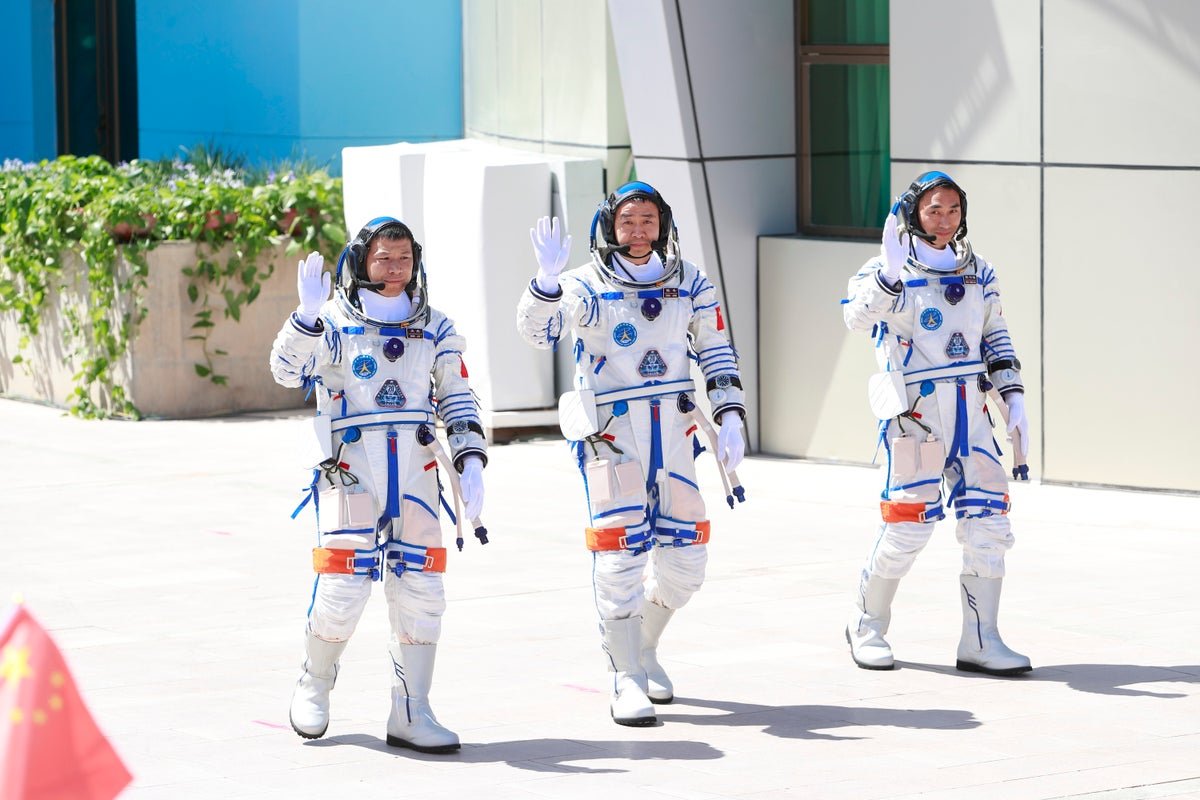
Wang Jie, Chen Dong and Chen Zhongrui before their April 2025 launch on the Shenzhou-20 spacecraft.
This week the China Manned Space Agency (CMSA) announced that the homecoming for three of its astronauts was delayed after a piece of space junk struck the Shenzhou 20 spacecraft that was intended to ferry them back to Earth from China’s Tiangong space station. While the agency continues to investigate the extent of the damage, independent experts say the incident is a clear sign that the danger of proliferating orbital debris is only going to grow.
Although this is the first known time a return to Earth has been affected by debris, scientists have long warned that the rising amount of space junk makes such disruptions inevitable.
“It was only a matter of time before this happened,” says research analyst Lauren Kahn of Georgetown University.
On supporting science journalism
If you’re enjoying this article, consider supporting our award-winning journalism by subscribing. By purchasing a subscription you are helping to ensure the future of impactful stories about the discoveries and ideas shaping our world today.
Space junk is essentially all the human-made objects floating in space that are no longer useful. As orbital launches and other space activities have increased, so have the fragments produced by collisions, accidental breakups, spent rocket stages, and more. In Earth orbit, debris can drift through space for decades, gradually descending because of atmospheric drag before finally experiencing a fiery reentry. The result, Kahn says, is that parts of Earth’s orbital environment are rife with hazardous objects that can collide with vital space infrastructure.
A recent analysis, co-authored by Kahn tracked 34,000 pieces of space debris larger than 10 centimeters that were cataloged from 1958 to mid-April 2025. The researchers found that 73 percent of all tracked debris in orbit today can be traced back to just 20 major sources—from launches by China, the U.S. and Russia.
According to NASA, as of today, there are more than 45,000 human-made objects orbiting Earth. Some of them could cause severe damage to space stations and satellites, endangering the global space economy floating above us, which is currently valued at more than $600 billion.
While objects larger than 10 cm can be found and tracked, the real danger comes from harder-to-see debris that can be as small as a bullet and travel at more than 27,000 kilometers per hour. “Those are the scary ones,” says Jonathan McDowell, an astronomer at the Center for Astrophysics | Harvard & Smithsonian. “They are time bombs in orbit.”
Although the CMSA has not revealed more details about the object that may have hit the Shenzhou 20 spacecraft, McDowell says that even a small piece could be dangerous if it struck a key system.
Still, the astronauts are expected to be safe, McDowell says, because China has another spacecraft docked to the space station and ready to retrieve them if they cannot return on the Shenzhou 20 craft.
A Cascade of Collisions
The greatest fear among space scientists is that debris could trigger a chain reaction of satellite collisions, creating even more junk, a nightmare scenario known as the Kessler syndrome.
In recent years, astronomers tracking space junk have focused on low-Earth orbit (LEO), where human space missions operate alongside communication and observation satellites. According to the analysis co-authored by Kahn, most space debris—more than 83 percent of tracked objects, as of April 2025—is in LEO.
Right now, there are about 13,000 active satellites orbiting Earth, about 10 times more than there were a decade ago. Because of that, McDowell says, satellites often must move out of the way to avoid crashing into other satellites or debris. These movements, called avoidance maneuvers, already happen tens of thousands of times every year. The number of maneuvers grows much faster than the number of satellites because more satellites mean more chances to cross paths. If satellites increase 10-fold, maneuvers could rise a 100-fold, making orbital traffic far more difficult to manage safely.
Even as this risk rises rapidly, there are still plans for launching mega constellations of tiny satellites akin to those that are already orbiting as part of SpaceX’s Starlink system, along with a newly emerging push for orbital data centers such as Nvidia’s Starcloud. “There’s no limit right now on how many satellites you can launch,” McDowell says.
Two problems are especially worrying, says Victoria Samson, chief director of space security and stability at the Colorado-based nonprofit Secure World Foundation: there is currently no way to clean up space debris, and there is very little international coordination to prevent further debris-creating collisions, especially between the U.S and China.
This isn’t the first time China’s human spaceflight program has encountered hazardous debris. In March 2024, CMSA said in a statement that a fragment had hit one of the Tiangong space station’s solar panels, damaging it and causing a power loss that forced astronauts to perform spacewalks to make repairs.
But the potential damage done by the increasing amount of collisions cannot always be repaired in a spacewalk. Beyond the risk to space infrastructure, the bigger concern is the growing number of astronauts in orbit. “There are a lot of people up there,” Samson says.
