

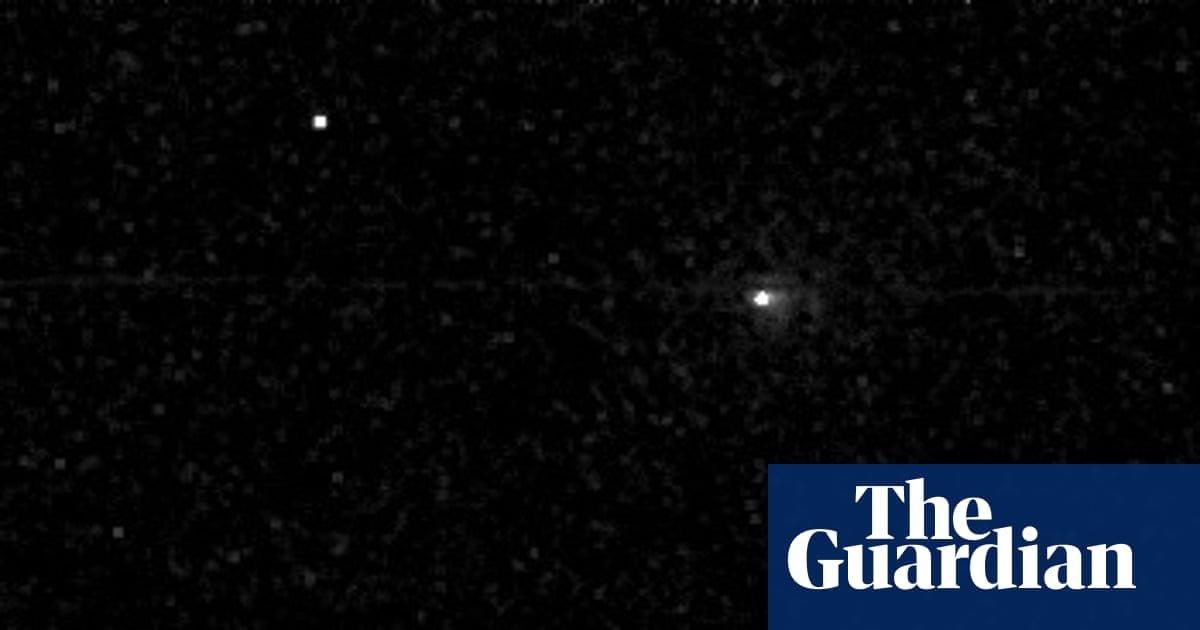
You wait ages for an interstellar comet to arrive and then three come along at once. Or at least over the space of a decade. The latest interloper from another star system is the 3I/Atlas comet, which was first detected in July. As space agencies track the speeding object, here’s what we know so far.
What are comets?
Comets are made from material left over when star systems form. In the solar system, that means dust and ice that dates back 4.6bn years. At the heart of a comet is a central, solid nucleus, or “dirty snowball”, made of frozen water, dust and volatile substances such as carbon dioxide, carbon monoxide, methane and ammonia.
When a comet nears the sun, the heat sublimates the surface ice into gas, producing a temporary atmosphere or coma around the nucleus. The dust and gas released make the comet look fuzzy and produce the tails that can stretch for millions of kilometres. Comets have two tails. One is white and formed by the dust billowing off the comet, the other is bluish and made from electrically charged molecules, or ions. The ion tail points directly away from the sun, regardless of the comet’s position.
Comet Neowise over Mount Washington in the US in 2020. The lower tail, which appears broad and fuzzy, is the dust tail billowing off the comet’s nucleus and trails behind the comet in its orbit. Photograph: Chris Pietsch/AP
What about interstellar comets?
As the name suggests, these come from even further out, having formed from the leftovers of other star systems. A chance encounter with the gravitational field of a passing star, or another massive body, can knock these comets off course and send them in our direction. So far, astronomers have only seen three interstellar comets barrelling through the solar system. The first, 1I/ʻOumuamua, was detected in 2017. The second, 2I/Borisov, was spotted in 2019, and the latest, 3I/Atlas, was reported in July this year.
What can they tell us?
Interstellar comets are the only material from other star systems that astronomers can observe relatively close up. If the comets pass close to the sun, the dust and gases that erupt from them reveal the chemical ingredients of the originating star system. “These objects are the first building blocks we can observe from those systems,” said Michael Küeppers, project scientist on the European Space Agency’s comet interceptor mission, Hera. “They tell us about the conditions in the stellar system where they formed.”
Studies of 3I/Atlas might be more revealing than observations of previous interstellar comets. Astronomers failed to detect much gas or dust around ‘Oumuamua and 3I/Atlas will get much closer to the sun than Borisov, making it spew more gas and dust to analyse.
Is 3I/Atlas special?
Astronomers have seen too few interstellar comets to know what counts as normal; their rarity makes them all exciting. But a few features are particularly interesting. Early measurements suggest 3I/Atlas is between 440 metres and 5.6km across, making it potentially larger than the cigar-shaped ‘Oumuamua, which is up to 400 metres long, and Borisov, which is about 1km across.
A comet streaking across a star field above the International Gemini Observatory on Cerro Pachón, near La Serena, Chile Photograph: AP
An interesting feature spotted in an image from the Hubble space telescope shows that 3I/Atlas has a coma that balloons out towards the sun. This “anti-tail” is thought to be caused by uneven sublimation of ices on the comet.
The comet also differs from more familiar solar system comets by the amounts of certain elements spewing off the surface. Astronomers using the European Southern Observatory’s Very Large Telescope in Chile spied a high nickel-to-iron ratio in the comet’s plume, which might be explained by sublimation of nickel tetracarbonyl and iron pentacarbonyl compounds in the comet. Other tentative observations have shown that light scattering off the comet is unusually polarised, but this could be explained by water ice and magnesium-rich silicates.
Where do they come from?
The comets that swing around Earth often come from the Kuiper Belt, a band of frigid bodies that lurk beyond Neptune. These take less than 200 years to complete each looping orbit around the sun. Others come from a region called the Oort cloud, which starts farther out and extends up to halfway towards our nearest neighbouring star. Comets from the Oort cloud can take 30m years to complete one orbit around the sun. There are thought to be billions of comets in the Kuiper Belt and many more in the Oort cloud.
This image captured on 2 June 2025 by David Rankin, an engineer at the Catalina Sky Survey at the University of Arizona, shows 3I/Atlas. Photograph: David Rankin/David Rankin, Saguaro Observatory/AFP/Getty Images
What route is the comet taking?
The comet entered the solar system close to the ecliptic, the imaginary plane that contains the Earth’s orbit around the sun. Other planets orbit close to the same plane. The comet is not going to hit Earth or any other planet in the solar system. The closest it will come to Earth is 240m km, more than 1.5 times the distance between the Earth and the sun.
The US astronomer Avi Loeb, who speculated that ‘Oumuamua was alien technology, has also speculated that Comet 3I/Atlas might be alien technology. He thinks the comet’s trajectory, which passes close to Jupiter, Mars and Venus, looks planned. Plus, he says the comet came from within nine degrees of the Wow! Signal, the radio waves detected in 1977 that some consider a potential alien transmission. But Loeb concedes that “by far the most likely outcome will be that 3I/Atlas is a completely natural interstellar object”.
Küeppers agrees. “It looks like a comet and it behaves like a comet. There’s no reason to think it’s something else,” he said. “If you start with the trajectory and then look at all kinds of distances, angles and so on, you will always find something that is relatively unlikely.”
What happens next?
Astronomers hope to take more images of the 3I/Atlas comet from ground- and space-based telescopes, Mars orbiters and rovers, and other probes such as the European Space Agency’s Juice mission. This week, Esa released images taken from two Mars missions, the Trace Gas Orbiter and Mars Express, as the comet zipped past the red planet. The comet was 30m km away, so appears as a small dot, but the coma is visible, showing that the sun’s heat and radiation are bringing the comet to life. When the comet is closest to Earth it will be behind the sun, but it will re-emerge in late November, giving astronomers another chance to observe it.
