
Close Menu

    Subscribe to Updates

    Get the latest creative news from FooBar about art, design and business.

    What's Hot

    Japanese shares hit record high as Sanae Takaichi wins landslide election victory | Japan

    Why has this winter been so cold in the U.S. East and warm in the country’s West?

    How to stop the survey-taking AI chatbots that threaten to upend social science

    Facebook X (Twitter) Instagram
    Facebook X (Twitter) YouTube LinkedIn
    Naija Global News |
    Tuesday, February 10
    • Business
    • Health
    • Politics
    • Science
    • Sports
    • Education
    • Social Issues
    • Technology
    • More
      • Crime & Justice
      • Environment
      • Entertainment
    Naija Global News |
    You are at:Home»Science»Prospect of life on Saturn’s moons rises after discovery of organic substances | Space
    Science

    Prospect of life on Saturn’s moons rises after discovery of organic substances | Space

    onlyplanz_80y6mtBy onlyplanz_80y6mtOctober 1, 2025003 Mins Read
    Share Facebook Twitter Pinterest LinkedIn Tumblr Email
    Prospect of life on Saturn’s moons rises after discovery of organic substances | Space
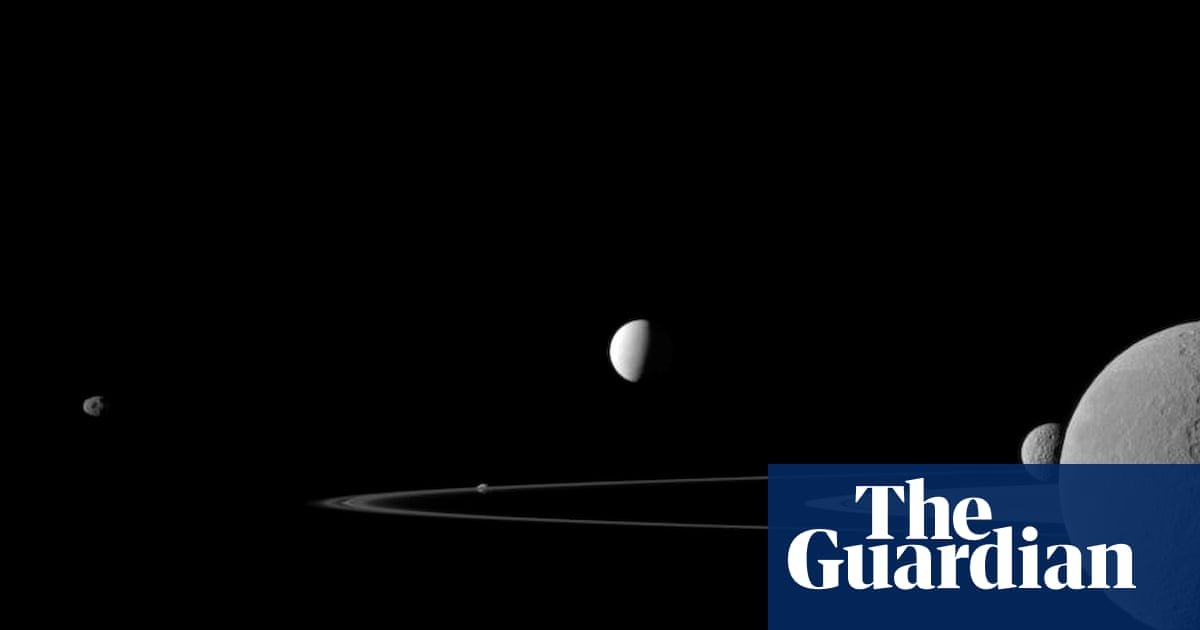
    A Cassini mission image shows Saturn moons including Enceladus (second right). Photograph: NASA/JPL-Caltech/Space Science Institute/EPA
    Share
    Facebook Twitter LinkedIn Pinterest Email

    The likelihood that one of Saturn’s moons may harbour life has risen, experts say, after finding an array of carbon-based substances being spewed out of Enceladus.

    The sixth largest of Saturn’s moons, Enceladus has become one of the leading contenders in the search for bodies that could harbour extraterrestrial life, with the Cassini mission – which ended in 2017 – revealing the moon has a plume of water ice grains and vapours erupting from beneath the surface at its south pole.

    The phenomenon has since been captured by the James Webb space telescope, with the plume reaching nearly 6,000 miles into space. The source of this material is thought to be a saltwater ocean that lies beneath the moon’s icy crust.

    Now researchers studying data from the Cassini mission say they have discovered organic substances within the plume, with some types of molecule detected there for the first time.

    Dr Nozair Khawaja, a planetary scientist at Freie University Berlin and lead author of the work, said the results increased the known complexity of the chemistry that is happening below the surface of Enceladus. “When there is complexity happening, that means that the habitable potential of Enceladus is increasing right now,” he said.

    Writing in the journal Nature Astronomy, Khawaja and colleagues reported how their previous work had revealed the presence of organic substances and salts within ice grains found in a ring of Saturn, known as the “E-ring”, that is composed of material ejected from Enceladus.

    However, as Khawaja points out, the material in this ring is months or years old, meaning its makeup could have been affected by radiation. By contrast the new work analyses data collected from ice grains found within the plume itself.

    “These grains were just minutes old,” said Khawaja. “It means that what we are capturing here is actually the pure sample from the subsurface.”

    The results, based on data from an instrument called the Cosmic Dust Analyzer, not only confirm the presence of the organic substances previously found in the E-ring of Saturn – indicating they originated from within Enceladus – but reveal the presence of other types, too. And while some of the latter have previously been detected by Cassini instruments, others have not previously been found in the plume.

    While the new findings do not show that there is life on Enceladus, Khawaja said they indicate there are complex chemical pathways at play that could lead to the formation of substances that could be biological relevant.

    The results, he added, support plans by the European Space Agency (ESA) to investigate the moon for signs of life. “I think all the signals are green here for Enceladus,” Khawaja said.

    Dr Jörn Helbert, the head of the solar system section at the ESA and who was not part of the study, told the Guardian the plan for the new mission – which he hopes would launch around 2042 – consists of an orbiter around Enceladus that will also fly through the plumes, as well as a lander that will touch down in the south pole region of the moon.

    The new study, he added, proves that complex prebiotic molecules are coming from the subsurface ocean of Enceladus. “That means we now have all elements required for Enceladus to harbour life – liquid water, energy and complex prebiotic molecules,” Helbert said. “This makes it so timely to send a mission that searches for signs of life.”

    Discovery life moons organic prospect rises Saturns space substances
    Share. Facebook Twitter Pinterest LinkedIn Tumblr Email
    Previous ArticleIsraeli settlers burn Palestinian home, fell olive trees in West Bank | Occupied West Bank News
    Next Article What to Know About the Government Shutdown and Higher Ed
    onlyplanz_80y6mt
    • Website

    Related Posts

    How to stop the survey-taking AI chatbots that threaten to upend social science

    February 9, 2026

    Elon Musk says SpaceX will prioritize establishing a city on the moon instead of building a Mars colony

    February 9, 2026

    A couple of teas or coffees a day could lower risk of dementia, scientists say | Medical research

    February 9, 2026
    Add A Comment
    Leave A Reply Cancel Reply

    Top Posts

    Watch Lady Gaga’s Perform ‘Vanish Into You’ on ‘Colbert’

    September 9, 20251 Views

    Advertisers flock to Fox seeking an ‘audience of one’ — Donald Trump

    July 13, 20251 Views

    A Setback for Maine’s Free Community College Program

    June 19, 20251 Views
    Stay In Touch
    • Facebook
    • YouTube
    • TikTok
    • WhatsApp
    • Twitter
    • Instagram
    Latest Reviews

    At Chile’s Vera Rubin Observatory, Earth’s Largest Camera Surveys the Sky

    By onlyplanz_80y6mtJune 19, 2025

    SpaceX Starship Explodes Before Test Fire

    By onlyplanz_80y6mtJune 19, 2025

    How the L.A. Port got hit by Trump’s Tariffs

    By onlyplanz_80y6mtJune 19, 2025

    Subscribe to Updates

    Get the latest tech news from FooBar about tech, design and biz.

    Most Popular

    Watch Lady Gaga’s Perform ‘Vanish Into You’ on ‘Colbert’

    September 9, 20251 Views

    Advertisers flock to Fox seeking an ‘audience of one’ — Donald Trump

    July 13, 20251 Views

    A Setback for Maine’s Free Community College Program

    June 19, 20251 Views
    Our Picks

    Japanese shares hit record high as Sanae Takaichi wins landslide election victory | Japan

    Why has this winter been so cold in the U.S. East and warm in the country’s West?

    How to stop the survey-taking AI chatbots that threaten to upend social science

    Recent Posts
    • Japanese shares hit record high as Sanae Takaichi wins landslide election victory | Japan
    • Why has this winter been so cold in the U.S. East and warm in the country’s West?
    • How to stop the survey-taking AI chatbots that threaten to upend social science
    • ‘A beaver blind date’: animals given freedom to repopulate Cornish rivers | Wildlife
    • Almost 70% of NHS areas in England offer only one cycle of IVF, data shows | IVF
    © 2026 naijaglobalnews. Designed by Pro.
    • About Us
    • Disclaimer
    • Get In Touch
    • Privacy Policy
    • Terms and Conditions

    Type above and press Enter to search. Press Esc to cancel.