

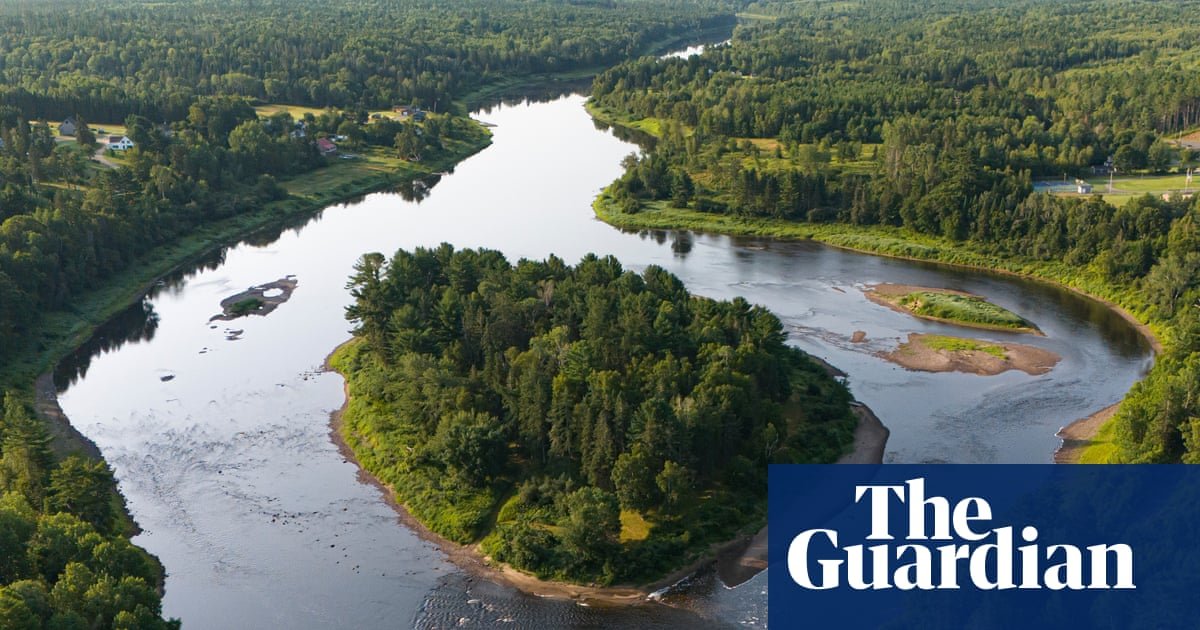
Since the 19th century, Atlantic salmon in the Miramichi have lured politicians, celebrities and wealthy anglers from across North America and Europe to fishing camps along the river’s banks, its undammed branches once producing more of the fish than almost any other river on the continent. In 2010, the fishery was valued at C$16m (£8.6m) and provided hundreds of jobs.
Rip Cunningham has been travelling from the US state of Massachusetts to the Canadian province of New Brunswick to fish since the 1970s. When he first started, he would sit on the deck at the Black Brook Salmon Club, on one of the Miramachi’s tributaries, watching the water boil with the leaps and rolls of salmon.
“It was an amazing experience, just because you saw the amount of life that there was in the river,” he says.
Sitting on that same deck 55 years later, Cunningham reflects on how much things have changed. Miramichi salmon have declined by as much as 86% since 2012 and with those declines the lodge’s bookings are down by half.
For some, that decline can be traced to one culprit: striped bass. As Miramichi salmon have declined, numbers of striped bass have been on an inverse trajectory. Researchers estimate there may now be half a million striped bass – predators that gobble young salmon as they migrate from their birthplace in the Miramichi to the Atlantic Ocean. As a result, anglers and conservation groups say, the only hope for salmon is to kill hundreds of thousands of bass.
Yet there is a wrinkle in that proposal. Striped bass is also native to the Miramichi, having coexisted with salmon for millennia. Thirty years ago, commercial fishing nearly drove striped bass to extinction; in the 1990s, they numbered less than 5,000. Since then, the closure of fisheries has helped bass make a spectacular recovery.
That recovery is now pitting two fish – and their supporters – against one another, in an ecosystem under increasing pressure from climate change.
On the side of the salmon are groups that say that 500,000 bass spawning in the Miramichi’s estuary is making it all but impossible for young salmon to make it out of the river alive. “It’s an all you can eat buffet,” says Cunningham.
Save Miramichi Salmon, a conservation group to which Cunningham belongs, wants the number of striped bass reduced to 100,000 reproductive-age fish, which would require removing hundreds of thousands of bass from the river.
This year Cunningham and five other outfitters, which provide fishing trips, lodge owners and anglers filed a lawsuit against the Canadian government, alleging that the government agency Fisheries and Oceans Canada (DFO) had failed to ensure a balanced ecosystem by allowing salmon to decline as striped bass have flourished.
“If we fail, we fail,” Cunningham acknowledges, but adds: “This river has meant so much to us for so long that we didn’t want to say, ‘We’ll just walk away from this.’”
Advocating for the bass is Trevor Avery, a biologist who researches striped bass at Acadia University in Nova Scotia. He says new removals, combined with a growing recreational fishery, could lead to a collapse in the striped bass population. “The population is going to drop,” he says, “and it’s going to drop precipitously.”
The rapidly depleting salmon population has consequences for the North Shore Mi’kmaq, the local Indigenous community who have relied on salmon for thousands of years. Now there are so few salmon that even the constitutionally protected sustenance fisheries are petering out.
Black Brook Salmon Club, on a tributary of the Miramichi, has seen bookings fall as salmon disappear
Ethan Augustine, senior biologist with the North Shore Mi’kmaq Tribal Council’s resource management department, says that when he was growing up he heard stories from his father about being kept awake by the splashing of salmon swimming upstream.
I don’t want to see one species wiped out for another’s proliferation … We want bothEthan Augustine, North Shore Mi’kmaq
“We’ve been taking stewardship of this land for thousands of years,” he says. “It’s only in recent times that [salmon] has fallen off. So we’d like to try to bring it back.”
As part of a strategy called Plamu First (plamu meaning Atlantic salmon in Mi’kmaq), the council, which represents Mi’kmaq communities in northern New Brunswick, also wants to see bass reduced, though Augustine says they do not want this reduction to be drastic, not least because the commercial striped bass fishery is run by a Mi’kmaq community.
“I don’t want to see one species wiped out for another’s proliferation,” he says. “We want both.”
Augustine is part of a coalition of researchers and conservationists who have been collecting hand-sized salmon from traps in the Miramichi during the spring seawards migration, tagging them and trucking a portion of those tagged fish an hour downstream. The work is designed to test whether bypassing spawning grounds can improve juvenile survival.
Atlantic salmon need cold water to survive; when temperatures rise above 30C (86F) – as is now common in the summer – they die from the heat. The need for more cold-water pools, along with other measures, is why the Mi’kmaq council is also seeking C$40m in federal funding over five years for their strategy.
The DFO says it is considering the council’s proposal but in the meantime it had raised the commercial quota of striped bass from 50,000 to 175,000 tonnes – far higher than the level requested by the Mi’kmaq.
Restoration work on the Miramichi, which tries to improve the flow of colder water from tributaries to pools in the main river, where salmon take refuge when the water gets too warm
By significantly increasing removals of striped bass, Avery claims the DFO’s decisions are not based on science and believes the fisheries body is bending to pressure from salmon conservationists. “I predict [salmon groups] are going to get their wish,” he says.
In a statement, the DFO said it had taken steps to manage the population of striped bass cautiously, including incremental increases for Indigenous and recreational fisheries, and that it was researching the decline in salmon, noting that populations “remain critically low due to a range of complex environmental factors”. It also said recent studies on predators in the Miramichi did not conclusively show that reducing striped bass would lead to the recovery of salmon.
We’re throwing one thing under the bus for anotherTrevor Avery
Avery says there is research that suggests smolts make up only a tiny proportion of the striped bass diets, and that Atlantic salmon everywhere are under pressure from unregulated fishing and increasing water temperatures due to climate breakdown, making it difficult to tease out the effect of predation. Meanwhile, bass, as a temperate species, can better withstand these changes.
“We’re throwing one thing under the bus for another,” he suggests. “Striped bass are the better-suited species for the current environment that we have, so why would we want to tamper with that?”
Striped bass, right, are better suited to the changing river conditions than salmon, left. Photograph of striped bass: Fertnig/Getty
Tommi Linnansaari, Atlantic salmon research chair at the University of New Brunswick, says there are two paths to equilibrium. One is to reduce striped bass to a low level, as salmon conservation groups are advocating. The other involves increasing salmon numbers with hatchery-raised fish and moderately reducing bass numbers and then allowing both populations to increase together.
Either way involves directing the river with a heavier hand – a kind of “meddling in nature” that rarely goes well, he admits. “But I wonder if the case of the Miramichi is one where we have to put the ‘patient’ on a machine and artificially keep it alive?”
In the meantime, silence is settling on the river. Scanning an empty riverbank, Lanny Burke, who has been a fishing guide on the Miramachi for almost half a century, recalls a time when the salmon were so abundant they sounded like horses thundering upstream. He says he would love to hear that again but fears it may be too late. With salmon numbers falling to the current level, he believes it is nearly impossible to bring them back.
Whatever that means for the future, he says, theMiramichi will not be the same. “Without the salmon, it’s just another river.”
