

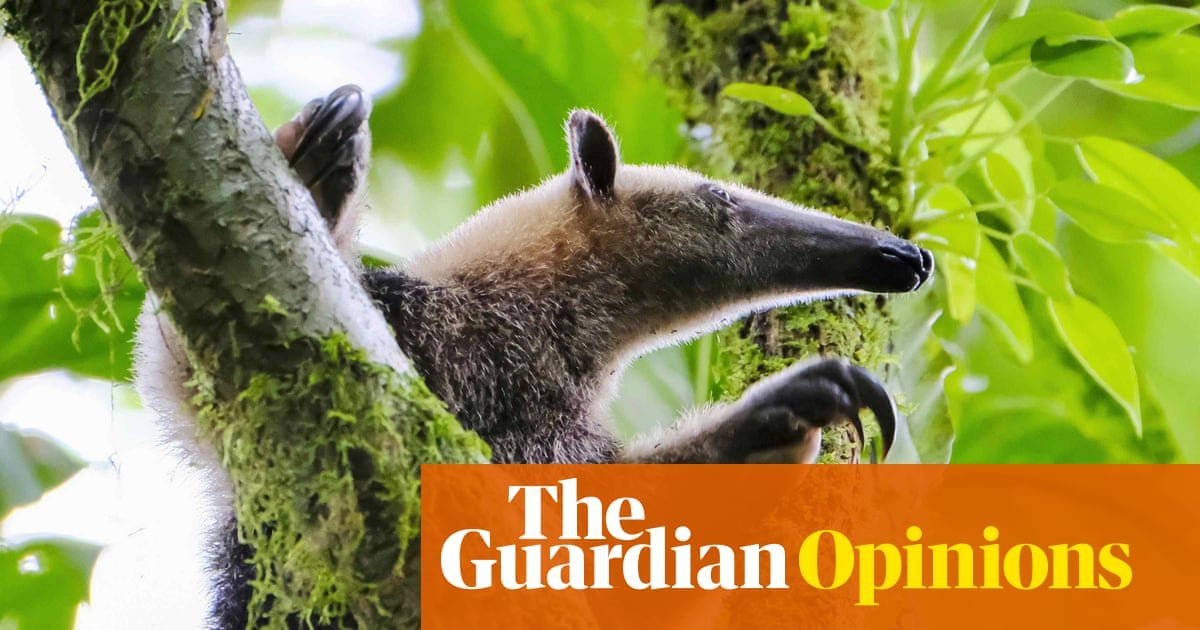
Who doesn’t love an anteater? I mean, apart from ants, obviously. With their long snouts and even longer sticky tongues, they trundle around, slurping up insects like milkshakes. They have handsome, bushy tails, which they wrap around themselves at night like a blanket. And they’re excellent parents. Giant anteater mothers allow their young to cling to their backs, rucksack-style, for periods of up to a year.
Indeed, the surrealist artist Salvador Dalí was so taken with the giant anteater that he once took one for a walk through the streets of Paris. And before you ask, no, this wasn’t a cheese dream. There is photographic evidence.
As if that weren’t enough, a recent study published in the journal Evolution has found that mammals have evolved into anteaters not once, not twice, but 12 times since the demise of the dinosaurs some 66m years ago. Anteaters, it seems, are a recurring trend. The finding prompted the study’s lead author, Thomas Vida from the University of Bonn, to tell Science magazine: “Things keep evolving into anteaters, somehow.” Which raises the question: will humans one day follow suit?
By “things”, Vida means mammals, and by “anteaters” he includes the four species of anteater from Central and South America, the pangolins and aardvarks of Africa and Asia, and the echidnas of Australia. Different animals, on different continents, that all practice myrmecophagy, also known as the consumption of termites and ants. If you were a parent of young children, you’d call them fussy eaters. If you were an evolutionary biologist, however, you’d point out that they’re not being deliberately difficult. Instead, they have evolved to fill a very particular ecological niche.
That niche is provided by the world’s extensive population of ants and termites, some 15,000 species, whose collective biomass is more than 10 times greater than that of all wild mammals. At least a dozen times in evolutionary history, mammals decided that if you can’t beat them, eat them, and began to consume the crunchy delicacy.
Such an abundant food source can act as what biologists call a “selective pressure”. Characteristics that enabled animals to eat more ants and termites – and thus survive better – are more likely to be passed on. Over millions of years, animals from all three major groups of mammal life, including marsupials and the egg-laying monotremes, evolved to have long, sticky tongues, reduced or missing teeth and strong forelimbs for busting into insect nests.
It’s a powerful example of convergent evolution, the phenomenon by which different species, in different places or times, independently evolve similar characteristics. Faced with the same problem – how do I eat these ants? – they all arrived at a similar solution. So, though they’re not closely related, they possess features that are superficially similar.
Convergent evolution is how echolocation (the ability to determine the location of objects using reflected sound) evolved separately in bats and dolphins, camera-like eyes evolved in octopuses and vertebrates, and opposable digits evolved in primates, koalas and chameleons. Powered flight has evolved independently at least four times – in birds, bats, pterosaurs and insects – and venom production more than 100 times, while crustaceans have evolved the classic, crab-like body plan at least five times. Known as carcinisation, it has spawned crabby memes aplenty.
The evolutionary biologist Simon Conway Morris has used convergent evolution to argue that evolution is both deterministic and predictable. Rewind the tape of life, play it over again and similar-looking lifeforms would evolve, he says.
This means that in theory, with enough time (many tens of millions of years), the appearance and retention of the requisite genetic mutations and, critically, the same selective pressures that shaped the emergence of former ant-eating animals, some mammals – including maybe us – could evolve gummy mouths and sticky tongues. Forget the history books, it’s the cookery books that would be rewritten.
Only there’s a fly in the ointment. We’re wrong to presume that because myrmecophagy has evolved multiple times, it is the pinnacle of some evolutionary tree. There are, after all, many more mammals that have not evolved into anteaters than have started breaking into termite mounds. The fact that convergent evolution occurs does not necessarily make it the default pathway.
In addition, evolution has a way of pulling the rug. It can be predictable, but it can also be quirky and erratic. In his 1989 book, Wonderful Life, another titan of evolutionary biology, Stephen Jay Gould, argued for the importance of random events. These can be anything from lightning strikes to asteroid impacts: any unforeseen occurrence that derails the prevailing trajectory of evolution and sends it along a different path. In other words, “sliding doors” moments that have been influencing evolution for as long as there has been life on Earth.
So, just because things kept “evolving into anteaters” in the past, doesn’t mean that history will repeat itself. Which is a shame. Anteaters and aardvarks don’t typically eat all of the ants or termites in a nest, but leave some behind so the colony can rebuild itself. This makes them the epitome of sustainable living. If we can’t evolve into them, we can at least learn from them.
