

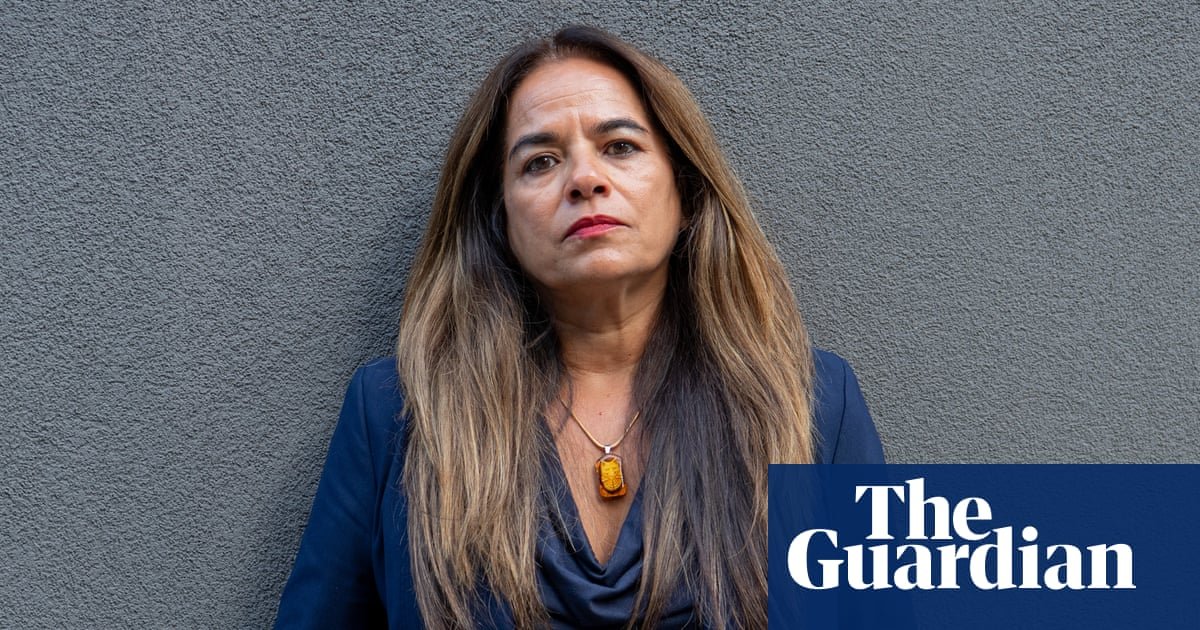
Pia Sinha has led the Prison Reform Trust since 2023. In that time, she has seen a Conservative government finally admit to an overcrowding crisis that had tipped over the edge. (It was in October 2023 that the early release scheme was devised; by May 2024, the Tories had also launched Operation Safeguard, using police cells as temporary housing.) She’s watched a change of government, then a change of prime minister, then Andy Burnham instantly assailed by negative headlines as the consequences of that early release scheme unfolded: prisoners had to actually be released early. “We’re a bit concerned about how [Burnham] has handled it,” she says, in the trust’s scruffy, un-corporate offices in central London, “but that’s in the knowledge that he had a bit of a hospital pass.”
To recap on Burnham’s handling: when he came in in July, he paused the scheme for an urgent review; in August he announced a series of exclusions, further crimes for which people couldn’t be released early, including manslaughter and death by dangerous driving. That solved an immediate problem, that the killers of PC Andrew Harper would otherwise have been released, but had the knock-on effect of reducing the numbers expected to be released by about a quarter. The conversation Sinha wants to have is what prison overcrowding looks like, what it does to prisoners and staff – and what it means for society.
Now 53, Sinha arrived in the UK from India with her parents, aged 14. “I think that’s part of the reason I can adapt from one prison to another: I had to learn how to survive and cope, you become very good at reading your environment,” she says, smiling at the implication that the teenagers of north Harrow, circa 1987, were not unlike a prison population. She studied psychology and economics, went on to do a masters in counselling psychology, and was running a pub in north London when she got a job at Holloway, the now defunct women’s prison. When she got her first prison governorship 14 years later, of the open prison Thorn Cross, she was very unusual – not just because she was the first Asian female prison governor, but also for her manner, which is sunny, personable, enquiring and receptive.
Prison governors – the women as well as the men – often construct a quasi-military persona to indicate that their word is final, and it’s easy to assume that is how it has to be done, since someone’s word has to be. That’s not Sinha’s style at all. But she was unusual from the start, since she came into prison work as a counselling psychologist, to support the prisoners themselves.
Traditionally psychologists were forensic: they saw their job as addressing the offending behaviour, with the aim of protecting the public. In 1999, after a spate of self-harm incidents and suicides, the service had started to ask: “How do you get these women out of their crises? How do you get them to not be so suicidal?”
‘I can adapt from one prison to another’ … Sinha at HMP Wandsworth in 2007. Photograph: Martin Godwin/The Guardian
She stayed at Holloway for five years, and it was rewarding work. The forensic and the counselling strands of psychology turned out to be complementary because – who could have foreseen? – it turned out: “You can’t actually do any meaningful work with people unless they are stable.”
A lot of people argue that incarceration per se is unjust to women, since they’re often victims of crimes that are worse than anything they’ve committed, and the stress of it on mothers, unable to care for their children and not necessarily trusting whoever is caring for them, is unbearable. But Sinha isn’t someone who thinks that women don’t belong in prison at all. “I don’t want to slip into describing all women as victims, because that’s often not the case. Women are capable of causing serious harm. Being in prison is an opportunity to look at the harm they’ve caused and get the insight that they need. I’ve seen it work. There are many women who will say that prison was the best thing that happened to them.”
The problem with prisons is that, whatever improvements are made, they’re still part of society and change with it. Nowhere is this more clearly demonstrated than in the women’s estate, where things really did get a lot better at the turn of this century, only to get a lot worse after austerity.
The use of force in the women’s estate has increased dramatically, which seems absolutely extraordinary. And more extraordinary still, as Sinha explains it, this is partly because prisons are often seen as a place of refuge: “Women go through the court process, presenting as really complex, with multiple unmet needs, and they need somewhere they can be safe. Whatever crime they’ve committed, there would need to be somewhere in the community that gives the judiciary some assurance that if they go back home, they won’t be going into more abuse; that their mental health or addictions can be addressed. The default position in many minds is that prison is safer. Prisons have become really good at coping with complexity.”
However, she says, “Women end up in prison and then get hugely triggered by the environment, which creates strong urges to self-harm or commit suicide. Staff are completely overwhelmed by the depth of complexity, so force is often used to try to stop women from harming themselves, which feels crazy.”
‘It made me cry’ … Liverpool prison. Photograph: Andrew Aitchison/Corbis/Getty Images
What about transgender prisoners? There has been much debate over where they should be held, but Sinha is quite reserved on the issue. “It’s a pressing issue only when it goes wrong, and this is just what happens in prisons. Everything trundles along fine, and then something really horrendous happens and then you have to take a policy position. Prisons are fundamentally all shades of grey. But policy has to be black and white.”
After Holloway, Sinha went to Wandsworth in 2004, during which time governor Ian Mulholland was trying to turn it around, from one of the most degraded prisons in Britain (a huge population, dilapidated, vermin-infested buildings, a febrile, lawless atmosphere) to one of the country’s success stories (though by 2024, per that point about prisons mirroring society, it was a story of yet more failure, with the high-profile escape of Daniel Khalife triggering an inspection that revealed conditions so appalling that the governor, Katie Price, resigned).
After leaving Wandsworth in 2009, Sinha did stints at Wormwood Scrubs, Send and Downview, among others. She arrived at Thorn Cross in Cheshire in 2013, just as the scandal broke that armed robber Michael Wheatley (AKA the Skullcracker) had absconded from a different open prison and immediately raided a building society. “Then there was another high-profile abscond,” she remembers. You can hear her 27 years in the service when she uses the jargon: “abscond” as a noun; “ROTL” for release on temporary licence. “The public didn’t realise, really, that open prisons existed, and that even quite notorious criminals might be ending their sentence in one.” This was where she got her reputation as a fixer, someone who could turn a crisis around, and that’s how she arrived at Liverpool prison.
double quotation markA prisoner would be asked: ‘Do you want a cell with lights or one with windows?’
This was 2017, and what was happening at Liverpool was “symptomatic of what was happening in prisons up and down the country,” she says. “It just got hit first.” It was a crumbling Victorian local prison, that was falling apart. “The estate contract had just been privatised, and grossly underfunded. They weren’t getting to any of the repair jobs, so it was literally breaking. The overcrowding wasn’t quite at the scale and magnitude of the crisis now, but every space mattered. And people were being put in cells that were disgusting. Every window broken. No plumbing, no heating, mould. Dickensian. It became a bit of a joke to staff. A prisoner would come in through reception, and officers would say: ‘Do you want a cell with lights or do you want a cell with windows? Do you want a cell that’s got mould or do you want a cell that has electricity?’ As a joke.” She is still audibly enraged.
“It was full of rats and cockroaches. Honestly, it made me cry when I went there. The inspector had written about a prisoner sitting with this vacant look, in a dark room without electricity, with the smell of mould, a broken window – mentally unwell. And the nail in the coffin was that when the inspector asked senior leaders, ‘How are you presiding over this? What do you think of the state of it?’ they said: ‘It’s going quite well.’”
The story of how Sinha remade Liverpool prison – getting prisoners involved in the refurbishment, fixing the electricity so that everyone could have a kettle, building partnerships with charities, universities, businesses, everyone she could find outside the jail – is a painstaking one, but it all started because the crisis was so bad that the head of the Prison Service, Michael Spurr, let Sinha cut capacity. Not every problem in a prison is down to overcrowding, but there’s almost nothing you can fix until you’ve fixed that.
Certain activities, such as 45 minutes’ exercise a day, are mandated, but an overcrowded prison is understaffed by definition, so it could take the prison officers the full day just to get everyone into the yard, one wing at a time, which means prisoners spend the other 23 hours locked in a cell. It wrecks morale, Sinha says, because “whether you go in as a prison officer or a psychologist, if you’re public spirited, you want to do a good job. But if really all you’re doing is banging people up, you start thinking: ‘I don’t want this job. This is shit.’”
‘The public didn’t realise that open prisons existed and notorious criminals might be ending their sentence in one’ … Michael Wheatley arrives at court in 2014. Photograph: PA Video/PA
When the right people leave the service and the wrong people stay, you get a lot of corruption. The range and scale of crimes committed by staff last year was staggering: one prison governor was convicted of having a relationship with an inmate; one prison health worker smuggled in drugs with a value of £1m to a single jail. You also get areas and corridors where prison officers won’t go. In Liverpool, Sinha asked an academic to see if there were any no-go areas, and she said: “Not yet, but there’s a risk, especially on the fives.” She meant the fifth floor of each wing, the reason being that overstretched officers don’t have time to go up five flights of stairs. “Nobody wants that. Prisoners don’t want their jails to be like that. In the end, you want a peaceful life as a human being, no matter where you are.
“The real underbelly of it,” Sinha continues, “is that if you lose control of the prison it falls into the hands of really sophisticated organised criminals, running quite successful, profitable businesses.” Phones and drugs are dropped in by drone; there’s a large captive market of bored, impulsive people (some of these conditions are modern, some timeless). And the prisoners running these empires? “They’re your good lads. They’re respectful. They keep their noses clean. They’re not really in trouble, and they are in plain sight. I don’t want to mince my words. This situation is very dangerous. When prisoners are controlling the prison as opposed to the staff, who protects the vast majority of prisoners? There are vulnerable prisoners whose only source of security is another prisoner. Staff are scared as well. I’m not saying this is everywhere, but it is a lot of places.”
Regularly, now, HMIP (his majesty’s inspectorate of prisons) warns of serious failings, “and HMIP is good – it’s independent,” Sinha says. But it can’t magic away the reality, “which is that standards are irrelevant if there are too many prisoners and not enough staff. The whole legitimacy of the inspectorate pivots on their standards being attainable.”
In this era, “the noise in the political system is all that prisoners need to be punished. When you’re saying, ‘Prisons should be decent’, you’re screaming into the void,” Sinha says. But she can’t stop making the case for reform, because the situation as it stands is absurd. It’s not just that overcrowded prisons can’t rehabilitate prisoners. It’s not even solely a humanitarian case, that conditions in many prisons aren’t defensible. It’s simply a fact that some prisons are in such chaos that they’ve become temples and academies of further crime. “So what’s the outcome for future victims?” Sinha asks. “You might be able to satisfy current victims with harsh policies, but what happens to the victims of the future?”
Do you have an opinion on the issues raised in this article? If you would like to submit a response of up to 300 words by email to be considered for publication in our letters section, please click here
