

The beginning: a single thread
AsingleThread-2 Illustration: Claire Harrup/The GuardianAsingleThread-Pink Illustration: Claire Harrup/The Guardian
The story starts with a single thread of polyester, dislodged from the weave of a cheap, pink acrylic jumper as it spins around a washing machine. This load of washing will shed hundreds of thousands of tiny plastic fragments and threads – up to 700,000 in this one washing machine cycle.
Along with billions of other microscopic, synthetic fibres, our thread travels through household wastewater pipes. Often, it ends up as sewage sludge, being spread on a farmer’s field to help crops grow. Sludge is used as organic fertiliser across the US and Europe, inadvertently turning the soil into a huge global reservoir of microplastics. One wastewater treatment plant in Wales found 1% of the weight of sewage sludge was plastic.
From here, it works its way up the food chain through insects, birds, mammals and even humans. Perhaps our jumper’s life as a garment will end soon, lasting only a few outings before it emerges from the wash shrunken and bobbling, to be discarded. But our thread’s life will be long. It might have only been part of a jumper for a few weeks, but it could voyage around the natural world for centuries.
Into the world of soil and worms
LifeInTheSoil-2 Illustration: Claire Harrup/The GuardianLifeInTheSoil-Pink Illustration: Claire Harrup/The Guardian
Spread on the fields as water or sludge, our tiny fibre weaves its way into the fabric of soil ecosystems. A worm living under a wheat field burrows its way through the soil, mistaking the thread for a bit of old leaf or root. The worm consumes it – but cannot process it like ordinary organic matter.
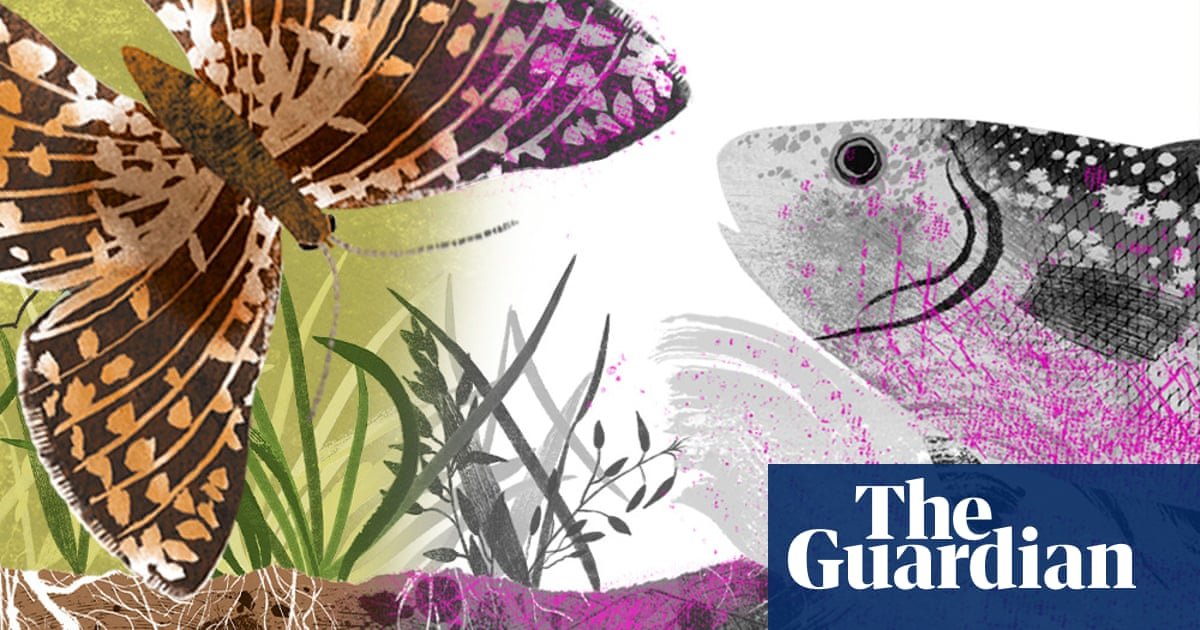
The worm joins nearly one in three earthworms that contain plastic, according to a study published in April, as well as a quarter of slugs and snails that ingest plastic as they graze across soil. Caterpillars of peacock, powder blue and red admiral butterflies all contain plastic too, perhaps from feeding on leaves contaminated with it, research shows.
With the plastic in its gut, the burrowing earthworm will find it more difficult to digest nutrients, and is likely to start shedding weight. The damage might not be visible but for insects, eating plastic has been linked to stunted growth, reduced fertility and problems with the liver, kidney and stomach. Even some of the tiniest lifeforms in our soil, such as mites and nematodes – which help maintain the fertility of land – are negatively affected by plastic.
Plastic pollution in the marine environment has been widely documented, but a UN report found soil contains more microplastic pollution than the oceans. This matters not only for the health of soils, but because creepy crawlies such as beetles, slugs and snails form the building blocks of food chains. Our worm is now enabling this plastic fibre to become an international traveller.
Up the food chain, into mammals and birds
BirdandMammals-Final Illustration: Claire Harrup/The GuardianBirdandMammals-Pink Illustration: Claire Harrup/The Guardian
In a suburban garden, a hedgehog snuffles through a dozen invertebrates in a night, consuming plastic fibres within them as it goes. One of them is our worm.
A study that looked at the faeces of seven hedgehogs, found four of them contained plastics, one of which contained 12 fibres of polyester, some of which were pink. If hedgehogs don’t live in your country, substitute another small, scurrying mammal or bird: the same study found mice, voles and rats were also eating plastic, either directly or via contaminated prey.
Birds that eat insects such as swifts, thrushes and blackbirds are also ingesting plastic via their prey. A study earlier this year found for the first time that birds have microplastics in their lungs because they are inhaling them too. “Microplastics are now ubiquitous at every level of the food web,” says Prof Fiona Mathews, environmental biologist at the University of Sussex. The meat, milk and blood of farm animals also contain microplastics.
At the top of the food chain, humans consume at least 50,000 microplastic particles a year. They are in our food, water, and the air we breathe. Fragments of plastic have been found in blood, semen, lungs, breast milk, bone marrow, placenta, testicles and the brain.
Washing into rivers and blowing in the wind
Water,Soil,Air-2 Illustration: Claire Harrup/The GuardianWater, Soil, Air-Pink Illustration: Claire Harrup/The Guardian
Even as it makes its way up the animal food chain, our polyester fibre has not been broken down. At some point, the thread returns to the dirt when the creature that consumed its host dies, and a new adventure starts. The body will decay, but the polyester fibre will endure. Once in the soil, it is ploughed in by the farmer before crops are sown. But it may not stay there for long – strong winds blow the dry, degraded soil into the air, taking with it a pink fragment of plastic. In heavy rain, the fibre could be swept into a river flowing to the sea: a major source of marine contamination is run-off from land.
This process of moving through natural systems over years has been called “plastic spiralling”. Scientists have found that microplastics equivalent to 300m plastic water bottles have rained down on the Grand Canyon, Joshua Tree and other US national parks. Even the most remote places are contaminated. One scientist found 12,000 microplastic particles a litre in samples of Arctic sea ice, swept there by ocean currents and blown in by the wind.
Infiltrating plants, flowers and crops
Plants-2 Illustration: Claire Harrup/The GuardianPlants-Pink Illustration: Claire Harrup/The Guardian
With the passage of time, our plastic thread has still not rotted, but has broken into fragments, leaving tiny pieces of itself in the air, water and soil. Over the course of years, it could become so small that it infiltrates the root cell wall of a plant as it sucks up nutrients from the soil. Nanoplastics have been found in the leaves and fruits of plants and, once inside, they can affect the plant’s ability to photosynthesise, research suggests. Here, inside the microscopic systems of the plant, the bits of our pink fibre cause all kinds of havoc – blocking nutrient and water channels, harming cells and releasing toxic chemicals. Staples such as wheat, rice and lettuce have been shown to contain plastic, which is one way they enter the human food chain.
Eight billion tonnes of plastic and counting
SourcesOfPlastic-2 Illustration: Claire Harrup/The GuardianSourcesOfPlastic-Pink Illustration: Claire Harrup/The Guardian
From its humble beginnings, our fibre may have journeyed around the world, shedding bits of itself along the way, and working its way into almost every layer of different ecosystems and the far reaches of the natural world. Extracting it once it begins that journey is extremely difficult. The best way to prevent its spread is to stop it at the outset – before the worm, before the soil, before the washing machine, even before the jumper is made.
Since the 1950s, humans have produced in excess of 8.3bn tonnes of plastic – equivalent to the weight of one billion elephants. It finds its way into packaging, textiles, agricultural materials and consumer goods. Opting to live without it is almost impossible.
Fast fashion companies, drinks giants, supermarket chains and big agricultural companies have failed to take responsibility for the damage this has caused, says Emily Thrift, who researches plastic in the environment at the University of Sussex. She says individual consumers can reduce their consumption but should not feel that this is entirely their responsibility. “If you do make this level of waste, there needs to be some form of penalisation for doing it,” she says. “I truly believe until there is policy and ways to hold big corporations accountable, I don’t see it changing much.”
