

This article was produced for ProPublica’s Local Reporting Network in partnership with Capital & Main, a 2022-2023 LRN partner. Sign up for Dispatches to get our stories in your inbox every week.
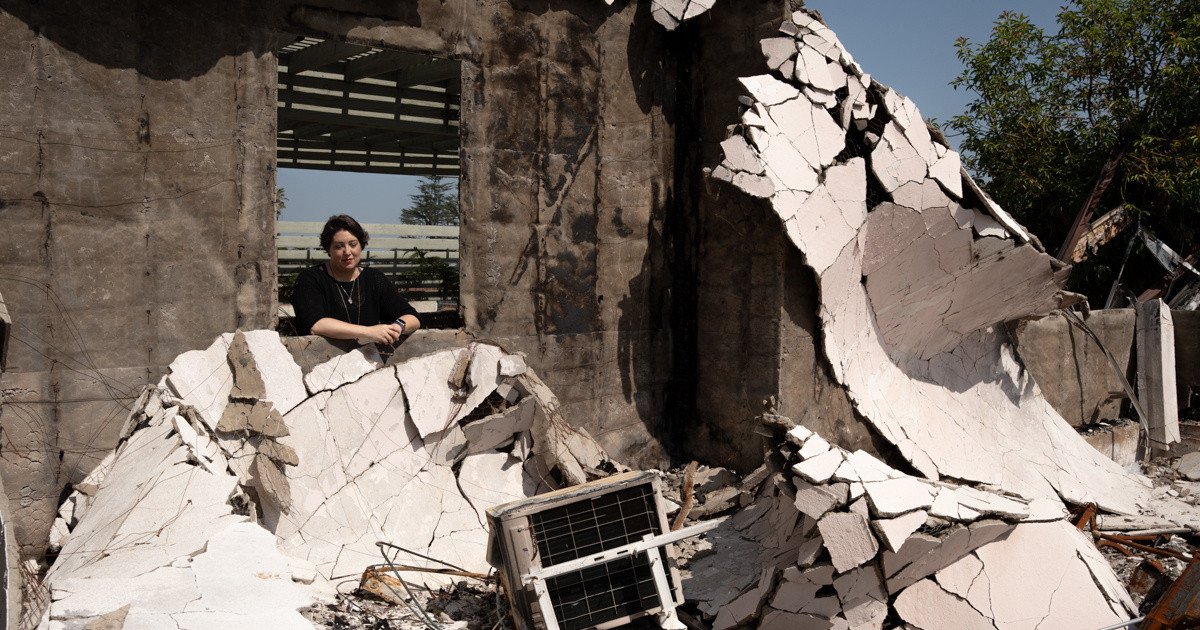
In January, Katie Clark’s one-bedroom rental of more than 15 years, and nearly everything inside, was incinerated by Los Angeles County’s Eaton fire, one of the most destructive wildfires in California history. For her troubles, she received a one-time payment of $770 from the Federal Emergency Management Agency, which she used to replace clothes, food and a crate for her dog. While it was only a fraction of what she needed, the money was at least available while she waited for other funding.
As an organizer with the Altadena Tenants Union who has been helping renters with their FEMA applications, Clark knows just how common her experience has been for fire survivors. She believes federal and local agencies severely underestimated the need and cost of housing for the 150,000 people displaced by the fires, leaving many still struggling to recover. A FEMA spokesperson denied the accusation, saying the agency’s “ongoing assessments indicate that the current Rental Assistance program is effectively meeting the housing needs of survivors eligible for FEMA assistance.”
The disaster response “has been so shockingly bad,” Clark said, but she recognizes that without FEMA’s help in responding to fires that killed at least 30 people and destroyed more than 16,000 structures, “it could have been so, so, so much worse.”
“We would have seen a whole lot more people left to their own devices. And what that would mean is homelessness. It would mean people just abandoned,” Clark said.
Even before President Donald Trump and Gov. Gavin Newsom squared off over Trump’s decision to send National Guard troops to quell immigration protests, before Newsom likened Trump to a dictator and Trump endorsed the idea of arresting the governor, the question of how much California could continue to rely on FEMA was front and center.
It’s a critical question in a state — with its earthquakes, wildfires, floods, drought and extreme heat — that frequently suffers some of the costliest disasters in the country.
Since Trump’s inauguration, his administration has floated sweeping proposals that would slash FEMA dollars and make disasters harder to declare. This has left both blue and red states wrestling with scenarios in which they must pay for what FEMA will not. States have long counted on FEMA to cover at least 75% of declared major disaster response and recovery costs.
In just the past few months, FEMA has denied federal assistance for devastating floods in West Virginia and a destructive windstorm in Washington. The agency approved such funding for deadly tornadoes in Arkansas after Gov. Sarah Huckabee Sanders appealed an initial denial and personally begged the president for help.
Last month, ProPublica reported that FEMA missed a May deadline to open the application process for many grants, including funding that states rely on to pay for basic emergency management operations. The delay, which the agency has not explained, appears to have little precedent.
In California, Trump has cast doubt on whether he will approve the $40 billion Newsom has requested to help pay for recovery costs associated with the fires, including $16.8 billion from FEMA to rebuild property, infrastructure and remove debris. That’s on top of the almost $140 million the agency has already provided to individual survivors.
The president told reporters last month that states need to be weaned off FEMA and that the federal government will start distributing less federal aid after hurricane season ends in November.
The questions now are: How much will be approved? Will it be enough? And, if not, what then?
A FEMA spokesperson did not directly respond to questions from Capital & Main about anticipated funding cuts and potential impacts on state and local communities, but said the agency “asserts that disasters are best managed when they’re federally supported, state managed and locally executed.”
The uncertainty makes it “very hard” to plan, said Heather Gonzalez, principal fiscal and policy analyst for emergency services at California’s Legislative Analyst’s Office. “The little bean-counters in the back are stressing out right now trying to figure out ‘what are we going to have to work with?’”
The recent “dust-ups” between Newsom and Trump, she said, have only underscored the unpredictability. For his part, Newsom said he prefers the “open hand” of cooperation over the “closed fist” of fighting when it comes to disaster response.
“Emergency preparedness and emergency planning, recovery and renewal — period, full stop — that should be nonpolitical,” he said on Monday, which marked six months since the fires.
A firefighter battles a blaze in Altadena during the Eaton Fire.
Credit:
Jeremy Lindenfeld/Capital & Main
The Rising Cost of Disasters
Since at least the 1980s, California has endured a rapidly growing number of billion-dollar disasters, with 18 occurring between 2015 and 2024 alone.
As the frequency and severity of California’s disasters increase, so too does its reliance on federal assistance to respond. In the aftermath of January’s Eaton and Palisades fires — the second and third most destructive wildfires in California history, respectively — FEMA has already provided $139 million for everything from home repair costs to medical expenses, and the agency “has allocated billions of dollars for debris removal,” according to a FEMA spokesperson. Over 5,000 properties have already been cleared of ash and fire debris.
The ruins of a bank that was destroyed in the Palisades Fire in Pacific Palisades. The wildfire was the third most destructive in California history.
Credit:
Sarahbeth Maney/ProPublica
Los Angeles County Office of Emergency Management Communications Director Emily Montanez said recovery efforts for the fires likely won’t be complete for many years and are heavily dependent on FEMA.
“After the Northridge earthquake in 1994, FEMA had field offices here for 28 years,” Montanez said. “We see this as being no different. This was way more devastation, way more impact. So this could be years, definitely decades.”
While Montanez acknowledged that potential “gaps” in disaster response efforts leave some survivors without sufficient resources, she said that the recent operations coordinated between FEMA and local agencies in Los Angeles have mostly been efficient and successful.
FEMA’s federal assistance supplements California’s own disaster response and mitigation resources like those allocated to the Governor’s Office of Emergency Services, which was allotted $4.4 billion in the May revision of the state’s 2025-26 budget. When the office’s funding does not cover all disaster costs, California can also pull from a number of its reserves, including the Budget Stabilization Account and Special Fund for Economic Uncertainties.
Newsom told Capital & Main on Monday that the state has increased its discretionary reserves as a direct consequence of Trump’s ongoing threats to FEMA, though he admitted that even that increased investment wouldn’t make up for the potential loss in federal funding.
California “can’t backfill the elimination of FEMA,” Newsom said. “There’s no state in America [that can], even the most endowed state — $4.1 trillion a year economy — largest in the nation, fourth largest in the world.”
And California’s $12 billion budget deficit will make backfilling the office’s shortfall especially difficult the next time a major disaster strikes, according to Laurie Schoeman, senior adviser on climate resilience to former President Joe Biden.
That will be made even harder if the still-unfinalized proposals outlined in an internal FEMA memo are implemented, according to Schoeman. One of the reforms floated in the memo caps the proportion of recovery costs covered by the federal government at the current baseline of 75%. Under current rules, the president can increase FEMA’s cost share up to 100%, as Biden did for the Los Angeles fires less than two weeks before he left office.
Another proposal quadruples the amount of damage that needs to be suffered in a disaster before FEMA awards any public assistance grants for infrastructure repair and debris removal. That would hike California’s damage threshold from roughly $75 million to nearly $300 million per disaster.
Trump’s First EPA Promised to Crack Down on Forever Chemicals. His Second EPA Is Pulling Back.
Had just that second reform been in place between 2008 and 2024, California would have received 26% less in public assistance funding from FEMA, a loss of nearly $2 billion, according to a May analysis by the Urban Institute, a Washington, D.C.-based think tank.
Such reduced funding during future events would cause an “apocalyptic scenario” where California communities would struggle to afford the cost of running shelters and paying for emergency responders to rescue disaster victims, according to Sarah Labowitz, a senior fellow in the Sustainability, Climate, and Geopolitics Program at the Carnegie Endowment for International Peace.
Yet already, significant damage has been done, Schoeman said.
In April, the Trump administration canceled the Building Resilient Infrastructure and Communities program, a FEMA initiative dedicated to funding disaster-preparedness projects. Over $880 million in federal funding was rescinded, including a $35 million grant in California’s Napa County largely dedicated to wildfire prevention work. The administration declined to respond to Capital & Main’s request for comment, referring questions to FEMA. An agency spokesperson said that its approach to disaster preparedness mirrors that of disaster response: FEMA will play a supporting role.
“All types of preparedness start with families, individuals and local and state officials ahead of any emergency and disaster,” a statement from the agency said.
The rescinded federal funding risks undermining communities’ abilities to protect against future disasters, Schoeman said, and undoes work accomplished under Trump’s first term.
“They’re just cutting these projects even though they have proven benefit cost analyses in place,” Schoeman said. “The BRIC program was started under the Trump administration … so it feels like the administration is going to cut their own leg off.”
Smoke drifts over Will Rogers State Beach and the Pacific Ocean during the Palisades Fire.
Credit:
Jeremy Lindenfeld/Capital & Main
Clark said she is already struggling to get help. She said her insurance provider has so far withheld over $25,000 due to disagreements over whether her transitional housing qualifies as temporary, and her applications for additional FEMA assistance have been denied due to her technically being insured. Some wealthier survivors had “the insulation and resiliency that economic resources give you,” while others had to depend on nonprofits or the kind of government assistance that is now at risk to afford transitional housing.
“If you don’t have those economic resources, your only option is to turn to either philanthropy or the state,” Clark said. “If neither of those are available, then tough luck.”
