

Eight police officers linger with their backs to the two-hectare (five-acre) site known as Stocamine. The place is nondescript in the morning drizzle: two mine shafts, some modern-looking office buildings, a staff car park, lines of landscaped trees. The reason for the police presence, however, is what lies beneath: 42,000 tonnes of toxic waste stored under our feet.
Stocamine, which lies in the old industrial town of Wittelsheim, Alsace, once held an old potash mine. Now, the mine shafts are closed, storing poisonous waste from elsewhere. Above the mine shafts is one of Europe’s largest aquifers.
Some fear this toxic waste won’t stay sealed in the mine. In time, scientists say it could seep into the Alsace aquifer, which feeds into the Upper Rhine aquifer running between France, Switzerland and Germany, potentially contaminating the drinking water of millions of people. Contained in the mine are substances that have been linked to mass die-offs in wildlife, which could have severe and longlasting effects on ecosystems.
On 17 June, a judge upheld the decision of the government and ruled the waste should stay and be smothered in tonnes of concrete to avoid it leaking out. Those campaigning for it to be removed have called the decision “a timebomb for future generations”.
Today, the main visitors are 30 cyclists in plastic ponchos, with a couple of children and support vehicles in tow. They have come to protest, but only last a short while in the rain before leaving.
Campaigners have protested regularly at the site since the 1980s. Photograph: Stefan Pangritz/The Guardian
“It’s rare the police aren’t here,” says Yann Flory, a retired sports teacher who campaigns against leaving waste in the mine and has organised more than 20 demonstrations since 1989.
Flory started fighting against the mine because he had small children. Now he is doing it for his grandchildren. “It won’t be for tomorrow. Maybe I won’t be impacted any more. I’m too old. But my children, my grandchildren, surely they will,” he says. “We are convinced that one day or another, the water we drink will be irreversibly polluted.”
An ‘eternal grave’ for waste
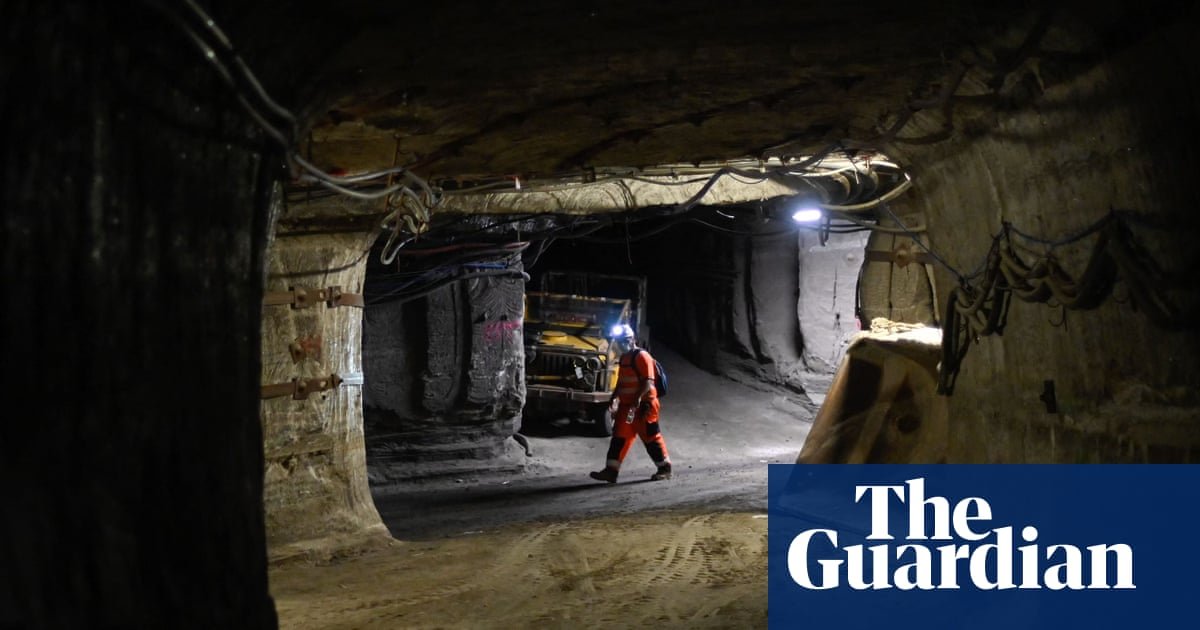
The aquifer sits 5 metres below the surface. Down another 500 metres through striped pink and white rock is the old potash mine, containing 125km of tunnels. A space the size of seven football pitches contains mercury, arsenic and other heavy metals as well as cyanide and residues from household waste incinerators. Reports suggest additional illegal waste may be hidden down there too.
The plan to store waste in the tunnels was originally sold as a life-line for former miners, providing them with continued employment. Photograph: Sébastien Bozon/AFP/Getty Images
Over the years, authorities and waste producers around the world have used former mines as “safe” eternal graves for toxic waste – out of sight, out of mind. But the rock here is in motion, subsiding under pressure from neighbouring mines, corroding in 30C heat. Ceilings are sagging and walls are caving in at a rate of 2cm a year. There are concerns some of the containers of waste are not accessible – or won’t be for much longer.
We hoped we would find a solution to treat this waste and recycle it. But work on this never saw the light of dayJean-Pierre Hecht
Projections vary, but research suggests that over the next 300 years water will gradually flood the mine. Some scientists say it is possible to seal the pits and delay the release of contamination – or even stop it altogether. Other scientists argue that the only thing to ensure the safety of future generations is to remove the waste, which could cost about €65m (£55m).
The government has chosen to inject tonnes of concrete into the galleries and backfill shafts to make them watertight, leaving the waste down there permanently. Environmental groups believe this is reckless, given the uncertainty over shifting rock.
A photograph taken at the bottom of one of the mine shafts in 2016. Water has still managed to enter despite the shaft being concreted and backfilled.
Even in low quantities, heavy metals in water have been linked to a series of health problems such as cancer, neurological conditions and kidney damage, and can accumulate in the body over time.
The prospect of a leak also has significant consequences for wildlife living in rivers and wetlands fed by the aquifer. In aquatic life similar impacts including neurological issues and developmental deformities have been documented, with researchers saying waste leakage globally poses an “enormous threat” to biodiversity. More cases are being documented of pollution leaching from landfill into water systems and contaminating soils, threatening ecosystems. Cyanide – one of the most toxic substances present in Stocamine – is extremely dangerous to river ecosystems, and has been linked to mass fish deaths and dead zones.
Alsace Nature took the case to the European court of human rights, arguing that leaving the waste where it was posed a risk to public health. On 17 June, the court ruled that the waste could stay, saying deterioration of the galleries had already made removal dangerous.
Miners ‘betrayed’
At the protest is one of the men who put some of the toxic waste in there in the first place: Jean-Pierre Hecht, who grew up in the town of Wittelsheim, known officially as a ville fleurie or “floral city” but informally as “the garbage commune”. Hecht started mining in 1982 when he was 20 years old. After long shifts he would hang his mining uniform on hook 366, proud of his work. He enjoyed the camaraderie and the physicality of it. He finished his career in the same tunnels where his grandfather started his.
Campaigner Yann Flory, left, and former miner Jean-Pierre Hecht, who says he feels ‘betrayed’. Photograph: Stefan Pangritz/The Guardian
“Everyone worked in the mine,” says Hecht. Mining companies created towns, roads, churches, canteens and health services for their workers. Schools and sports clubs were provided for children. The company subsidised holidays by the sea or in the mountains. “What was good was that everyone was the same. There was no jealousy, everyone knew each other,” says Hecht. In the 80s there were 6,500 miners arriving here each morning. But even that was half the number who had worked here in the 60s, and through the 90s it continued to wane. “We were the last generation,” he says.
In 1997, the decision to store toxic waste in the mine was sold as a lifeline to miners: running a waste repository underground could provide them with continued employment. For years, officials reassured the public that the waste would only be stored down there for 30 years.
“We hoped that by storing the waste underground, we would find a solution to treat this waste and be able to recycle it in one way or another thanks to advances in technology. But work on this never saw the light of day,” says Hecht. Flyers distributed at the time described the project as “a mine to serve the environment”.
A classic car show takes place outside the mine, whose disused conveyor tower can be seen in the background. Photograph: Stefan Pangritz/The Guardian
More than 90 jobs were planned, but they did not materialise. In September 2002 a fire broke out below ground, burning for days and spewing out toxic fumes for months. The CEO at the time received a four-month suspended sentence and the facility was closed down, having created just 24 jobs. After liquidation in 2009, the French government became the sole shareholder of Mines de Potasse d’Alsace, which owns Stocamine, and declined to comment for this article.
We have to fundamentally change the way we deal with waste. We cannot dispose of it in the environment – it will come back.Marcos Buser
Many of the children of miners still live in Wittelsheim. Today, Hecht – once a supporter of the project – says: “Us former miners feel like we were betrayed.”
The mayor of Wittelsheim, Yves Goepfert. Photograph: Stefan Pangritz/The Guardian
When asked by journalists in 2022 what he would wish for the year ahead if he had a magic wand, the mayor of Wittelsheim, Yves Goepfert, said: “I’d get rid of Stocamine.” For Goepfert, leaving the waste in the mine was “the least bad solution that there is … For the moment.”
“I don’t have an alternative solution that is less harmful than this one,” he said. He said there needed to be more research to understand the hydrology of the area, and potential risks in terms of flooding scenarios, and how it could be made more stable. “There are plenty of hypotheses – as many hypotheses as specialists who come to have a look,” he said.
‘A burden for our dependents’
Subterranean landscapes are unpredictable and what is buried can resurface in other ways. Stocamine is destined to gradually flood over the coming centuries but much is unknown about what happens when water meets waste. Several salt and potash mines have collapsed due to contact with fresh water, causing landslides, subsidence and sinkholes above ground.
Dozens of hydrologists, geochemists and geologists have been pulled on to the Stocamine dossier to work it out. One is Marcos Buser, who first studied the case in 2010 when he was appointed by the French government as part of a steering committee.
Buser’s conclusion from the outset was clear – the waste can be removed and it should be done urgently. “It’s best to do it now and not to leave these things to future generations,” says the Swiss geologist, who is a specialist on toxic and nuclear waste.
The standard approach of burying waste underground and forgetting about it is flawed, says Buser, who describes the history of hazardous waste disposal in landfills as “a history of failures”. Containment measures often only last a few decades, and then it is expensive to remediate them.
An aeriel view of Stocamine. Photograph: Sébastien Bozon/AFP/Getty Images
Stocamine is more than just a technical issue – it is a moral one too, he says. “We have to fundamentally change the way we deal with waste. We cannot dispose of dangerous waste in the environment – it will come back,” says Buser, adding that we have to work towards a circular economy, not entomb mountains of waste. “We are just leaving this burden for our dependents.”
In the meantime, the European Community of Alsace will appeal against the government’s decision to seal up the waste in Stocamine with concrete. “We intend to systematically remind citizens and their elected officials that they have a timebomb ticking under their feet,” says Flory.
