

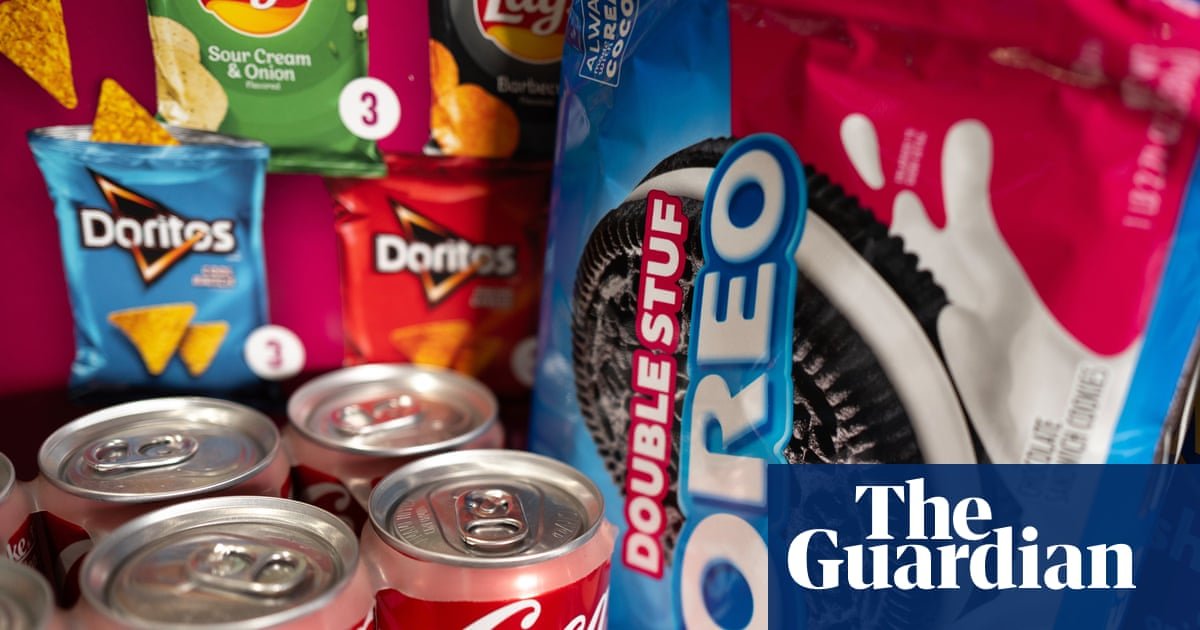
The world’s biggest ultra-processed food companies have filed scores of lawsuits challenging government policies that tackle junk diets, the Guardian can reveal.
Ultra-processed food (UPF) is linked to harm in every major organ system of the human body and poses a seismic threat to global health. Worldwide consumption is rising and UPF now makes up as much as half the average diet in many countries, including the UK, the US and Australia.
Governments around the world have adopted measures to fight back and safeguard the health of children and adults. Among the regulations are front-of-pack warning labels, marketing restrictions on unhealthy products to make them less alluring and taxes on junk food.
Publicly, the world’s biggest UPF companies insist they support the policies, are committed to helping consumers make informed choices and want to be part of the solution.
But an investigation by the Guardian, in collaboration with academics, the non-profit newsroom Lighthouse Reports and a coalition of media partners across four continents, found many of these same companies are taking governments to court to overturn, weaken or delay the policies.
In total, 235 lawsuits were lodged over health policies targeting UPF in Mexico, Colombia, Brazil, the US and the UK from 2010 to 2025, the investigation found.
It is not clear who is behind every lawsuit. However, three-quarters were filed by UPF manufacturers or trade associations representing them, the investigation found. Some of the corporations involved in the legal cases, which can be revealed for the first time, requested courts withhold their names.
Of the cases filed by companies where the plaintiff was identifiable, 38% were brought by eight parent corporations: Coca-Cola, PepsiCo, Mondelēz, Kellogg’s, Danone, Ferrero, Xignux and Heartland Food Products Group.
Dozens of cases are ongoing. Of those that have been resolved, three-quarters were lost by the food giants. But the length of some of the legal battles added up to almost 600 years in court, the investigation found.
Some of the ultimately unsuccessful lawsuits delayed the adoption of vital public health policies for years, while also tying up government and public health officials in complex and expensive litigation.
In the meantime, the lawsuits are prolonging the growing global public health crisis, and costing countries billions in legal and healthcare costs, experts say.
While governments are being sued over policies aimed at tackling unhealthy diets, the amount of UPF consumed continues to expand, contributing to rising cases of obesity, type 2 diabetes, heart disease, mental ill health and other conditions.
Marion Nestle, a professor of nutrition at New York University, accuses food manufacturers of using the tactics deployed by tobacco companies. Photograph: Neilson Barnard/Getty Images for New York Times
The world’s biggest UPF firms would “not fight so hard” if policies to curb intake of their products were ineffective, said Marion Nestle, a professor of nutrition, food studies and public health at New York University. “The lawsuits tell us that public health measures reduce sales of unhealthful products.”
While the majority of cases were eventually won by governments, experts said the intensive litigation by UPF companies suggested other objectives: slowing down the implementation of laws, limiting the desire and capacity of countries to enact other public health measures and chilling regulators.
The tactics mirrored those used by the tobacco industry for decades, Nestle said, adding: “Food companies are well trained. They follow the tobacco industry playbook to the letter. When all else fails, sue.”
Litigation by tobacco companies is well documented. They have repeatedly sued governments over laws mandating that colourful, branded cigarette packs be replaced with plain ones displaying prominent health warnings, including graphic pictures of rotting teeth, diseased organs and cancerous tumours.
Although the tobacco lawsuits were also mostly unsuccessful, they imposed huge stress, workloads and costs on governments trying to turn the tide on public health.
“The UPF industry appears to be adopting the same strategy,” said Phillip Baker, an associate professor at the University of Sydney who studies food systems and the rising global burden of UPF.
“The UPF industry and its affiliates have persistently challenged front-of-pack warning labels, marketing restrictions and taxation through the courts, concentrated in the years immediately following each policy’s adoption.
“That courts have upheld public health regulation in the large majority of resolved cases is an encouraging signal. But the continued volume of litigation, the years-long duration of some proceedings, and the opacity surrounding a substantial share of corporate plaintiffs together indicate that litigation functions as much as, if not more to delay, deter and constrain as to overturn.”
Get in touch
Contact Andrew Gregory about this story
If you have something to share about this story you can contact Andrew using one of the following methods:
Secure Messaging in the Guardian app
The Guardian app has a tool to send tips about stories. Messages are end to end encrypted and concealed within the routine activity that every Guardian mobile app performs. This prevents an observer from knowing that you are communicating with us at all, let alone what is being said.
If you don’t already have the Guardian app, download it (iOS/Android) and go to the menu. Select ‘Secure Messaging’.
SecureDrop
If you can safely use the tor network without being observed or monitored you can send messages and documents to the Guardian via our SecureDrop platform.
Finally, our guide at theguardian.com/tips lists several ways to contact us securely, and discusses the pros and cons of each.
Show more
UPF is made using industrial methods and ingredients not typically found in shops. It often contains additives like flavourings, colourings or emulsifiers to make it appear more attractive and palatable.
Evidence reviewed by 43 of the world’s leading experts and published in The Lancet journal last year suggested that diets high in UPF are linked to overeating, poor nutritional quality and higher exposure to harmful chemicals and additives.
Because they are often cheap, convenient and accessible, they are rapidly displacing fresh food in diets on every continent. In response, countries are increasingly adopting policies designed to curb the harmful effects of UPF.
But these measures have been met with fierce resistance. UPF corporations are using a range of aggressive tactics to drive consumption and prevent regulation. These tactics include lobbying policymakers, launching public-private partnerships and skewering scientific debate.
Last year, the Guardian revealed that the UK government dropped new guidance urging shops to promote minimally processed and nutritious food after a lobbying campaign by UPF companies.
In 2024, the Guardian exposed how three out of five scientists on an expert panel that suggested UPF was being unfairly demonised had ties to the world’s largest manufacturers of the products.
In the first multi-country analysis of its kind, the Guardian and other media outlets worked with researchers from the Robert and Ethel Kennedy Human Rights Centre, the University of Sydney, the University of São Paulo and the University of Caldas to investigate the scale of the UPF industry’s legal pushback.
The investigation identified 235 lawsuits filed over policies targeting UPF in Mexico, Colombia, Brazil, the US and the UK between 2010 and 2025. Labelling on food items was the policy that governments were most sued over, followed by taxes on junk food and marketing restrictions.
That is not surprising, according to Melissa Mialon, an associate professor at Inserm, the French national institute of health and medical research.
She said: “The industry doesn’t want front-of-pack labelling because it’s a first step toward classifying the products for its healthiness or not, and then it gets easier to tax them, it gets easier to put bans on them for marketing and those types of things.”
Most lawsuits were filed in Mexico (193), Colombia (18) and Brazil (17), the investigation found.
“This makes sense as Latin America has been a global leader in adopting some of the first strong food environment policies, making it a key testing ground for both public health innovation and industry resistance,” said Katherine Shats, a legal specialist in child nutrition at Unicef.
Mexico is among several countries that have explicitly recommended avoiding or limiting UPF or “highly processed foods”.
“We saw similar patterns with tobacco control laws, where Australia faced many lawsuits and challenges when it began to introduce plain packaging and other effective tobacco control measures,” said Shats.
Chris van Tulleken, author of Ultra-Processed People, says government officials are ‘terrified’ of lawsuits from food companies. Photograph: TT News Agency/Alamy
There were six lawsuits in the US and one in the UK, the investigation found. Chris van Tulleken, an associate professor at University College London and the author of Ultra-Processed People, said: “The food industry doesn’t need to bother bringing legal action in the UK very often because our regulations are so shot through with loopholes and exemptions.
“This is partly because for the last three decades industry has helped design the rules that regulate unhealthy food so obviously these regulations aren’t functional.”
The UK policy environment is so deeply embedded with food companies that there is “complete policy paralysis” because of the threat of litigation, van Tulleken said. “People in the government are terrified of these lawsuits.”
“Ultimately, governments need to be bold,” said Shats. “These measures are about safeguarding children, protecting food systems, and addressing a food environment that is driving ill health across entire populations.
“Delaying action due to fear of litigation risks prolonging preventable harm that is much more difficult and costly to address in the longer term.”
A Coca-Cola spokesperson said: “We believe public health challenges are best addressed through collaboration among governments, public health authorities, the private sector and civil society. We engage constructively on topics affecting our business and respect the role each stakeholder plays in advancing public health goals.”
A Ferrero spokesperson said it supported public health objectives aimed at reducing obesity and diet-related disease. They added: “Where Ferrero has engaged with different authorities and regulators, this has concerned clarity around policy implementation – such as inconsistencies in how comparable products are treated under the same rule – rather than opposition to public health objectives.”
A Danone spokesperson said: “We are convinced that businesses should play a positive role, alongside governments, public health institutions and other stakeholders, in addressing public health challenges. We are committed to open dialogue and engaging constructively with policymakers around the world.”
PepsiCo, Mondelēz, Kellogg’s, Xignux and Heartland Food Products Group did not respond to a request for comment.
This investigation was produced in collaboration with Lighthouse Reports, Agência Pública (Brazil), Cuestión Pública (Colombia), Follow the Money (the Netherlands), Il Fatto Alimentare (Italy), L’Espresso (Italy), O Joio e O Trigo (Brazil), Quinto Elemento Lab (Mexico), Santa Cruz Local (US) and The Wire (India)
