

March 19, 2026
4 min read
Add Us On GoogleAdd SciAm
When did plate tectonics on Earth begin? New research finds some of the earliest clues
Scientists have found the oldest direct evidence for tectonic motion on Earth by more than half a billion years
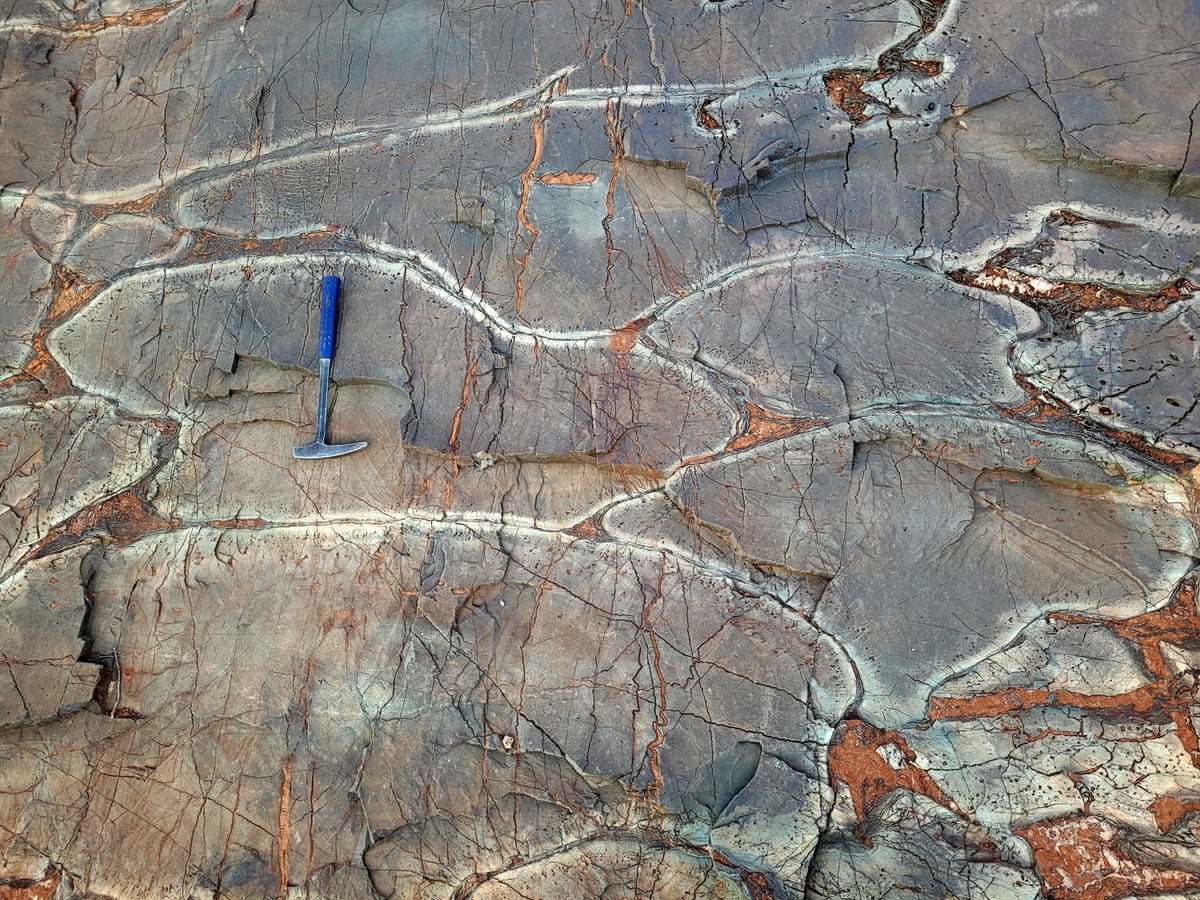
Outcrop of a 3.5-billion-year-old ”pillow basalt“ lava flow.
Alec Brenner, Harvard University/Yale University
The colossal movements of tectonic plates shape our world, influencing the composition of Earth’s atmosphere, the planet’s protective magnetic field and perhaps even the flourishing of life. Now researchers have compelling evidence that some form of plate tectonics may have started as early as 3.48 billion years ago, according to a new study appearing today in Science.
Using magnetic traces from ancient pieces of Earth’s crust, researchers found that a chunk of what is now Western Australia drifted toward the magnetic north pole over a few million years, as part of South Africa remained stationary. It’s the earliest documented instance of relative plate motion by more than half a billion years, and it has implications for understanding early life on Earth and how the planet’s tectonic activity began. (Disclosure: The author of this article embedded with the research team in last year’s field season.)
Earth today is a jigsaw of giant chunks of crust that travel across the planet, smashing together like huge bumper cars, pushing up mountain ranges and melting back into magma along their edges. All this activity, called plate tectonics, seems to be unique in our solar system. It’s believed that our rocky planet neighbors instead have a continuous, solid shell.
On supporting science journalism
If you’re enjoying this article, consider supporting our award-winning journalism by subscribing. By purchasing a subscription you are helping to ensure the future of impactful stories about the discoveries and ideas shaping our world today.
No one knows, however, how or when plate tectonics got started on Earth in the first place. “It’s one of the most fundamental questions in Earth science,” says study co-author Roger Fu, a Harvard University paleomagnetist. Geologists use various tools to investigate the state of Earth’s crust over the eons, but the gold standard is evidence of relative motion: one piece of Earth’s crust moving away from, or toward, another piece. For that, Earth’s magnetic field—powered by the motion of its core—holds the key.
This illustrated cross-section of Earth 3.5 billion years ago shows the core generating a magnetic field as well as subducting tectonic plates.
Alec Brenner, Harvard University/Yale University
Like any magnet, Earth has a north and south magnetic pole, aligning roughly with the globe’s geographic poles. These poles flip at irregular intervals; the last such reversal was about 780,000 years ago. (Right now Earth’s magnetic north is technically in the Southern Hemisphere.) The direction and angle of lines of force curving between the poles become imprinted in molten rock as it solidifies at the planet’s surface, providing clues to where ancient rocks have been.
To find such traces, the team analyzed rock samples from remote parts of Western Australia and South Africa. These regions contain some of the planet’s oldest chunks of crust, called cratons, which have survived billions of years of grinding and melting processes and form the building blocks of continents.
The rock layers’ magnetic record shows that a chunk of the craton in Australia shifted northward over the course of a few million years, while part of the craton in South Africa stayed stationary. Such motion is exciting because it “suggests there’s likely to be a plate boundary between the two [cratons],” says Michael Brown, a University of Maryland emeritus geologist who was not involved in the study.
Multiple researchers agreed that this study is about the earliest we will be able to see such results, as so few rocks remain intact from Earth’s first billion years. “It’s like having a thousand-piece jigsaw, but you only have 35 pieces,” Brown says. The relative motion doesn’t tell us exactly what was going on in this period, Brown adds, but it can put new limits on the mathematical models that researchers use to recreate ancient Earth.
The Pilbara Craton, Western Australia, holds 3.5-billion-year-old rocks.
Alec Brenner, Harvard University/Yale University
The findings may support another recent study, which uses ancient crystals of the mineral zircon—found in a different part of Western Australia—to suggest that pieces of Earth’s crust may have been melting back into the mantle around 3.35 billion years ago. Evidence from zircon crystals is notoriously difficult to interpret, and the cycling of Earth’s crust into the mantle may happen under many different circumstances. The process is necessary, however, to any form of plate tectonics. In that sense, the two studies reinforce one another.
Fu’s team also found evidence of the earliest known reversal of Earth’s magnetic poles, around 3.46 billion years ago. In concert with the evidence of relative tectonic motion, the study’s results “demonstrate that Earth was behaving very similar to today,” according to Jun Korenaga, a Yale University geologist who was not involved in the study.
The Western Australian craton that the team studied is home to the world’s oldest confirmed fossils of single-celled organisms, which date back to roughly 3.48 billion years ago. Knowing the latitude of those rocks at the time could help researchers learn more about life’s origins. And understanding what kind of tectonics operated back then may set limits on ways in which Earth’s modern plate tectonics got started. If we know what Earth’s early tectonics looked like, we can start to hunt for similar behavior on other planets, which may in turn guide the search for life. “What kind of planet did life first appear on?” Fu wonders. The answer, he says, “has implications for how abundant life is likely to be in the universe.”
It’s Time to Stand Up for Science
If you enjoyed this article, I’d like to ask for your support. Scientific American has served as an advocate for science and industry for 180 years, and right now may be the most critical moment in that two-century history.
I’ve been a Scientific American subscriber since I was 12 years old, and it helped shape the way I look at the world. SciAm always educates and delights me, and inspires a sense of awe for our vast, beautiful universe. I hope it does that for you, too.
If you subscribe to Scientific American, you help ensure that our coverage is centered on meaningful research and discovery; that we have the resources to report on the decisions that threaten labs across the U.S.; and that we support both budding and working scientists at a time when the value of science itself too often goes unrecognized.
In return, you get essential news, captivating podcasts, brilliant infographics, can’t-miss newsletters, must-watch videos, challenging games, and the science world’s best writing and reporting. You can even gift someone a subscription.
There has never been a more important time for us to stand up and show why science matters. I hope you’ll support us in that mission.
