

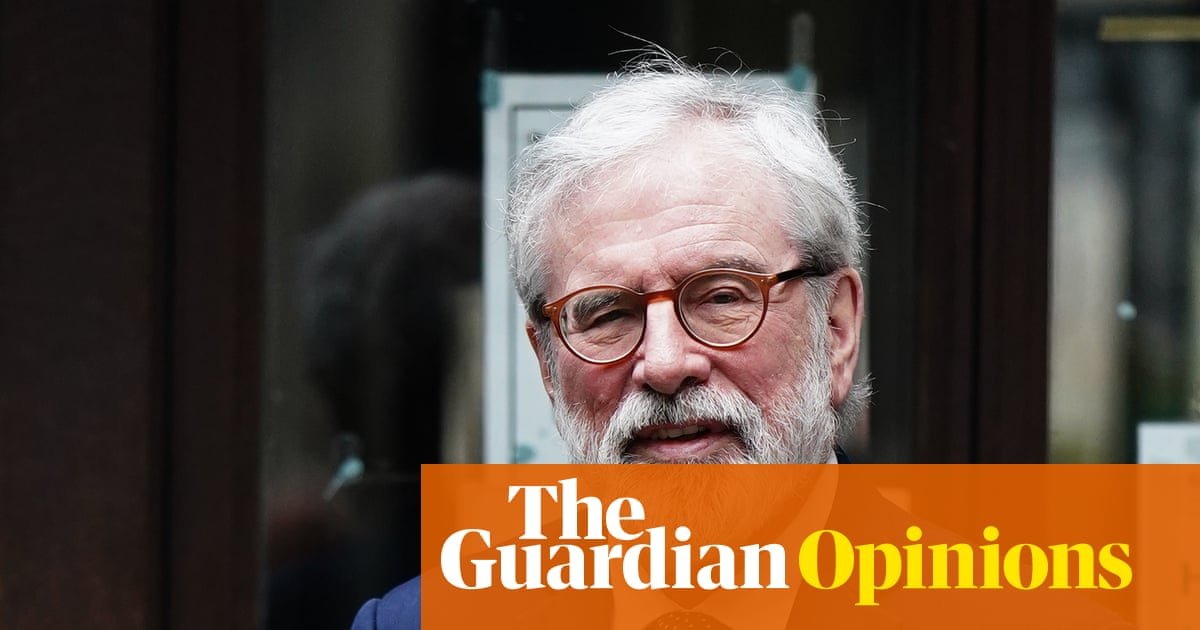
“A very happy St Patrick’s Day,” said Gerry Adams, as he took his seat in the stand at court 16 in the Royal Courts of Justice on Tuesday. Mr Justice Smith hadn’t quite caught what the defendant said, and asked him to repeat himself.
“Oh that’s very kind of you,” the judge stammered when he finally worked it out. The green tie and small sprig of shamrock in Adams’s lapel – worn alongside a Palestinian flag pin – ought perhaps to have been a clue.
Adams used to spend 17 March at the White House, glad-handing a succession of thematically dressed presidents and supportive senators of Irish extraction. This year, though, the former Sinn Féin president had a prior engagement in a British courtroom.
It was not a criminal dock, as some of those present in the public benches – who included the relatives of people murdered by the IRA during the Troubles – would certainly have preferred.
Adams is being sued in the civil high court in London by three surviving victims of IRA bombings, who want the judge to establish, on the balance of probabilities, that the former president of Sinn Féin was also a former senior IRA leader and so could be held personally liable for their injuries.
Money may not be immediately at stake – the three claimants are seeking symbolic damages of £1 – but for Adams, 77, the potential cost is still extremely high.
For more than five decades, in defiance of the flat assertions of multiple former allies, foes and journalists that he had a senior operational role in the IRA during what he described in court as “the war”, Adams has insisted that he was never a member of the republican paramilitary group. Anyone who expected him to concede anything different once under oath was going to be disappointed.
Previous witnesses, including a former IRA bomber, former British army commander and former senior police and intelligence officers, have told the court that it is “inconceiveable” that Adams was not involved in authorising bombings, and that his previous denials “lack credibility”. For the defendant, however, there would be no change to his insistence of more than half a century. “I can’t talk about my involvement in the IRA because I wasn’t involved.”
He would insist so again and again under cross-examination by Sir Max Hill KC on behalf of the claimants. Adams’s witness statement to the court had asserted: “I was never a member of the IRA or its Army Council. I was never the ‘Commanding Officer’ or ‘OC’ of the 2nd Battalion of the IRA’s ‘Belfast Brigade’. Indeed, I have never held any rank or role within the IRA.”
Was his statement really the truth? he was asked by Hill. “It is dead true,” replied Adams.
When a 23-year-old Adams had attended secret ceasefire meetings with the British government in London in August 1972 alongside senior Republicans he was there as a member of the IRA, wasn’t he? “No.”
Hadn’t Seán MacStíofáin, the acknowledged IRA chief of staff at the time, insisted several times that Adam had been there as an IRA member? “He is mistaken.”
“Mr Adams,” said Hill, “you are rewriting history. This was an IRA delegation of which you were one.”
“Well, I don’t accept that,” said Adams.
The flat west Belfast voice that was once deemed too dangerous for British ears – requiring broadcasters to dub Adams’s words using Irish actors until the ban collapsed in 1994 amid no little mockery – was low and frequently muffled, requiring the judge to ask him several times to speak up.
Adams has retired from professional politics both in Northern Ireland, where he was a (non-sitting) Westminster MP until 2011, and in Ireland, where he represented Louth in the Dáil until 2020. The former firebrand has seemed in his later years to enjoy leaning into a more avuncular persona, hugging trees and maintaining a head-scratchingly whimsical Twitter feed that heavily featured his teddy bear, Ted.
He has never been convicted of any offence, and a Dublin jury last year awarded him €100,000 after finding that a BBC Northern Ireland documentary had libelled him by claiming that he sanctioned the murder of an IRA informant in 2006. (Bringing the case, Adams said after his win, had been about “putting manners on the British Broadcasting Corporation”.)
Comedian Benny Hill in a sketch sometime around 1975. Photograph: TV Times/Future Publishing/Getty Images
But those allegations that he was much closer to IRA violence than he admitted? They haven’t gone away, you know. Again and again, in sometimes testy exchanges, Hill put it to Adams that the multiple assertions that he had also been involved in the armed struggle must be true.
Adams had attended meetings with fellow members of the Belfast Brigade of the IRA to plan the 1973 bombing of London, as asserted by the leading IRA man (and his former friend) Brendan Hughes? “Untrue.”
But he said he “stood by” the IRA? “Well I stand by the African National Congress and you don’t suggest I was a member of the ANC. I stand by the Palestinian people, you don’t suggest I am a member of the PLO.”
What about the photograph of Adams wearing a beret to carry the coffin at a 1971 Republican funeral, which a convicted IRA bomber, Shane O’Doherty, has previously told the court was a clear sign of IRA membership? “Benny Hill wore a beret,” said Adams. “In very different circumstances,” shot back the barrister.
While he hadn’t been an IRA member, insisted Adams, he had defended many of the organisation’s actions in the past, “and I don’t resile from that”.
“If your neighbourhood was invaded and under occupation, some patriotic Englishmen would organise some form of resistance,” he said. “I’m glad the IRA have left the stage, I’m glad they are not killing any more members of the British army, but I don’t distance myself from the IRA.”
The case continues.
