

Key events
6m ago
Zelenskyy warns that cheap drone technology has increased risks of attack
40m ago
Zelenskyy to address MPs and peers in parliament
42m ago
MSPs to vote on assisted dying bill for Scotland this evening, with supporters worried it has lost majority support
52m ago
More than 100,000 UK nationals have returned from Middle East since Iran war started, Cooper tells MPs
1h ago
Badenoch calls Trump’s recent criticism of Starmer ‘very childish’
2h ago
Being in Sinn Féin not the same as being in the IRA, Gerry Adams tells high court
2h ago
Zelenskyy thanks UK for standing by Ukraine through ‘difficult winter’
2h ago
Starmer tells Zelenskyy that he won’t let Iran war distract attention from need to keep backing Ukraine
2h ago
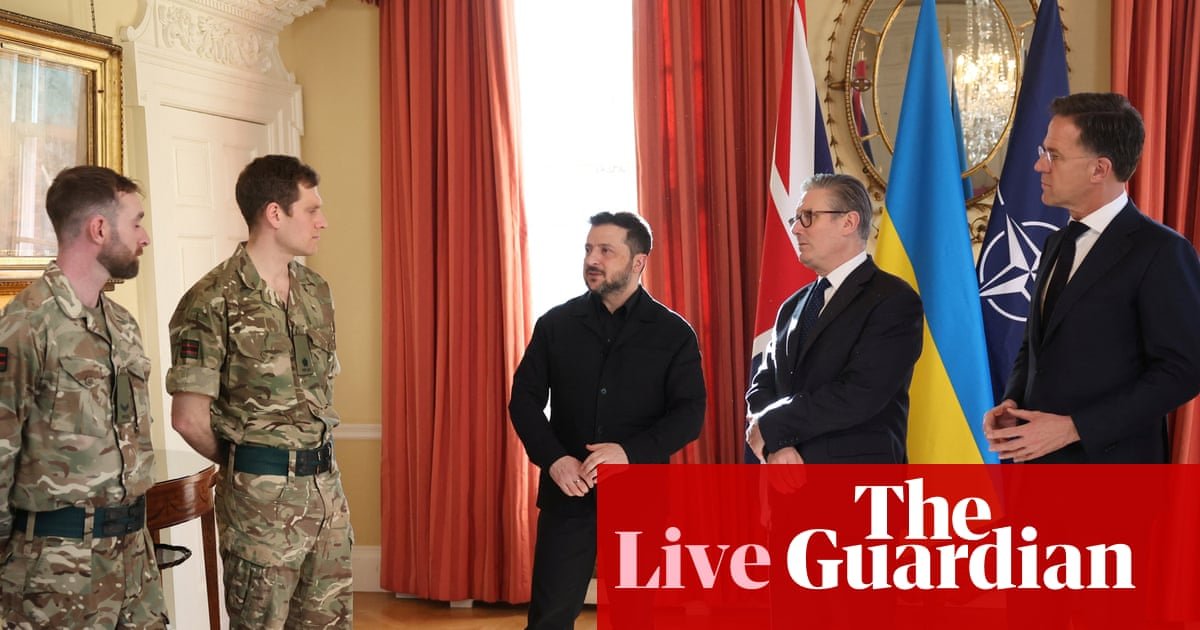
Ukrainian president Volodymyr Zelenskyy arrives at No 10 for talks with Starmer
2h ago
Cooper tells MPs that Lebanon conflict on brink of widening with ‘disastrous humanitarian consequences’
3h ago
Reeves asks officials to draw up plans for fiscal devolution
3h ago
Newly unearthed Nigel Farage videos reveal support for rioter, neo-Nazi event and far-right slogans
3h ago
Streeting says he’s ‘particularly concerned’ about childhood vaccination rates, saying NHS not doing well enough
3h ago
Streeting explains meningitis symptoms to MPs, and explains how it’s spread
4h ago
Streeting backs Lib Dems in condemning anti-vaccine ‘political postioning’ by some MPs, in jibe at Reform UK
4h ago
Streeting says JCVI being asked to consider case for older children to be given MenB vaccine
4h ago
Streeting says Kent students being offered MenB vaccine in response to meningitis outbreak
4h ago
Streeting sets out health advice for anyone at risk from current outbreak
4h ago
Streeting said he’s confident UKHSA ‘acted as quickly and comprehensively as possible’ in response to outbreak
4h ago
Streeting says meningitis outbreak ‘unprecedented’, with 2 deaths, 4 cases confirmed and 11 under investigation
5h ago
Streeting to make statement to MPs about meningitis outbreak
5h ago
Farage say king’s visit to US ‘absolutely must go ahead’
5h ago
Farage claims Starmer has made ‘big strategic mistake’ by not backing US over Iran
5h ago
Farage claims there is now ‘no chance’ of US agreeing Chagos Islands deal in light of Iran war developments
5h ago
Farage said Reform UK would impose ‘very, very tough’ benefit cuts to help fund higher defence spending
6h ago
Farage defends Tice’s tax avoidance scheme, rejecting claims it flouts Reform UK ‘stop offshore taxpayer rip off’ pledge
6h ago
Reform UK announces lottery, with winner getting energy bills paid for year, to promote announcement about VAT cut on energy
6h ago
Funding for community radio stations to double under local media strategy announced by Lisa Nandy
6h ago
UK to fund AI team in Ukrainian Ministry of Defence as part of new partnership agreement
7h ago
Streeting urged to make Commons statement about meningitis outbreak in Kent
7h ago
UK must learn lessons from AI race and retain its quantum computing talent, says Liz Kendall
7h ago
Government defeated in Lords on pensions bill as peers vote down plan to let ministers tell pension schemes where to invest
8h ago
Trump says he’s expecting king’s state visit to US to go ahead
8h ago
Labour’s Emily Thornberry backs calls for king’s state visit to US to be postponed given Iran war and US rift with its allies
Show key events only
Please turn on JavaScript to use this feature
Zelenskyy says Ukraine can watch every Russian attack on its cities in detail using technology.
There are almost no nights in Ukraine without Russian attacks, he says.
He says the two main shortages for his country are petrol and drone missiles.
He recalls a night when there were almost 500 attacks on Ukraine. Using iPads, they could see how the Ukrainain defences were performing.
He says they could look at each individual attack to see how it worked. This happens after every attack, he says.
Interceptor drones are the latest defence. They use hundreds of them every day, he says.
He says he is glad there is a project with the UK to produce them.
There are Patriot air defence systems in the Gulf. But these are not enough, but Iran’s offensive systems have developed more quickly.
Share
Zelenskyy warns that cheap drone technology has increased risks of attack
Zelenskyy says Iran started its drone programme years ago. And about three years ago it started supplying them to Russia.
He says the drones being used by Iran now have Russian components.
Ballistic missiles can strike targets thousands of miles away.
If evil wins, it will be able to strike targets on the other side of the world. No oceans or mountains will keep people safe.
That is why security matters, he says.
He says Ukraine tried to live alongside Russia. But it has had two invasions within 10 years.
And regimes like Russians are finding new wars of fighting.
He says an Iranian drone costs about $50,000. Opponents are shooting them down with missiles costing $4m, he says.
With the spread of drones, mass attacks are much cheaper.
And that means it is not just the rich madmen like Putin who pose a threat.
Share
Zelenskyy says there are some Ukrainians already in the Gulf protecting countries from Iranian missiles, and others read to deploy.
This was part of a drone deal he offered to the US, he says.
And Ukraine will offer similar deals to other countries.
He says it would not be wise for people to ignore what Ukraine can offer.
And he says he is glad Ukraine has signed a new security deal with the UK. (See 10.45am.)
Share
Zelenskyy says, in this great building, they are “calm and safe”.
He says people here do not have to worry about drones, or about the reliability of their wifi.
People do not have to live underground for their protection.
He says, with life like this in London, it is almost impossible to imagine life like this ending.
But in Ukraine ordinarly life has ended, he suggests.
He says it is hard to know where modern warfare will end up.
But governments have to stay ahead of this technology, he says.
And they have to be able to tell people that “tomorrow, at least, will be safe”.
He says the duty for this generation of leaders is to deliver real safety.
Share
Volodymyr Zelenskyy is speaking now.
He thanks the MPs and peers for their support for Ukraine, and for the support given by the British people.
Together, they have saved many lives.
UK is one of the countries Ukrainians trust most, he says.
Share
Hoyle says the UK won’t be secure until Ukraine is secure.
He says he looks forward to being able to welcome Zelenskyy to the UK when his country is free.
In the meantime, the UK will stand with Ukraine.
Share
Volodymyr Zelenskyy has arrived in the Commons committee room where he will speak to MPs and peers.
He is being introduced by Lindsay Hoyle, the Commons speaker, who says that, although Zelenskyy is welcome, there will be nothing to celebrate until a just peace is in place.
Left to right: Michael Forsyth, the lord speaker; Lindsay Hoyle, the Commons speaker (standing); Volodymyr Zelenskyy and Keir Starmer. Photograph: PAShare
Zelenskyy to address MPs and peers in parliament
Volodymyr Zelenskyy, the Ukrainian president, is about to address MPs and peers in a committee room at the Houses of Parliament.
MPs and peers wait for Volodymyr Zelenskyy to address them Photograph: PAShare
MSPs to vote on assisted dying bill for Scotland this evening, with supporters worried it has lost majority support
Severin Carrell
Severin Carrell is the Guardian’s Scotland editor.
Proposals for Scotland to be the first part of the UK to legalise assisted dying hinge on a knife-edge vote in the Scottish parliament tonight, following a bruising campaign by critics of the bill.
Expectations are growing that MSPs at Holyrood will reject the assisted dying for terminally ill adults (Scotland) bill by a narrow majority in a free vote at 10pm, despite several years of consultations, drafting and redrafting led by the Liberal Democrat MSP Liam McArthur.
The bill was initially passed in principle by 70 votes to 56 in May 2025; it is thought at least seven of those supporters have switched sides in recent weeks. McArthur said on Tuesday he accepted the final vote at 10pm was on a knife edge. He said:
double quotation markI’m nervous, and anxious to get this over the line. But I’m absolutely certain if parliament doesn’t grasp this opportunity, that’s not going to make these issues go away. Public support for a change in the law will continue to intensify.
Religious groups and opponents played a large part in tabling more than 320 amendments during the bill’s third and final stage last week, forcing Holyrood to debate them over four days.
Those amendments, some of which were accepted by McArthur, such as introducing fixing a six-month terminal prognosis for eligibility, gave opponents a platform to attack the bill’s primary goal, to legalise self-administered assisted suicide.
Critics argue the bill has insufficient protections against coercion of vulnerable people, including the disabled or infirm, and also claimed the UK government could not be trusted to honour its promises to introduce legal protections and conscience clauses for medical professionals, including pharmacists.
Supporters of the bill believe that strategy echoed the filibustering by peers in the House of Lords which has prevented Kim Leadbeater’s assisted dying proposals for England and Wales from being approved before the end of this Westminster session, despite winning majority support in the Commons.
Several royal medical colleges, including the Royal College of Psychiatrists, registered their opposition to the Scottish bill last week after rejecting repeated assurances from the UK government that it would approve all the legal changes to UK legislation needed.
Earlier this month, the pro-choice group Dignity in Dying released an MRP poll from Opinium based on polling 5,000 people which found significant levels of majority support for assisted dying in every constituency in Scotland, including 77% support in John Swinney’s constituency of Perthshire North, 72% in Anas Sarwar’s Glasgow region. Both Swinney and Sarwar oppose the bill.
Share
More than 100,000 UK nationals have returned from Middle East since Iran war started, Cooper tells MPs
Ben Quinn
Ben Quinn is a Guardian political correspondent.
The number of UK nationals flown back from the Middle East since the start of the conflict with Iran reached 100,000 on Tuesday, Britain’s foreign secretary has said.
This is a third of the 300,000 who were in the region at the outset of hostilities, Yvette Cooper told parliament. Many were stuck when airspace was closed while the figure included tourists and Gulf residents who have temporary left.
However, she was urged by fellow MPs to help many British citizens who were still stuck in the region and those who were said to be struggling to get extensions for visas in the countries where they had gone on holiday before the US and Israeli strikes on Iran.
Cooper also provided an update on Britain’s part in discussions which could see an international coalition involved in opening the strait of Hormuz, adding that this was “separate from the conflict”.
She said:
double quotation markThe focus at the moment is what the practical measure might be to ensure shipping can be restored as the conflict subsides and so Iran cannot continue with the long term ability to hold hostage the global economy ….
Because it is an international shipping lane, multiple nations need to be involved in planning the way forward. And our discussions will continue to reflect serious, expert military and commercial assessments about what is credible and feasible so that commercial shipping can return as soon as possible as the conflict subsides.
Cooper said Britain was in talks about this with European allies including Germany, Italy and France, as well as with the US and Gulf states.
The Conservative shadow foreign secretary, Priti Patel, pressed Cooper on what specific commitments Britain had made to Gulf states about helping them protect British bases and allies in the region. She said:
double quotation markThe way in which our friends and close security partners who host British armed forces have been subject to outrageous, unprovoked aggression has been painful to watch. Britain cannot stand by while our allies do the heavy lifting to protect us all.
Cooper replied the UK was providing Gulf countries “with direct military defensive support”, with F35 and Typhoons in the region.
The behaviour and comments of Donald Trump was cited by the Conservative MP and committee chair, Simon Hoare, who asked Cooper if she agreed with him that the US president was becoming “an increasingly unreliable and erratic partner”. He asked her if it was right for the UK to be strategically skeptical and questioning of his motives and pronouncement.
Cooper replied: “Our focus needs to be on the substance of that relationship and the real issues, not on rhetoric or statements.”
Share
