

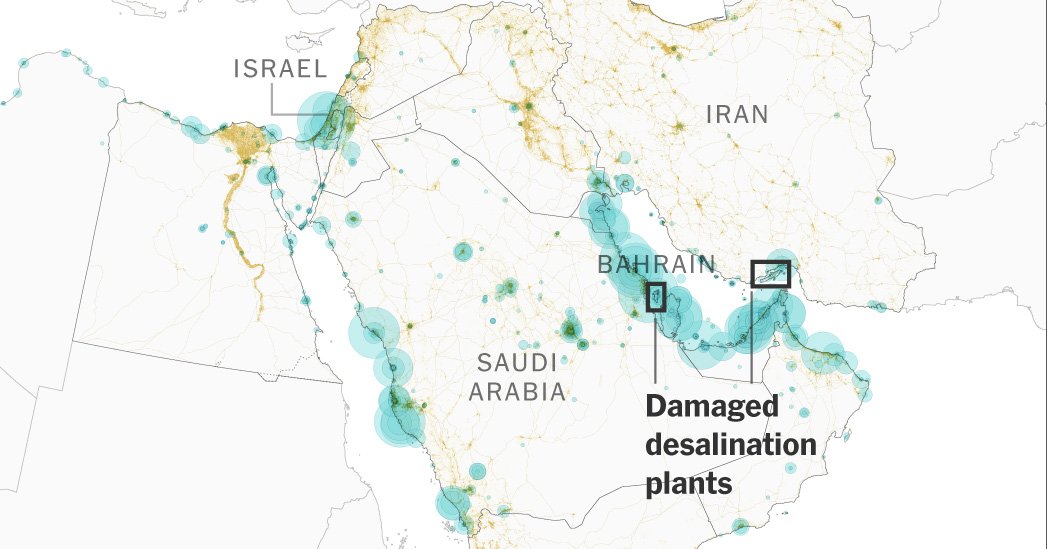
Two weeks into the war in Iran, two water desalination plants in the region have been damaged in military operations, raising concerns over the vulnerability of a system that serves as a lifeline for millions across the Middle East.
Last week, Abbas Araghchi, Iran’s foreign minister, said an attack on a desalination plant on Qeshm Island, in the Persian Gulf, on March 7 had affected the water supply to 30 villages. While Iran blamed the United States for the attack, the Pentagon has denied responsibility, as has Israel.
And in Bahrain, the Interior Ministry blamed an Iranian drone for “material damage” to a desalination plant, though the country’s water and electricity authority said water supplies had not been affected.
Over the last few decades, the arid countries of the Persian Gulf have become increasingly reliant on desalination plants to supply water to cities and towns.
Desalination plants have become crucial infrastructure in places like Qatar and Bahrain, both of which now rely on the technology for more than 50 percent of their fresh water.
Share of water from desalination plants
Efforts to remove salt from seawater and brackish groundwater in the Middle East go back more than a century. But desalination plants have proliferated on the Persian Gulf as climate change has made droughts more frequent and severe, and as desalination technology has improved.
Damage to a single large desalination plant, including a plant shutdown, could have immediate and widespread effects on the region, said Menachem Elimelech, an environmental engineer at Rice University.
The Al Dur plant in Bahrain, for example, supplies over one million people with water each day, providing more than a third of the country’s needs. Desalination facilities are complex, and extensive damage could take a long time to repair.
While countries like the United Arab Emirates have tried to build up strategic water reserves, analysts say that some stocks would be depleted within days.
“The response would be to truck in bottled water, mobile desalination systems, tanker water,” said David Michel, a fellow in the Global Food and Water Security Program at the Center for Strategic and International Studies, a policy research organization. “Those supply chains exist,” he said. “But that’s still a huge logistical hurdle. It’s extremely disruptive.”
International law prohibits attacking or destroying infrastructure indispensable to the survival of civilians. That includes water infrastructure, food supplies and energy systems.
Still, the episodes on Qeshm Island and Bahrain “appear to not be inadvertent or collateral damage, but an intentional, direct targeting of those systems,” Mr. Michel said. “So the signal has been sent that those systems could be at risk.”
“When you’re targeting water infrastructure, you’re directly affecting a civilian population,” said Mohammed Mahmoud, Middle East Lead for the U.N. University Institute for Water, Environment and Health. “That’s absolutely a war crime to attack infrastructure that civilians are so dependent on, on either side.”
Even if desalination plants aren’t targeted directly, damage to surrounding facilities could still disrupt their operations. Some plants draw water from the sea, raising the prospect that polluted water could clog plant filters or contaminate pipes.
“Say there is an oil spill next to the intake to the desalination plant,” Mr. Elimelech said. “That would practically kill the desalination plant.”
In 1991, the United States accused Iraq of deliberately spilling millions of gallons of Kuwaiti crude oil into the Persian Gulf with the intention of crippling desalination capacity or thwarting an amphibious invasion.
That created a nine-mile oil slick and prompted a monthslong effort to keep the oil from shuttering a desalination plant that supplied half of the drinking water for Riyadh, the Saudi capital. Oil spills on land, meanwhile, infiltrated many of Kuwait’s aquifers.
Energy infrastructure is another vulnerability. Desalination plants are energy‑intensive, and many are built on sites shared with oil, gas and renewable power plants. They risk losing power if nearby facilities are damaged or taken offline.
Riyadh, for example, is supplied by water pumped hundreds of kilometers from the coast. Damage to a water pipeline could interrupt supplies even if desalination plants remained operational.
Countries like the United Arab Emirates heavily subsidize desalinated water, allowing for copious consumption of water, including watering golf courses and other luxury uses that would otherwise be economically unsustainable in a desert, Mr. Michel said. But that has hampered investment in water efficiency and increased the region’s dependence on desalinated water.
Some nations have taken measures to bolster their reserve supplies of water. There has also been talk of interconnecting water supply systems internationally. But that hasn’t moved ahead amid regional rivalries and mistrust, Dr. Mahmoud of the U.N. University said.
Those efforts have been tricky, he said, because states prefer self‑reliance over shared systems. “But what do you do when you lose your water lifeline?” he said.
