

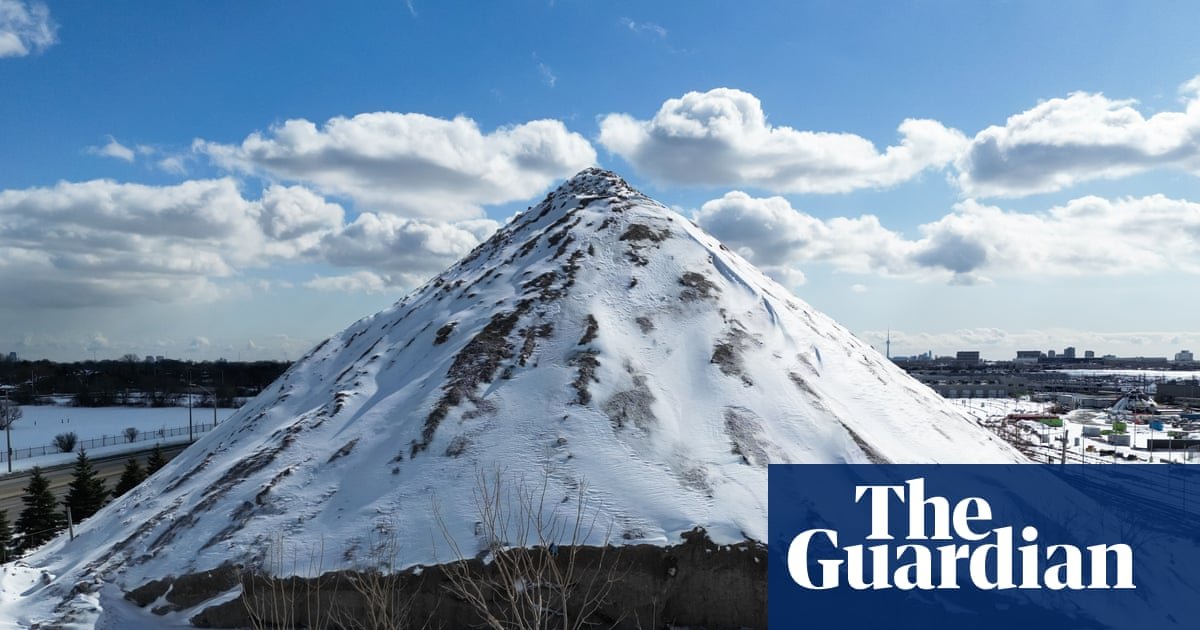
Most mountains take tens of millions of years to form. Toronto’s newest mountain took just days.
Towering atop the crowns of evergreens, it has no skeleton of limestone or granite. There are no spires, cornices or headwalls. It is simply piles upon piles of snow, mixed with a toxic cocktail of road salt, antifreeze, oil, coffee cups and lost keys. It is the final resting place for the forces of nature that have battered the city in recent weeks – and a daunting environmental hazard.
In late January, Toronto was hit with what many experts said was the heaviest single day of snowfall in the city’s history. In some spots, nearly 23in fell, driven in part by a collision of weather systems. The city had already removed 264,000 tonnes of snow from 1,100 km (680 miles) of roads, sidewalks and bike lanes by mid-February.
A similar storm hit New York City at the end of February with more than 25in of snow piling up in some regions, part of a two-day storm with hurricane-like winds.
Major cities that experience the full brunt of winter have long been forced to confront a reality that snow cannot stay on streets or sidewalks. The solution is to truck the snow – sometimes for weeks on end – to storage facilities along the urban outskirts.
Toronto’s six resulting snow mountains are scattered throughout the city. Most are secret, to deter illegal dumping. One site, however, in the north-western outskirts of the city, is most visible to drivers travelling along the highway. It can hold 144,000 cubic metres of snow on its two acres.
Reaching nearly 100ft – the height of a 10-storey building – it resembles an Italian marble quarry, with yellow excavators moving in unison against the ashy snow. Plumes of steam rise from industry melters – contraptions roughly the size and shape of a shipping container which slowly reduce the size of the mountain over time. The site operators pull long shifts: during particularly nasty storms, the machinery works 24 hours a day, seven days a week.
Operations at Toronto’s snow dumping area in the neighbourhood of Downsview on 27 February. Photograph: Cole Burston/The Guardian
“Certainly, there’s a need to remove the snow to minimise risk on roads and sidewalks, especially from a public safety perspective,” said Donald Jackson, a professor of ecology at the University of Toronto. “But the challenge is what they’re trying to balance against: the ultimate impact to aquatic ecosystems.”
Canada’s largest city has spent more than C$1 bn dollars over more than a decade to successfully re-naturalise the mouth of the Don River, restoring its natural flood mitigation capabilities and reviving a riparian ecosystem once left for dead.
The city says it uses a variety of tools to prevent contaminants such as oil from cars entering water systems. But salt is a pervasive foe, passing though most storm water treatment.
Toronto has so far used more than 130,000 tonnes of salt this season and local governments are grappling with a shortage – even though the world’s largest salt mine sits less than 150 miles west of the city.
Power shovels scoop up large piles of snow in Toronto. Photograph: Cole Burston/The Guardian
“We know cities are trying to reduce their usage and reliance on salt. But it works,” said Jackson. “But while we know roughly how much the city uses, we have no idea how much is being used to salt private driveways and places like grocery store parking lots.”
Furthermore, the risk of legal liability prompts many private operators to overuse salt, Jackson said.
The rock salt used on roads – sodium chloride – is chemically the same as table salt. But the two elements pose different risks to the environment and human heath.
Chloride in high concentrations is toxic to fish in fresh water systems. In recent testing, Jackson and Lauren Lawson, a doctoral researcher, found chloride levels were high enough to be lethal to a majority of aquatic species at 30% of sites tested. Virtually all the sites they tested were in excess of federal guidelines.
Meanwhile, in areas where people use wells for drinking water, sodium levels increase over time as salt is absorbed into the groundwater.
In John McPhee’s Annals of the Former World, the author wrote: “Remember about mountains: what they are made of is not what made them.”
And what made them is not what will destroy them. A recent thaw eroded chunks of Toronto’s snow mountain, pushing vast amounts of salt into waterways.
An overhead shot of a power shovel moving piles of snow. Photograph: Cole Burston/The Guardian
“You can have places where it’s elevated to 10, or even 100, times the background level,” he said. “But we’ve also seen locations in where the amount of salt in the water exceeds seawater concentration.”
Experts warn that while the climate crisis will lead to overall warmer temperatures, it is also likely to unleash brutal storms, similar to those that choked infrastructure in Toronto and New York. Those storms will require more salt – like many things humans put into the environment – which will last a long time.
“The trajectory isn’t good, based on sort of what trends have been over time. We’re looking at increasing concentrations that we see in our rivers, in our lakes. And there isn’t any reason to expect that to stop,” Jackson said. “Even if we stopped applying salt right now, it would take years to decade to flush out of all of our soils and the groundwater.”
