

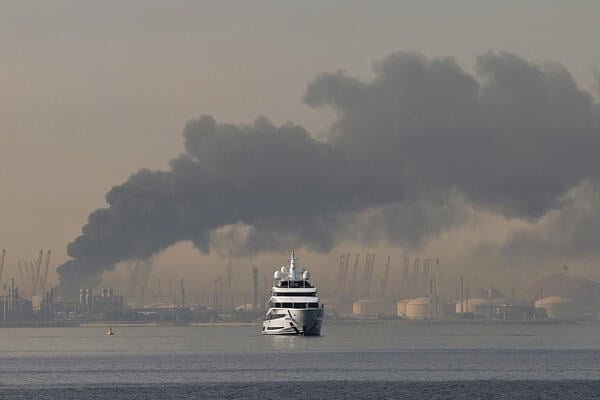
Campuses in the United Arab Emirates and other countries have switched to online learning.
Fadel Senna/AFP/Getty Images
The spiraling war with Iran has stranded American students and employees in the Middle East and shuttered branch campuses following Iran’s attacks on multiple Gulf states in retaliation for the U.S. and Israeli bombing campaign.
Thousands of flights were canceled across the region as Iran hit airports in Bahrain, Kuwait and the United Arab Emirates, along with residential buildings in Bahrain and hotels in Dubai, The Wall Street Journal reported. Israeli emergency services said at least nine people were killed in an Iranian missile strike that hit a city west of Jerusalem. The U.S. State Department on Monday called on Americans to immediately depart 14 countries in the region, including Israel, Egypt, Qatar and the United Arab Emirates.
But some students and employees participating in programs in the region—including in U.S.-allied nations, which are typically safe—were still struggling to get back to the U.S. Monday, three days after the war started. They include an unknown number from Texas’s Southern Methodist University and Tennessee’s Carson-Newman University.
Southern Methodist told families in an online message Saturday that “SMU has formally canceled its program in Dubai. Local authorities have issued shelter-in-place guidance, and regional airspace conditions remain fluid.”
“We have been in direct contact with our students and employees in the region, and at this time, they have confirmed they are safe.”
In a Sunday update, the university said, “Students and faculty are following local guidance and remain sheltered in secure accommodations.” On Monday, SMU spokesperson Megan Jacob told Inside Higher Ed the students and faculty were part of a Cox School of Business program but didn’t provide many further details or an interview. “We are working to facilitate their safe return as conditions allow,” Jacob wrote in an email.
Carson-Newman University spokesman Kevin Triplett told Inside Higher Ed in an email that the institution has “a team of students and faculty who are in the Middle East,” though he didn’t say how many. He noted that they were in Israel as part of the Christian institution’s archaeology program but didn’t share their present location and said no one was available for interviews.
“Our president has spoken with members of the group multiple times over the last couple of days as well as parents of the students back here in the U.S.,” Triplett said. “They are in the process of relocating. They are safe and in good spirits and plans are being made to get them home.”
Times Higher Education, the parent company of Inside Higher Ed, reported that Qatar, the UAE and Bahrain ordered universities in their countries to shift to online learning.
Education City, just outside of Doha, hosts Qatar campuses for eight universities, including Carnegie Mellon, Georgetown, Northwestern, Texas A&M, Virginia Commonwealth and Weill Cornell Medicine. Texas A&M at Qatar has been sharing on its website the frightening updates from the U.S. Embassy there.
“Missile Incoming. Imminent missile strikes. Duck and cover until further notice. Continue to shelter in place,” the embassy warned Saturday. On Sunday, it recommended that all Americans continue to shelter in place, telling them to “remain vigilant, as the Iranian government and its proxies may seek to target Americans in retaliation.”
Francisco Marmolejo, higher education president at the Qatar Foundation, which runs Education City, said in a statement that “in-person activities and events have been canceled, and classes are being delivered virtually.”
“Qatar Foundation (QF) is taking the utmost precautions to ensure the safety and wellbeing of our students, faculty, and staff,” Marmolejo said. Education City is home to over 4,400 university students from more than 110 countries, he said, and “across QF and our partner institutions, our staff exceeds 5,000 dedicated professionals.”
RIT’s Dubai campus has seen “no direct impact” from Iran’s attacks, President William Sanders said.
Rochester Institute of Technology
When the war began Saturday, Rochester Institute of Technology president William H. Sanders sent a message to the community saying there’s been “no direct impact” on RIT’s campus in Dubai. “Leadership there is working closely with local officials and are following all guidance to keep our students, faculty, and staff safe,” he wrote.
On Monday, RIT spokesperson Bob Finnerty told Inside Higher Ed that the roughly 3,500-student campus will stick with online learning through Wednesday. He did note that “civil aviation has resumed limited, special flights to allow those stranded in Dubai to depart the country.”
The University of New Haven has been trying to establish the world’s first branch campus in Riyadh in Saudi Arabia, which Iran has also struck. A university spokesperson said in an email that “employees working to develop an international branch campus in Saudi Arabia are safe and accounted for.”
