

Would I like to write about my favourite place?
The invitation inspired me to recall so many magical places – from north-east Arnhem Land to Mediterranean island hamlets with idyllic quayside tavernas, from the Melbourne Cricket Ground on grand final day to Dickensian London pubs, from picture postcard villages beneath snow-capped alpine peaks to the haunts of my literary giants and on to Joshua Tree and Hagia Sofia.
Ultimately, though, I returned to an Australian place I’ve probably wandered through more than any other. I no longer go there regularly. I don’t even live in the same city. Yet it’s to the heights of Canberra’s Red Hill, with its walking tracks, scar trees and ochre earth underfoot, that my memory keeps transporting me. The place remains as vivid in my recollections as if I still visited daily.
As someone who became a parent at a relatively young age and having walked through so much of life with dogs at my heels, perhaps it’s not unusual that my connections to different places feel strongest where my memories of them are seeded with kids and canine family.
And that brings me inexorably back to Red Hill from whose pinnacle can be viewed the ghostly visage of the Griffins’ geometrically designed (but never realised) city on the limestone plains, with its monuments (the national library, the war memorial, the national museum, art and portrait galleries) symbolising a federation born of noble ideals – not the cold steel and cordite that forged nationhood elsewhere.
I thought of all of that every time I went up there, weekly when I worked for many years as a journalist at Parliament House (with all its Darwinian ambition, malevolence and the reason I reluctantly moved to the city), and daily after I was liberated to write of a broader world.
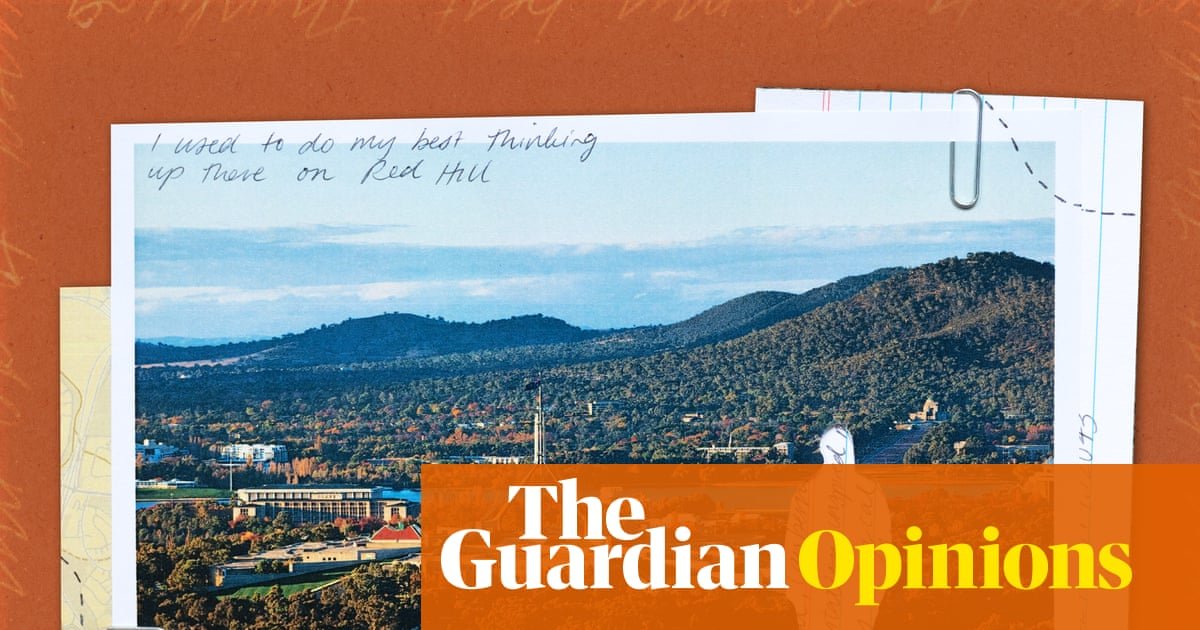
Parliament House as seen from Red Hill in Canberra, 29 September 2021. Photograph: Mike Bowers/The Guardian
As a much younger person, Canberra – landlocked by bush and ostracised by the rest of the country – became an unlikely physical, intellectual and emotional sanctuary for this devoted urban Melburnian.
Some who move there will always dislike the city for its relative quietness. Complain about its sparsity, its seeming unfinished-ness. Australians, largely coastal city dwellers, have long mythologised a connection with the bush. But the truth is that for most of us the bush – with its rugged expanses, its creatures, its loner-eccentrics, its consuming silence – is dauntingly foreign.
The bush capital is, as its name suggests, a landlocked city planted in with urban forest and surrounded by plains of trees and grassland – a broad connotation of the mythologised place Australians fallaciously claim such affinity with. And yet tell outsiders you live there, and many have no problem blithely bagging the place in a way they would not dare any other city.
For me, once I broke through loneliness, and especially once I made another family, the quiet and the bush became a balm. Meditative. Creatively inspiring.
I used to do my best thinking on Red Hill while trudging up those steep, thigh-burning tracks in the sleet or in the blazing sun with a cerulean blue sky that you only get in the mountains, the labradors intoxicated by the scent of roos and foxes and rabbits and blue-tongues and brown snakes, the eagles gingerly circling on the updraughts above, ready to dive on unleashed miniature dogs. Stories of the big birds and small dogs – and all dogs versus snakes – up there are legion.
Our most extraordinary dog, Nari – a black lab with the stamina, smarts and demeanour of a collie – is now long dead. I still pine for her badly. But daily she lives up there on the hill in my mind, revelling in the wind, pouring rain or blazing heat, delighting in the bucolic pleasures of a dog’s life lived on the fringe of the bush.
The pup, shiny crow-black Ronda – more reticent than her adoptive mother – died at 13 just before Christmas, having spent her peaceful final months comfortably lazing and listening to classical music in Sydney. My most enduring, vivid memories include her haring about the ancient eucalypts and great rocky knolls up there, stopped in her tracks by boxing eastern grey kangaroos and squawking gang-gangs. Dogs, I find, are such poignant markers of our own time here.
Not least, Red Hill was a playground for our three kids too.
The two youngest were somehow hauled up there by my partner when still in utero, ripe and ready to arrive, the youngest just a day before she was born.
Then we took them up there regularly as babies strapped to our chests in pouches, their infantile closed-eye faces raised to the elements, the wind tousling their hair. As children they’d wander the hill with us learning about snakes and insects and birds. Later they’d disappear up there for hours with their mates doing … well, we still don’t really know.
This place – at once prosaic and so special – is the stage for so many of my happiest, most poignant recollections. And what is a favourite place if not one built upon our fondest memories?
