

February 27, 2026
1 min read
Add Us On GoogleAdd SciAm
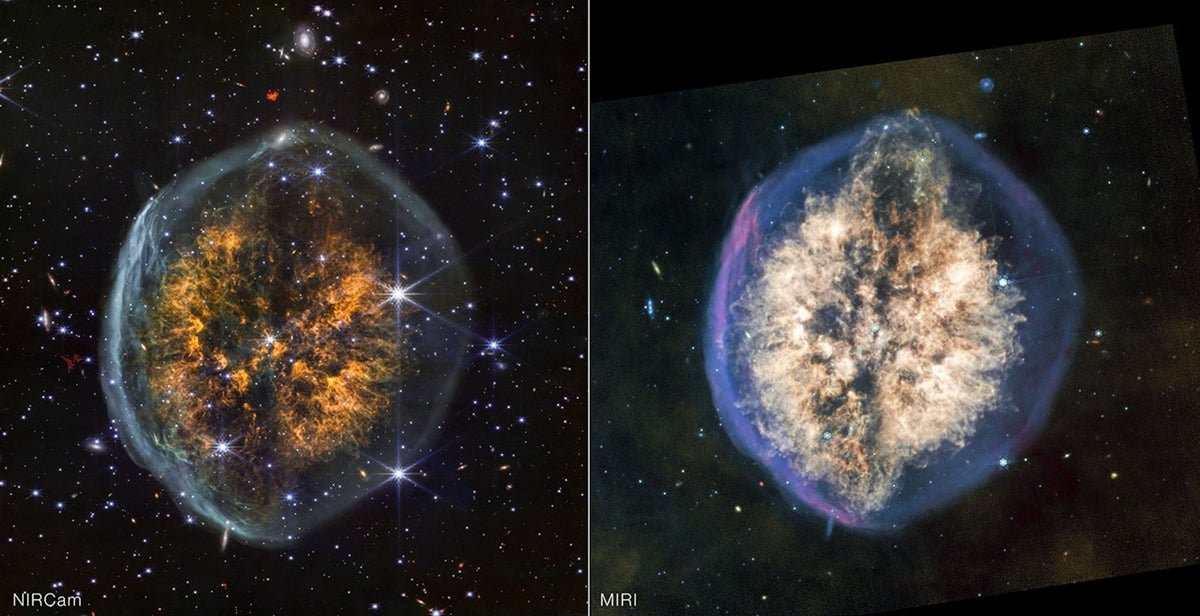
Eerie brain-like nebula captured in stunning new JWST images
Nebula PMR 1 looks uncannily similar to an electrified brain inside a semi-transparent skull
Image: NASA, ESA, CSA, STScI; Image Processing: Joseph DePasquale (STScI)
The death of a star never looked so beautiful. New images captured by the James Webb Space Telescope reveal what looks eerily like a brain floating in space, housed inside a semi-transparent skull.
This is the “Exposed Cranium” nebula, also known as Nebula PMR 1. Located some 5,000 light-years away in the constellation Vela, it’s a massive, moribund star coming to the end of its fuel-burning life. As the star dies, it is shedding layers of its material, generating billowing clouds of gas and dust.
The new images show the nebula in both near- and mid-infrared light, revealing a dark channel that runs through the middle of the clouds of gas and dust—just like the longitudinal fissure that separates our brain’s right and left hemispheres. In the nebula, this feature may be caused by jets coming from the dying star, pushing the inner gas out. The outer layer of gas is mostly made up of simple hydrogen, but the inner gas clouds are more complex.
On supporting science journalism
If you’re enjoying this article, consider supporting our award-winning journalism by subscribing. By purchasing a subscription you are helping to ensure the future of impactful stories about the discoveries and ideas shaping our world today.
It’s unclear what will happen to the dying star. If it is massive enough, it will explode into a supernova. But if not, it will deteriorate until only its core remains, at which point it will become a white dwarf, a dense object that astronomers believe cools over time to become a black dwarf—a cold, dark object that exists only in theory, perhaps because the universe is too young for any to have formed.
It’s Time to Stand Up for Science
If you enjoyed this article, I’d like to ask for your support. Scientific American has served as an advocate for science and industry for 180 years, and right now may be the most critical moment in that two-century history.
I’ve been a Scientific American subscriber since I was 12 years old, and it helped shape the way I look at the world. SciAm always educates and delights me, and inspires a sense of awe for our vast, beautiful universe. I hope it does that for you, too.
If you subscribe to Scientific American, you help ensure that our coverage is centered on meaningful research and discovery; that we have the resources to report on the decisions that threaten labs across the U.S.; and that we support both budding and working scientists at a time when the value of science itself too often goes unrecognized.
In return, you get essential news, captivating podcasts, brilliant infographics, can’t-miss newsletters, must-watch videos, challenging games, and the science world’s best writing and reporting. You can even gift someone a subscription.
There has never been a more important time for us to stand up and show why science matters. I hope you’ll support us in that mission.
