

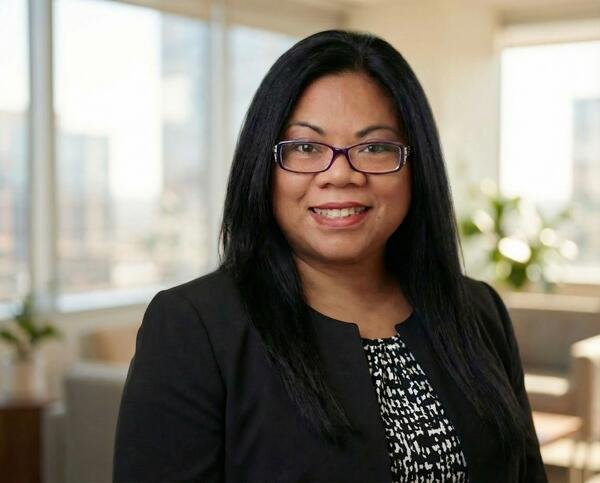
Emelyn A. dela Peña doesn’t shy away from a challenge.
She’s taking over the National Association of Diversity Officers in Higher Education at a time when its members are under fire. In recent years, many campuses renamed or shut down diversity, equity and inclusion offices; pared down supports for students and faculty of color; and laid off diversity officers in response to rapid-fire state and federal policy shifts.
But dela Peña, NADOHE’s new president and CEO, said she felt called to this role precisely in this precarious moment. She spent three decades doing diversity work in higher ed, most recently as the vice president for diversity, equity and inclusion at Loyola Marymount University. She wants to use that experience to support others like her at a time when they most need it, she said.
Inside Higher Ed spoke with dela Peña about her plans for NADOHE and her thoughts on the future of diversity, equity and inclusion work on campuses. The conversation has been edited for length and clarity.
Q: Congratulations on the new position. What drew you to the job?
A: First and foremost, I was drawn to the role at NADOHE because as someone who’s been in the diversity, equity, inclusion, social justice, multiculturalism—whatever you want to call it, the terms have shifted over the last 30 years—I’ve been in it, and I know firsthand how complex and how demanding this work is. Having led diversity, equity and inclusion efforts on campuses, I understand that it’s both a strategic role and that it requires emotional labor on the part of the people who are doing it.
And when I look back over my 30-year career doing this work, there were certainly moments when I wished for even stronger national infrastructure, when I wished for some clear guidance from some kind of umbrella organization, when I had wished that there was more visibility and solidarity for people across the country and internationally who are doing this work. When I think about the times when I was wishing for those things, NADOHE was one of the few places that remained in the public spotlight when it started to get really hard. And I just really wanted to help strengthen the organization at a time when it needs it most and when the field itself really needed it most.
Throughout my career, I’ve always believed that higher ed can be this kind of transformative force when institutions are intentional about who they serve and how they serve them.
[Leading NADOHE] felt like an opportunity to help shape a future where the expertise of the people who are doing this work is understood as an essential component of leadership on college campuses. And I think also it felt like an opportunity to do this work and to support the people on the ground doing it without the politics and constraints of an institution, because sometimes it’s your allies that need to be the one who speak up when it’s not safe for you to speak up.
Q: You touched on this, but you’re taking over NADOHE at this challenging, crucible moment for many higher education diversity officers and people doing related work on campuses. What’s it like for you to step into this role in this particular political moment?
A: I think the way that you put it, “crucible moment,” is so spot on. It really feels like that in this moment. There’s no denying that. It’s really challenging for not just the field but for the people who are in it and for the people who have been doing this work, whether or not they had a title that had diversity, equity or inclusion in it. I think this is such a pivotal moment. It feels like a responsibility to carry on this mantle in this contested time.
And I feel like even though it’s contested in this moment, the underlying work hasn’t disappeared. Students still need environments where they feel a sense of belonging. Faculty and staff still want equitable practices and opportunities for fair representation, and institutions still have a legal and ethical obligation to serve increasingly diverse communities.
I understand what it feels like to carry this portfolio of work when the spotlight is really intense and when the support around it is uneven. But I also understand the quiet, unseen victories, the small policy shifts that happen, the student success stories, the incremental cultural changes that make a real difference. I call that the deep organizing. And that’s the stuff that doesn’t make headlines. You’re not going to win awards for it. You might not even include those kinds of things in reports that you do for boards of trustees. But they make such a difference in small, very tangible ways. It’s that lived experience that grounds how I approach this kind of work.
So, feeling that kind of strong sense of responsibility is always in the back of my mind as I jump in headfirst into this role—a sense of responsibility to not just the professionals who are very visible but also those who are doing the work behind the scenes. The folks who practice equity, who practice fairness, who practice flourishing, even without a title, I feel a sense of responsibility to them. And I feel a sense of responsibility to ensure that NADOHE remains this steady, principled voice that is supporting them in the work that they’re doing.
The last thing about stepping into this role right now is I feel a lot of hope. Sometimes it can feel demoralizing, but the students give me hope, because they hold us accountable to what we promised them when they applied to our institutions. And I have to remember that this isn’t the first time that higher ed has faced backlash when we try to expand opportunities and when we try to expand access. Our field has always evolved in response to external pressures, internal pressures. And so, the question isn’t whether the work continues but how it continues—with clarity, with integrity and with purposeful strategy.
Q: For a recent story, I asked some diversity professionals and scholars how they were thinking about DEI’s future on campuses, whether they felt this was the death of DEI or whether they felt like DEI was changing. You used the word “evolving.” If DEI is changing, in what ways? How do you see the future of this work on campuses right now?
A: What’s different now is that we are moving away from using “DEI” as a noun. We have to get specific about what we’re talking about, because even just the term “DEI” has become such a dog whistle. Part of the work that we have to do and how it’s evolving is to be clear about what are we actually talking about.
For me, diversity can’t die because it’s just a fact. This is the country we live in. You walk onto any college campus and there will be some kind of diversity. Then “equity” is a term that encompasses so much. It encompasses fairness. It encompasses how we think about disparate impact of the policies and programs that we have. It encompasses equal opportunity and antidiscrimination—all of the things that folks who are anti-DEI are saying that they care about. And then inclusion is just the outcome of the things that we’re doing to promote fairness, fair representation, an environment where there isn’t different impact based on identity, where we’re following antidiscrimination.
So, I do believe the field has to evolve under this pressure. And evolution is sometimes uncomfortable. Change is uncomfortable, but I’m hoping that it leads us to greater clarity and focus and intentionality about the language that we’re using and the things that we’re actually trying to change and affect.
From my own experience, I know that diversity, equity and inclusion has never been static. Our language has changed over the years. I started in this work when it was “multiculturalism.” I even remember conversations where we moved from “multiculturalism” to “cross-cultural issues” to amplify the coalition building and the fact that “crossing” felt more active as a word. I’ve been in this work when we’ve called it “pluralism.” It’s always required adaptation to the latest scholarship, the legal shifts, the demographic changes across the country, leadership transitions, whether it’s on a college campus or at a system level or in the country.
I have to remember that the essential questions are still there, and they remain unchanged. The essential questions for me are who has access? Who doesn’t? Who feels like they belong at our institutions? Whose voices aren’t included? Who’s not at the table? Who’s succeeding and who is not? We can’t ignore those questions. Those questions have been the ones that we’ve been trying to answer, at least for me.
Q: In that “adaptation” moment, how do you understand NADOHE’s role? What do you hope the organization can offer its members and higher ed more broadly?
A: In a moment that feels hard, in a moment where you feel like your very identity is under attack, when your life’s work is in the spotlight and often in very negative ways, I hope that NADOHE can be a shot in the arm. I hope we can be the place that lifts you up when you are feeling like there’s no hope—not just for our members, but for the field in general. I hope that we can provide a steadiness and an expertise in a climate that feels really uncertain right now. Practitioners in the field are navigating rapid-fire legislative changes, public and private criticism, institutions that are restructuring sometimes overnight, and so they need credible information from us, some practical guidance about how to navigate this.
Even more importantly, they need a trusted peer community and a system of support when they’re feeling isolated in the work that they’re doing. I understand that the folks in these roles [are] asked to wear so many different hats. We’re asked to manage risk. We’re asked to build consensus and build community. We’re asked to support students in crisis. We are advising senior leaders and boards all at the same time, and all while navigating our own identities and the ways we experience the institution ourselves. That is some sophisticated organizational leadership. And so NADOHE has to continue to affirm and strengthen that professional identity for equity practitioners.
And then I think that we also have the responsibility to equip future equity practitioners to confidently navigate all of this complexity. We’re an association that serves the field, not just the CDO, whether that’s a cultural center director trying to make sense of the current legal landscape or whether it’s an HR director trying to create inclusive hiring or inclusive interviewing protocols, or whether it’s academic affairs trying to think about what does equitable tenure standards look like? We have to be an association that serves all of those people.
Q: What are some of your goals for NADOHE over the next few years?
A: One major goal I have is to strengthen professional development. Many of the early-career as well as senior diversity officers are entering these roles that are more politically complex than ever before. We need to upskill the folks who are doing this work. They need skills in change management, in policy navigation, in strategic communications, in crisis communications and in executive leadership.
I also want to expand NADOHE’s research and thought leadership. We need to continue to document the impact of diversity, equity and inclusion efforts and to examine how institutional models are shifting, how adaptations are working, because that knowledge helps ground our conversations in evidence rather than in political rhetoric, rather than in frustrations and feelings and in anecdotal data.
I want to create a community of practice, because I think a system of support is so important for folks who are on the ground. Building community is really important, and recognizing that in moments like this isolation can be one of our greatest challenges. I want our members to feel connected and supported and equipped to do this work.
And then, practically speaking, sustainability and long-term strategy are really critical right now. We have to remain financially strong. We have to remain forward-thinking, and we have to be responsive to the evolving needs of the profession, whether that means expanding what our membership base looks like or thinking differently about how we are servicing the field and not just the chief diversity officer.
Ultimately, my goal is that our members feel affirmed in their expertise and that we are serving the broader field of diversity, equity and inclusion. [We want to be] inserting ourselves in conversations about antidiscrimination, about fair representation, about equal opportunity, and then making sure that diversity officers and equity practitioners are positioned as strategic partners within their institutions, because that makes the institution stronger and more innovative. And ultimately, that helps all of us to better serve all students.
