

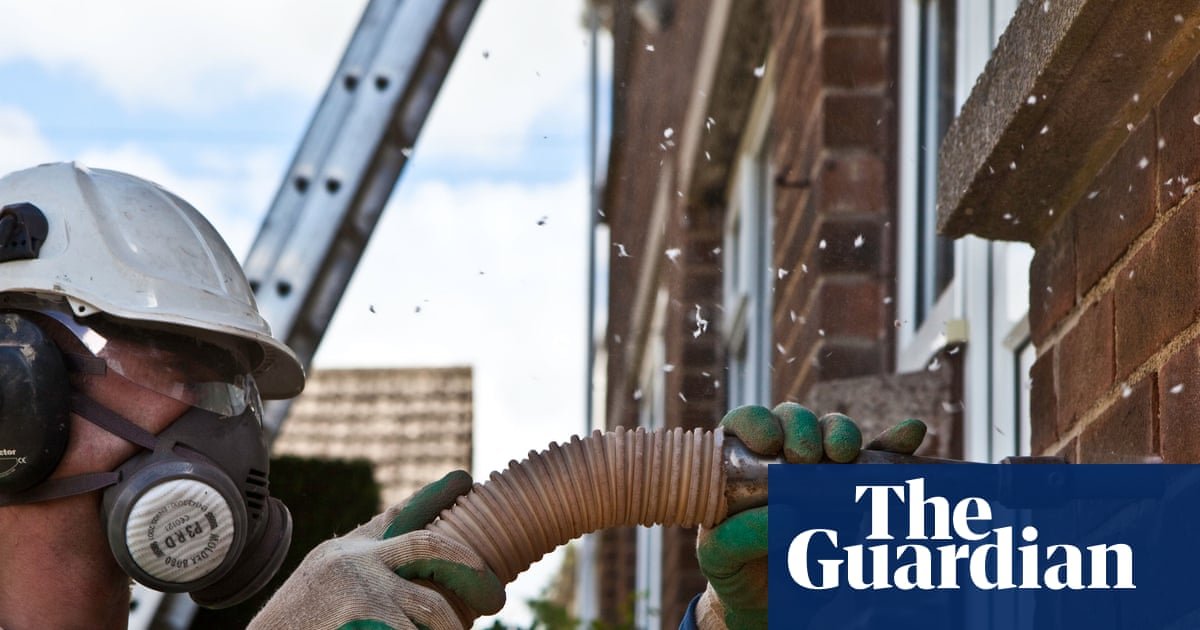
Councils should train up their own workers to install insulation in England’s draughty houses, and offer home upgrades street by street, beginning in the most deprived areas, according to proposals for cutting energy bills.
Setting up “home improvement corporations” would allow greater control by councils over low-carbon retrofits for housing, and would be a more efficient way of spending limited public funds for insulation, according to the Common Wealth thinktank, which will set out the proposals in a report this week.
Under the warm homes plan, unveiled in January, the government plans to spend £15bn over the next three years to equip homes with better insulation, heat pumps and solar panels, which should cut energy bills as well as reducing greenhouse gas emissions.
Much of the work will need to be done by local authorities, and the standard way of working is for councils to join together and bid for government funding. Many local authorities are frustrated with this method, which can be time-consuming and bureaucratic for small gains.
Common Wealth cited the example of the Warmer Homes consortium, led by Portsmouth city council, which was allocated £22m among 31 authorities over three years. This breaks down to about 450-650 homes per year, or 15-20 homes per local authority per year.
Most insulation schemes to date have relied heavily on private contractors to do the work, but this has often proved problematic. Last year, the National Audit Office found repairs were needed to 98% of homes fitted with external wall insulation under the energy company obligation (Eco) and Great British Insulation Scheme, run by the last Conservative government.
More than a quarter of those fitted with internal insulation under the schemes also needed remediation, the NAO found. In January, the public accounts select committee called for an investigation by the Serious Fraud Office into the “catastrophic failure” of the schemes.
To avoid the same contractors delivering similar failures, Common Wealth proposed that councils be allowed to do more of the work in-house, training up a large proportion of the estimated 140,000 people needed to install insulation, and employing them permanently in order to keep up a steady stream of home improvements beyond the current warm homes plan.
Madeleine Pauker, the lead author of the Common Wealth report, said: “The current model is not capable of delivering that level of increase in the number of skilled workers. It has to be led by the public sector.”
Having more workers under the control of councils rather than private contractors would raise standards, she said. “[Home improvement corporations] mean accountability and oversight.”
The insulation teams could offer home upgrades systematically on a street-by-street basis, instead of the patchwork systems of the past which have tended to rely on households applying for grants or loans, with mixed results. Street-by-street programmes could work on an opt-out basis – families would have to explicitly reject upgrades, rather than proactively ask for them – and could be coupled with repair and remedial operations where homes are rundown.
Common Wealth argues that working this way, with 30 home improvement corporations covering England, would allow for greater coverage of insulation upgrades among deprived communities, and higher efficiency in the programme.
The Department for Energy Security and Net Zero, which is in charge of the warm homes plan, said: “Our £15bn warm homes plan could upgrade entire streets of social homes at once, lowering bills and making whole neighbourhoods warm.
“Our new Warm Homes Agency will also transform people’s experience of home upgrades, including providing initial advice to ensure consumers have confidence in accessing quality installations.
“We will work closely with local government, as we improve millions of homes in communities across the country.”
Responding to the report, Christopher Hammond, the chief executive of UK100, a network of local authorities pursuing climate goals, said: “The Eco scandal showed what happens when you create a gold rush for markets with short-term funding rather than building long-term quality local supply chains. The warm homes plan recognised the need for local authorities to have a greater role in the biggest energy efficiency upgrade in a generation. The good news is that there are councils already doing street-by-street home improvements well.”
Hammond said the Holbeck district in Leeds had been “transformed” by the council taking on needed repairs alongside insulation, with a 90% uptake by residents.
He said the creation of home improvement corporations, as recommended in the report, was not the only way of achieving this. “We’re already operating with tight timescales to scale up what’s already working,” he said.
“The report also prompts a look at why past schemes haven’t worked and why we need to keep benefits local. The simplest way to do that is by giving local leaders the long-term, non-competitive resources they need.”
