

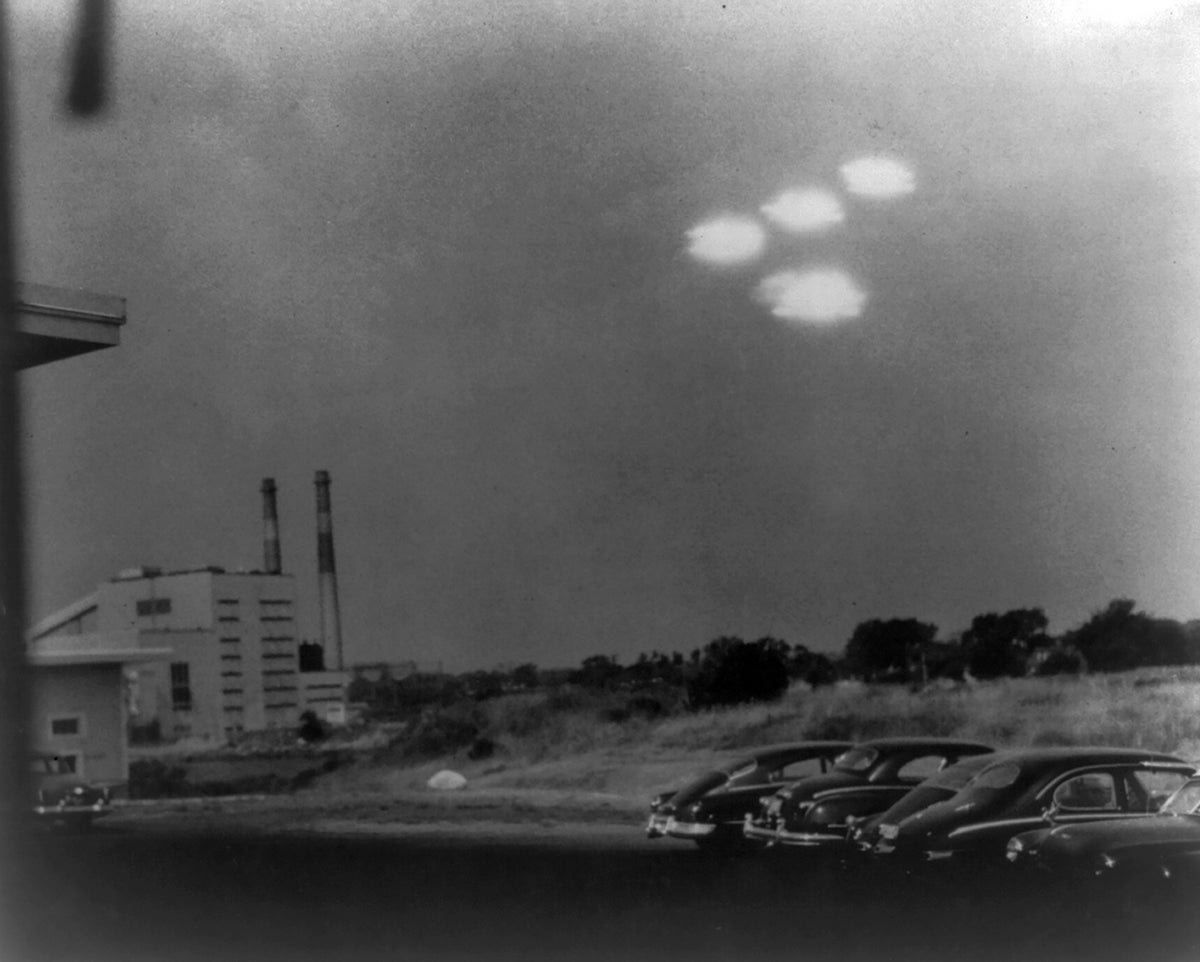
U.S. President Donald Trump on Thursday announced that he directed the Department of Defense and other federal agencies to “begin the process of identifying and releasing Government files related to alien and extraterrestrial life, unidentified aerial phenomena (UAP), and unidentified flying objects (UFOs), and any and all other information connected to these highly complex, but extremely interesting and important, matters.”
The directive comes after former President Barack Obama in a podcast interview earlier this week said he believes aliens are “real,” but that he hadn’t seen evidence of them during his presidency.
Speaking to reporters aboard Air Force One on Thursday, Trump criticized Obama’s remarks, alleging that the former president’s comments had disclosed “classified information.” (Trump himself has previously faced charges for improper handling of classified materials.) Trump’s declassification order, the current president said, “may get [Obama] out of trouble.”
On supporting science journalism
If you’re enjoying this article, consider supporting our award-winning journalism by subscribing. By purchasing a subscription you are helping to ensure the future of impactful stories about the discoveries and ideas shaping our world today.
Sean Kirkpatrick, who served as the first director of the Pentagon’s All-Domain Anomaly Resolution Office (AARO) from 2022 to 2023, tells Scientific American that “Obama said nothing classified, and in fact said nothing that hasn’t been said in many forums—including in Congressional testimony.”
Trump’s announcement also comes hot on the heels of the contentious release of other government documents—a vast, heavily redacted database of materials derived from federal investigations into the disgraced financier Jeffrey Epstein, with whom Trump and many other powerful world figures had been associated.
What do President Trump and former President Obama know about aliens?
Obama has since clarified his views on aliens after his podcast interview caused uproar, saying that he “saw no evidence during my presidency that extraterrestrials have made contact with us. Really!” The assertion that aliens are real, the former president said, was a matter of statistics: “The universe is so vast that the odds are good there’s life out there,” he wrote in an Instagram post. “But the distances between solar systems are so great that the chances we’ve been visited by aliens is low.”
Trump, for his part, explained to reporters aboard Air Force One that he, too, is in the dark, saying that “I don’t know if they’re real or not.”
Is there evidence that aliens have ever visited Earth?
To date, no U.S. government report or investigation has produced any evidence that extraterrestrials have visited Earth despite many decades of official study tracing back to the mid-20th century. In the last decade, the Pentagon’s AARO as well as a NASA-commissioned expert panel have documented sightings of unexplained objects, but neither have concluded that any of these incidents are evidence of alien technology or life.
“There is no evidence to suggest that any of these UAP sightings are extraterrestrial in nature,” Kirkpatrick says. “There is, however, a tendency to sensationalize sightings for which there is little hard data.”
Many such events have been ultimately attributed to misidentified aircraft, atmospheric phenomena or sensor artifacts—although experts acknowledge there is much still to learn.
“As a scientist and a member of NASA’s UAP panel, I haven’t seen anything that indicates we have observed phenomena that violate the laws of physics and require an alien society visiting us to be explained,” says Federica Bianco, an astrophysicist at the University of Delaware. “We have shown in our NASA study group that even the most unusual sightings could be explained by known human-built technologies, when the right assumptions were made.”
Beyond the federal realm, some space scientists such as Avi Loeb, a Harvard astrophysicist, and Beatriz Villaroel, a researcher at the Nordic Institute for Theoretical Physics in Sweden, have independently presented claims of evidence for possible alien visitation. Much of Loeb’s focus has been on the surprising behavior of interstellar objects passing through the solar system, while Villaroel has argued that lights in the sky appearing on pre-Space Age photographic plates could indicate artificial objects in Earth orbit before the launch of humanity’s first satellites.
These claims have been widely met with skepticism by other scientists, with some arguing that these observations can be explained by natural causes or human activity.
Thomas Zurbuchen, an astrophysicist and former associate administrator of NASA’s Science Mission Directorate who set up the agency’s UAP panel, says scientific investigations of potential alien encounters should not be inappropriately stigmatized, and that the recommendations in the group’s final report still stand.
“It’s a good idea to look at various datasets and to look for unusual activity—and learn from it as much as we can,” he says.
The scientific search for extraterrestrial life is alive and well. Loeb, for instance, has launched the Galileo Project, a network of small telescopes and other instruments that could observe and study overflying UAPs, and multiple modest Search for Extraterrestrial Intelligence (SETI) efforts exist to look for electromagnetic transmissions washing over Earth from putative cosmic civilizations. Like all previous searches, these have yet to deliver any conclusive evidence of aliens.
NASA, for its part, has spent decades and billions of dollars on the quest to find life elsewhere in the universe, most recently launching Europa Clipper to scout out the habitability of a moon of Jupiter and developing Dragonfly, a flying drone for studying the environment of Titan, Saturn’s largest and perhaps most astrobiologically intriguing moon.
But the space agency’s most notable search for aliens is probably its effort to identify possible signs of ancient life on Mars and to bring samples back to Earth. The “Mars Sample Return” program, however, has been plagued by budget overruns and schedule delays. Earlier this year its funding was zeroed out, effectively canceling the mission.
Meanwhile, observations of potentially habitable exoplanets by the James Webb Space Telescope have also uncovered what some scientists have controversially interpreted as possible biosignatures. NASA is now in the midst of developing an even more ambitious telescope, the Habitable Worlds Observatory, that is targeted for the 2030s and could more closely study promising exoplanets for potential signs of life.
What happens next?
Trump’s Thursday directive did not specify which government files would be declassified or when they might be made public, but rather signaled the start of a process in which officials would review relevant documents and other evidence for potential disclosure. The selection, review, declassification and eventual release of any materials could take weeks, months or even years.
Kirkpatrick expects any release will contain “no new revelations.”
While acknowledging she lacks access to classified information, astrophysicist Bianco says that “the timing convinces me that this is but a move to distract the people in the United States from multiple ongoing political and societal crises and the failures of this administration.”
