
Close Menu

    Subscribe to Updates

    Get the latest creative news from FooBar about art, design and business.

    What's Hot

    The Guardian view on the royals and the law: no more managed disgrace | Editorial

    After Research, Tennessee Lawmaker Drops Bill to End Tenure

    Microsoft scientists invent tiny glass ‘books’ that could store data for millennia

    Facebook X (Twitter) Instagram
    Facebook X (Twitter) YouTube LinkedIn
    Naija Global News |
    Friday, February 20
    • Business
    • Health
    • Politics
    • Science
    • Sports
    • Education
    • Social Issues
    • Technology
    • More
      • Crime & Justice
      • Environment
      • Entertainment
    Naija Global News |
    You are at:Home»Science»Simulations shed light on how snowman-shaped body in Kuiper belt may have formed | Space
    Science

    Simulations shed light on how snowman-shaped body in Kuiper belt may have formed | Space

    onlyplanz_80y6mtBy onlyplanz_80y6mtFebruary 19, 2026003 Mins Read
    Share Facebook Twitter Pinterest LinkedIn Tumblr Email
    Simulations shed light on how snowman-shaped body in Kuiper belt may have formed | Space
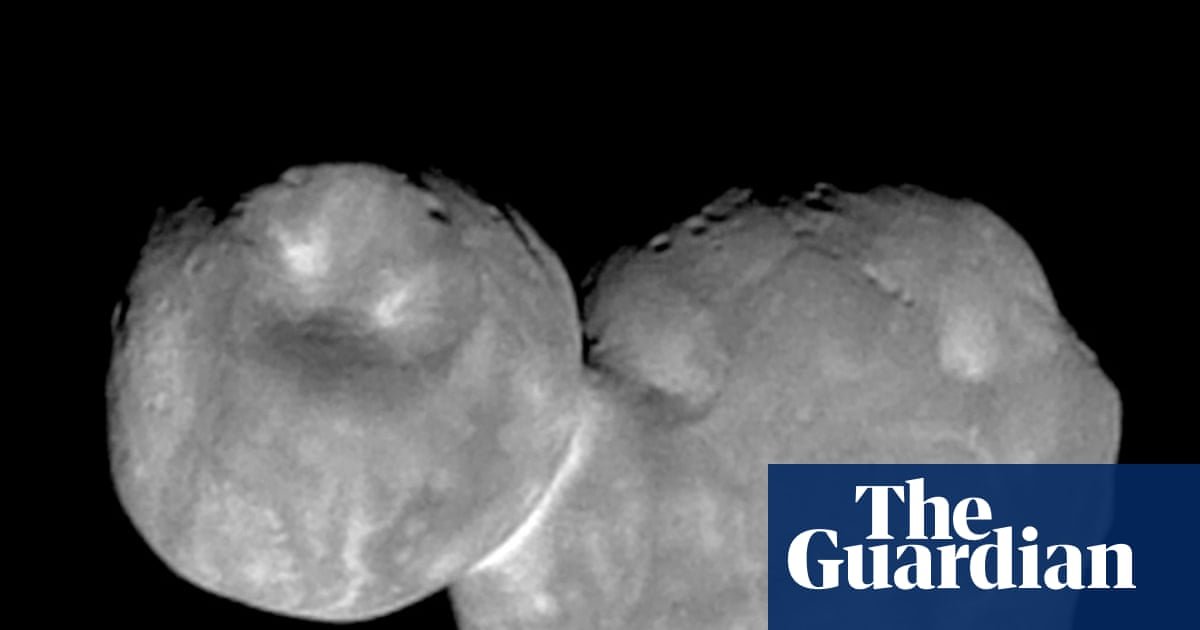
    A 2019 image by Nasa of Arrokoth in the Kuiper belt. Photograph: AP
    Share
    Facebook Twitter LinkedIn Pinterest Email

    It is the most distant and primitive object ever visited by a spacecraft from Earth: now researchers say they have fresh insights into how the ultra-red, 4bn-year-old body known as Arrokoth came to have its distinctive snowman-like shape.

    Arrokoth sits in the Kuiper belt, a vast, thick ring of icy objects that lies beyond the orbit of Neptune. This region of space is home to most of the known dwarf planets as well as comets and small, solid rubble heaps called planetesimals – the building blocks of planets.

    Not all of these planetesimals are rounded: indeed, astronomers estimate 10-25% of those found in the Kuiper belt, including Arrokoth, have two lobes, meaning they look a bit like a peanut or a snowman.

    Experts have previously said Arrokoth’s shape, composition and small number of craters suggests both lobes formed at the same time and in a non-violent way, proposing that this could have occurred through a process known as gravitational collapse. However, the details of just how this would have happened have been debated.

    Now researchers have used computer simulations to show that gravitational collapse can indeed produce such double-lobed objects, and to shed light on the mechanism.

    “It’s so exciting because we can actually see this for the first time,” said Jackson Barnes, the first author of the research, based at Michigan State University. “This is something that we’ve never been able to see from beginning to end, confirming this entire process.”

    As Barnes notes, the Kuiper belt is a remnant of the solar system’s primordial protoplanetary disk, within which vast rotating clouds of pebbles are thought to have formed. In the gravitational collapse scenario, gravitation forces within these clouds caused the pebbles to form into clumps, or planetesimals, of different sizes.

    Writing in the Monthly Notices of the Royal Astronomical Society, Barnes and colleagues report how they ran 54 simulations involving an initial pebble cloud containing 105 particles, each with a radius of about 2km (1.25 miles). This is a low-resolution model of the true situation as it is thought real pebble clouds would have contained about 1024 millimetre-sized particles.

    The team found that in some cases two small planetesimals ended up orbiting each other, eventually spiralling inwards until, at velocities of about 5 metres a second or less, they touched and joined, forming a doubled-lobed planetesimal, or “contact binary”.

    “Some of the contact binaries in our model look strikingly like Arrokoth,” Barnes said.

    He noted that researchers had simulated gravitational collapse before but, unlike the new approach, they did not take into account the physics of how particles rest upon each other when they make contact. As a result, these simulations suggested any collision between smaller planetesimals would simply result in one larger, spherical object.

    Barnes said the new simulations were also important because they supported the long-held view that planetesimals in general were formed through gravitational collapse.

    Alan Stern, a planetary scientist at the Southwest Research Institute and principal investigator of Nasa’s New Horizons mission to the Kuiper belt, welcomed the study.

    “It’s in agreement with previous work and support[s] the hypothesis that Kuiper belt object Arrokoth, which New Horizons explored in a close flyby, is the result of gentle formation processes,” he said.

    Alan Fitzsimmons, an emeritus professor of astronomy at Queen’s University Belfast, noted that the simulations only suggested 4% of objects “out there” formed as contact binaries.

    “Telescopic surveys imply much higher fractions,” he said. “It may be that Mother Nature prefers other ways of making them, or that future even more complex simulations can close the gap between what is calculated and what we see.”

    belt body Formed Kuiper Light shed Simulations snowmanshaped space
    Share. Facebook Twitter Pinterest LinkedIn Tumblr Email
    Previous ArticleOpenAI and Anthropic Rivals Share Awkward Moment at A.I. Summit
    Next Article Schools in England to get budget for children with special needs as part of Send overhaul | Special educational needs
    onlyplanz_80y6mt
    • Website

    Related Posts

    Microsoft scientists invent tiny glass ‘books’ that could store data for millennia

    February 20, 2026

    the struggles faced by researcher mothers

    February 19, 2026

    Alzheimer’s blood tests predict the average age at which the disease may strike, study finds

    February 19, 2026
    Add A Comment
    Leave A Reply Cancel Reply

    Top Posts

    Watch Lady Gaga’s Perform ‘Vanish Into You’ on ‘Colbert’

    September 9, 20251 Views

    Advertisers flock to Fox seeking an ‘audience of one’ — Donald Trump

    July 13, 20251 Views

    A Setback for Maine’s Free Community College Program

    June 19, 20251 Views
    Stay In Touch
    • Facebook
    • YouTube
    • TikTok
    • WhatsApp
    • Twitter
    • Instagram
    Latest Reviews

    At Chile’s Vera Rubin Observatory, Earth’s Largest Camera Surveys the Sky

    By onlyplanz_80y6mtJune 19, 2025

    SpaceX Starship Explodes Before Test Fire

    By onlyplanz_80y6mtJune 19, 2025

    How the L.A. Port got hit by Trump’s Tariffs

    By onlyplanz_80y6mtJune 19, 2025

    Subscribe to Updates

    Get the latest tech news from FooBar about tech, design and biz.

    Most Popular

    Watch Lady Gaga’s Perform ‘Vanish Into You’ on ‘Colbert’

    September 9, 20251 Views

    Advertisers flock to Fox seeking an ‘audience of one’ — Donald Trump

    July 13, 20251 Views

    A Setback for Maine’s Free Community College Program

    June 19, 20251 Views
    Our Picks

    The Guardian view on the royals and the law: no more managed disgrace | Editorial

    After Research, Tennessee Lawmaker Drops Bill to End Tenure

    Microsoft scientists invent tiny glass ‘books’ that could store data for millennia

    Recent Posts
    • The Guardian view on the royals and the law: no more managed disgrace | Editorial
    • After Research, Tennessee Lawmaker Drops Bill to End Tenure
    • Microsoft scientists invent tiny glass ‘books’ that could store data for millennia
    • Brazilian Amazon on Track for Record Low Deforestation
    • CDC vaccine panel meeting postponed amid RFK Jr bid to reshape policy | Robert F Kennedy Jr
    © 2026 naijaglobalnews. Designed by Pro.
    • About Us
    • Disclaimer
    • Get In Touch
    • Privacy Policy
    • Terms and Conditions

    Type above and press Enter to search. Press Esc to cancel.