

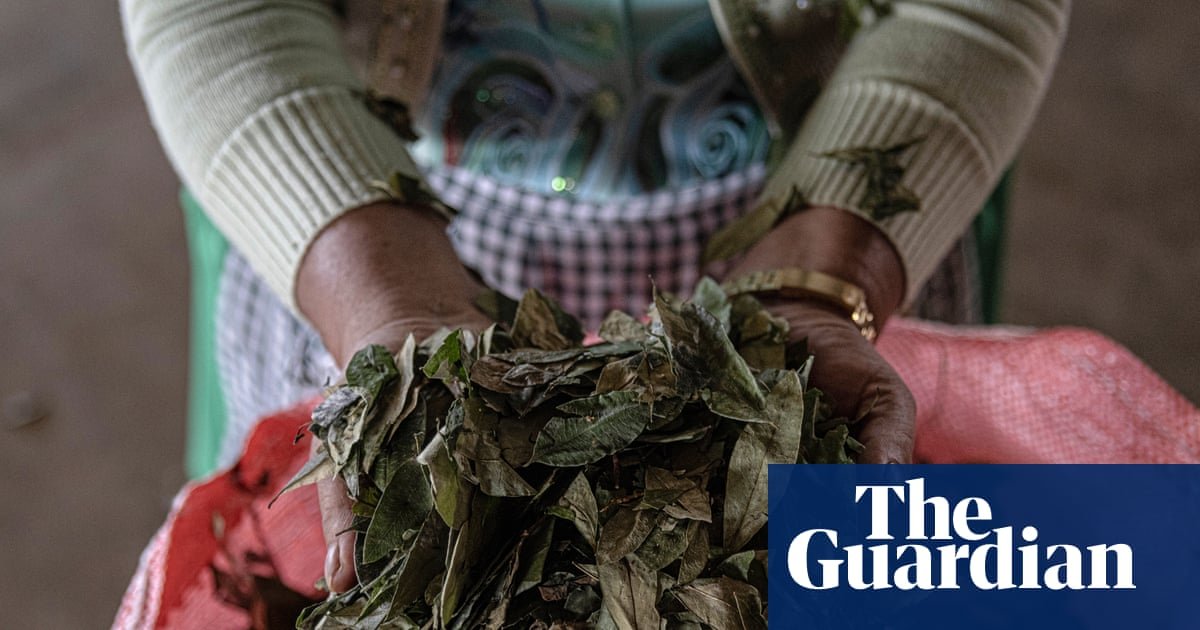
For thousands of years, Andean people living around what is now the town of Coripata, east of La Paz, Bolivia, have used coca leaves to relieve fatigue, hunger and altitude sickness (known as soroche), as well as to treat headaches and digestive problems.
Concerned about the future of this cultural and religious practice, Daynor Choque, heir to this ancient tradition, points to a pile of leaves on the table in front of him.
“We have been using coca without any problems since the time of our ancestors,” says Choque, leader of the commercial arm of local coca producers. “Now, producers are being pushed into the illegal cocaine market just to survive – unless we can sell our coca legally on international markets.”
The growers’ wishes were dealt a blow last December when, 65 years after the UN’s convention on narcotic drugs first declared that the coca leaf should be as restricted as its derivative, refined cocaine, the World Health Organization (WHO) refused to change the leaf’s status.
Even though a recent WHO critical review found that coca leaf (Erythroxylum coca) does not harm human health, the leaf – which contains 1% or less of the cocaine alkaloid – remains on the same dangerous drug list as heroin, fentanyl and cocaine.
For six decades, we have suffered this violation of … our legitimate rights to use our sacred coca leaf as we see fitDavid Choquehuanca
The list, established under the 1961 UN convention, regulates 138 substances and is recognised by 186 countries. In 2023, Bolivia, backed by Colombia, requested that the WHO conduct its first published critical review of coca leaf in the hope that it would reclassify coca or remove it from the UN list.
The coca leaf is a vital part of Andean-Amazonian Indigenous culture, entwined in daily social interactions and present in every ritual from birth to death. The Andean peoples of Bolivia traditionally use coca leaves as a central element of their culture.
“Coca is life itself for us,” says Celestina Ticona, a coca farmer.
Bolivian miners chew coca leaves during a protest in La Paz. Chewing it helps relieve fatigue and hunger, as well as altitude sickness in the high Andes. Photograph: Jorge Bernal/AFP/Getty
The leaf is consumed daily by an estimated 5 million people as a mild stimulant and herbal remedy, comparable to tea or coffee. The WHO’s critical review recognises its antioxidant, anti-inflammatory, antimicrobial and anticancer properties.
“For six decades, we have suffered this violation of Indigenous sovereignty,” says Bolivia’s former vice-president David Choquehuanca, whose office coordinated the international reclassification effort.
“The WHO’s recent historical error has violated our legitimate rights to use our sacred coca leaf as we see fit for therapeutic, nutritional and ritual practices, and to share it with the world,” he says, adding: “A country that doesn’t respect its culture is destined to disappear.”
The recent WHO decision significantly contradicts international law, according to John Walsh, director for drug policy and the Andes at the Washington Office on Latin America (WOLA), a human rights advocacy organisation.
“Given the evolution of Indigenous rights within the UN, including the WHO, over the past decades, there is a huge gap between how the WHO is developing its other work and this ruling,” he says.
The WHO cited mounting public health concerns for its decision, noting in the review: “While acknowledging the longstanding cultural and traditional value of coca use, particularly in the Andean region, the committee emphasised that scientific evidence on dependence, long-term safety and potential therapeutic applications that would justify broader international trade of coca leaf for medical and scientific use remains limited.”
Celebrations in La Paz for El Día Nacional del Acullico (national coca-leaf chewing day). Photograph: C Morales/Reuters
Dilkushi Poovendran, a WHO technical officer, says: “Rising cocaine seizures and cocaine stimulant use disorders as well as the discovery of cocaine in regions of the world that haven’t seen it before were all considered.”
We want to be able to sell products made from our sacred coca leaf worldwideDavid Choquehuanca
Increased coca cultivation since the Covid pandemic have precipitated surging cocaine production and consumption worldwide, making it the world’s fastest-growing illegal drug.
Cocaine has become so widespread on international markets in recent years that its wholesale price has halved in recent years. According to Volker Türk, UN high commissioner for human rights, policies founded on the logic of the “war on drugs”, despite failing to reduce use or deter crime, have proved inadequate to slow this flow, putting pressure on the UN to maintain existing controls.
A woman in La Paz sells coca-based remedies on the national day of acullico (chewing coca). Photograph: J Bernal/AFP/Getty
Reclassifying coca leaf could have enabled the adoption of national drug policies that overturn bans on products made from the leaf, such as teas, balms and toothpaste. “We want to be able to sell products made from our sacred coca leaf worldwide,” says Choquehuanca.
Poovendran insists that coca-producing regions can do this. “Countries can rely on the current international control measures to pursue their interest in commercialising preparations such as coca-leaf teas,” she says.
In practice, however, most national drug policies take their lead from the UN, resulting in state bans on the coca leaf under the same stipulations as those restricting cocaine.
According to WOLA’s Walsh, upholding these regulations creates a paradox in which scientific research into coca’s effects and potential therapeutic uses, which could justify reclassification, is restricted.
However, experts say that until a legal international market for coca-leaf products that benefits growers is well developed, farmers already committed to the illegal market will not benefit from a lifting of worldwide restrictions.
Growers harvesting coca leaves at a plantation in Los Yungas, Bolivia. As coca-leaf production soared in recent years, the wholesale price of cocaine fell. Photograph: Marcelo Perez del Carpio
Tom Grisaffi, an anthropologist at the University of Reading who has researched coca growers, says: “Coca’s illegality provides a comparative advantage for small farmers.
Given that Andean countries are inserted on such unfavourable terms into global markets, crops such as tea, coffee, oranges, or pineapples just don’t make money; illegal coca does.”
Turning products designed for legal markets such as coca tea or flour into coca paste is not viableJohn Walsh, human rights advocate
A fundamental question in the WHO’s critical review addressed how easy it is to transform the leaf into refined cocaine. Poovendran says: “What the critical review found is that converting coca leaf to coca paste is quite simple to do. It doesn’t take big volumes of coca leaf, and it doesn’t require a lot of chemicals.”
This assessment is disputed by those campaigning for the coca leaf’s reclassification. Walsh says: “Turning products designed for legal markets such as coca tea or flour into coca paste is simply not viable economically, given the volume of leaf needed.”
The WHO calculates that it takes a ton of dried leaf to produce about 900g of cocaine that is 85% pure. Producing purified cocaine from the leaf requires a three-stage process that many analysts describe as lengthy and labour intensive.
Growers fill sacks of leaves at Chimoré’s coca market. It takes a ton of dried leaf to produce about 900g of cocaine but far less for its traditional uses. Photograph: Marcelo Pérez del Carpio
The WHO recommendation came in the aftermath of the decision by its most important funder, the US, to withdraw from the international health body from January 2026. The US has always been the world’s strongest advocate against modifying coca’s status.
“US defunding clearly reinforced the WHO’s own tendency to maintain the leaf in the same narcotics drug category,” says Walsh.
A fortune teller uses coca leaves to read a client’s future during acullico celebrations in La Paz. A Bolivian politician calls the plant ‘a sacred part of our culture’. Photograph: C Morales/Reuters
The recent review is not the first time that the WHO has conducted research into coca leaf. Scheduled for release in 1995, a two-year WHO study, billed as the largest ever on cocaine use, reached conclusions similar to the latest analysis.
But the study never saw the light of day once the US representative warned the WHO’s principal decision-making body that “if activities relating to drugs failed to reinforce proven drug control approaches, funds for the relevant programmes should be curtailed”.
The next challenge for drug reform advocates is to identify a country willing to launch an appeal to the UN economic and social council, whose broader mandate may permit it to override the WHO ruling. Given a conservative new government in Bolivia and the term of the Colombian president, Gustavo Petro, ending in August, the momentum towards rehabilitating the coca leaf may have faded.
“We see this outcome as another attack on our culture,” Choquehuanca says of the decision. “The WHO refused to consider coca as we have always done: a sacred part of our culture that has nothing to do with cocaine.”
The headline of this article was amended on 10 February 2026 to refer to “curbs” rather than a “ban” on coca leaves.
