

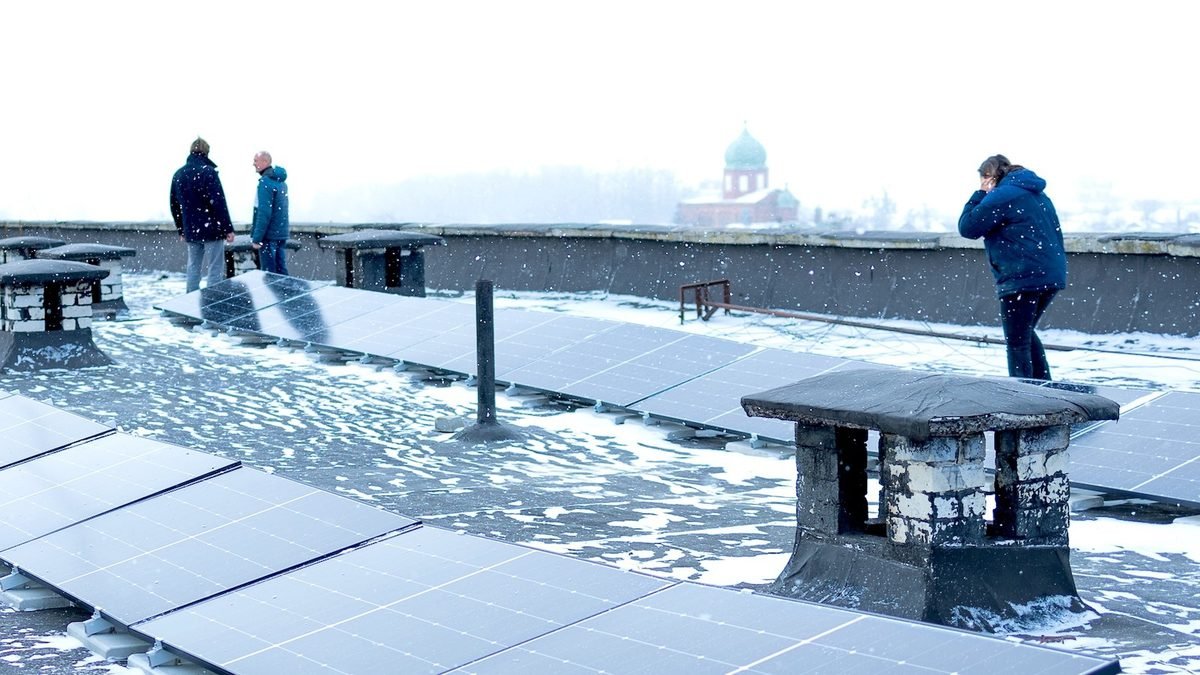
When Russian air strikes knocked out Ukrainian power plants earlier this winter, much of the Black Sea port city of Mykolaiv went dark, and indoor temperatures plummeted. Just 60 kilometers from the front, Tornado rockets, cruise and ballistic missiles, and attack drones have been raining down on the city of 450,000 for the last four years. Now, during the coldest winter in more than a decade, most of Mykolaiv’s citizens are once again enduring bitterly cold homes and, when electric water pumps fail, dry taps.
But there are new glimmers of hope in Mykolaiv. Last November, 26 newly installed photovoltaic roof panels, paired with 100 kilowatt-hours of lithium battery storage, began to power heat pumps and generators to keep the city’s Urban Rehabilitation Center for Children and Persons with Disabilities up and running. Thanks to the Danish Refugee Council and Denmark’s foreign ministry, the project’s donors, the center continued operating even during a 32-hour stretch of shelling in mid-December. In addition to treating 70 patients a day, the center has opened its doors to at-risk Mykolaivians who lack heat. Several other institutions in Mykolaiv have also jettisoned their exclusive reliance on the national grid, which is mostly powered by large natural gas, coal-fired, and nuclear plants, and now draw energy from small-scale distributed systems that produce electricity at or near the point of use.
Grid operators are looking past the next drone swarm, pushing to diversify the country’s energy sources.
Since the war’s onset, Russia has targeted Ukraine’s energy infrastructure — its old-school fossil-fueled power plants, substations, and transmission lines — in an effort to advance its offensive and beat down the Ukrainian people. Before this winter even set in, half of Ukraine’s energy infrastructure lay in ruins. Economists estimate that total damage to the nation’s energy sector now exceeds $56 billion.
Subscribe to the E360 Newsletter for weekly updates delivered to your inbox. Sign Up.
This winter is the most devastating yet: Attacks have left giant swaths of the country with irregular electricity and heat as temperatures have plummeted to minus 4 degrees Fahrenheit. The bitter conditions have left many schools and other public services closed since Christmas. In Kyiv, as well as in Kharkiv, Poltava, and Dnipro, more than 1,000 public heating tents, powered by diesel generators and wood-burning stoves, offer residents warmth and a place to charge their phones. But these improvisations are too little. On January 14, President Volodymyr Zelensky declared a state of emergency in the energy sector.
While Ukraine’s energy system, which had a pre-war generation capacity of 60 gigawatts, scrambles to keep the lights on, grid operators are also looking past the next drone swarm, pushing to diversify the country’s energy sources, says Lars Handrich, a German energy expert who works closely with Ukraine. The plan is to replace the bulky thermal plants and centralized grid, which are vulnerable to drone and other attacks, with distributed renewables and modestly sized gas-fired plants that make less attractive targets for incoming fire. According to estimates from the Solar Energy Association of Ukraine, the nation installed at least 1.5 gigawatts of new solar generation in 2025 — enough to power roughly 1.1 million homes — and grid operators intend to almost double the country’s renewable energy production over the next four years.
A power plant damaged by Russian attacks at an undisclosed location in Ukraine.
Roman Pilipey / AFP via Getty Images
Ukraine is revamping its power sector as rapidly as it can, not for climate protection but for energy security. “Ukraine’s energy transition is not a slogan,” says Ievgeniia Kopytsia, a Ukrainian energy analyst at the Institute for Climate Protection, Energy and Mobility. “Since the full-scale invasion, Ukraine has added over 3 gigawatts of new renewable energy capacity. It’s a security-driven transformation, unfolding under extreme constraints, that prioritizes decentralization, flexibility, and speed of recovery.”
Wind and solar arrays with independent transmission lines are scattered over the landscape, which makes them harder to hit and easier to repair. “A coal power station [is] a large single target that a single missile could take out,” says Jeff Oatham of DTEK, Ukraine’s largest energy company and its largest private energy investor. “You would need around 40 missiles to do the equivalent amount of capacity damage at a wind farm.”
Solar, too, makes an unattractive target. “Attacking decentralized solar power installations is not economically rational,” says Ukrainian energy expert Olena Kondratiuk. “Missiles and drones are expensive, and significantly disrupting such systems would require a large number of strikes, while the overall impact on the energy system would remain limited.” Both solar and wind parks can function even when parts of them are out of operation.
Ukraine’s shift away from fossil fuels began before Russia’s full-scale invasion: To join the European Union, the nation must adopt the bloc’s climate criteria, and in 2021 Ukraine pledged to be coal free by 2035. The war interrupted this phaseout, but it also accelerated Ukraine’s adoption of renewables, despite its strapped budget.
Solar installations atop households and businesses have continued at an unprecedented pace during the war.
European countries are bankrolling most of Ukraine’s energy makeover, including all of the Mykolaiv solar installations. West of Kyiv, the city of Zhytomyr has plans to run entirely on renewables by 2050 with the help of the Rebuild Ukraine initiative, which is largely European funded. And in the Kyiv region and beyond, solar systems supported by the Solar Supports Ukraine program are keeping schools open during blackouts. A self-financed exception: Before the war began, the Sunny City cooperative in Slavutych, a town near the Belarus border, crowdfunded to create a solar power plant on the roofs of three municipal buildings.
From ruins to reuse: How Ukrainians are repurposing war waste. Read more.
According to the International Energy Agency, Ukraine made “strong strides” in rebuilding and bolstering its system’s resilience this past summer. The renewables rollout was — and still is — dominated by rooftop solar, small photovoltaic arrays, wind, local storage, and biomass combustion.
Some self-sustaining energy zones combine renewables with conventional energy. The central Ukrainian city of Vinnytsia, for example, boasts five microgrids that combine local generation, including solar, gas, and hydroelectric power, with energy storage systems. Five major wind farms will join the energy mix in the next two years. In Khmelnytskyi, the national university’s 4,400-kilowatt microgrid includes a natural gas-fired cogeneration unit (it produces both electricity and heat), a 264-kilowatt solar array, a diesel-powered plant, and a gas-fired boiler house, which generates heat.
The Tyligulska Wind Power Plant being built near Mykolaiv, Ukraine.
DTEK
Before Russia seized territory that hosted more than half of Ukraine’s wind power capacity in 2014 and 2022, including major wind farms on the Sea of Azov coast, Ukraine had 34 wind parks, comprised of nearly 700 turbines. Since wind generation is so central to its decentralized energy strategy, Ukraine has strived to increase wind generation even in the midst of Russian attacks.
Just 65 miles from the front, DTEK is installing the 500-megawatt Tyligulska Wind Power Plant, the first wind park ever built in a war zone. It is a crucial source of electricity in southern Ukraine and will supply 900,000 households when it’s finished. The country currently has 7 gigawatts of wind power in the pipeline that could be installed this year, according to Andriy Konechenkov, of the Ukrainian Wind Energy Association, should conditions on the ground allow it. The new turbines would more than triple the country’s current wind-power capacity.
While the war has sidelined the rollout of utility-scale wind farms, solar installations atop households, businesses, and public institutions have continued at an unprecedented rate. Ukraine’s YASNO utility, which supplies electricity and gas to millions of Ukrainians, says its customers are snapping up the solar and storage packages that it offers. On sunny days, Ukraine even boasts energy surpluses.
Battery projects that take two years to roll out in Europe take just six months in Ukraine.
The German Ukrainian Energy Partnership, a platform for intergovernmental dialogue on energy matters, estimates that Ukraine’s long-term technical solar potential exceeds 80 gigawatts, on par with the output of 80 medium-sized nuclear reactors. “The sector is emerging as one of the fastest-developing renewable markets in Eastern Europe,” according to its website. A University of Technology Sydney study suggests Ukraine could meet 91 percent of its energy needs from a combination of solar and onshore wind using 1 percent of its land.
“Individual consumers want to get off the grid any way that they can,” explains Andriy Martynyuk of Ecoclub, a Ukraine-based NGO that helps communities develop renewables. “It’s largely a grassroots phenomenon and a bit chaotic now,” he says. But Martynyuk expects the demand for renewables will further surge when state subsidies for fossil energy, which have priced Ukrainian energy significantly below market rates, are eventually phased out.
This boom, of course, begs for storage options, and there, too, Ukraine has moved quickly. In 2024 and 2025, the country’s national grid operator invested in half a gigawatt of storage capacity — an impressive amount according to experts, who note that it is just under a quarter of Germany’s total storage supply. The battery projects that in Europe take two years to roll out, the Financial Times reports, take just six months in Ukraine.
How restored wetlands can protect Europe from Russian invasion. Read more.
In terms of a new, cutting-edge distributed energy system, Ukraine may be racing forward with the zeal of a new convert, but even the planned rollout of renewables in 2026 won’t keep most of the Ukrainian population safe from Russia’s depredations next winter. Wartime Ukraine has the will but not the financial resources to revamp its energy production on its own. The nation’s largest donor, the E.U., is already contributing nearly $200 billion to Ukraine’s budget for military expenditures and humanitarian aid, including energy. The speed with which Ukraine blankets its territory with distributed energy systems could make the difference between surviving another punishing winter — or succumbing to its cruelty.
