

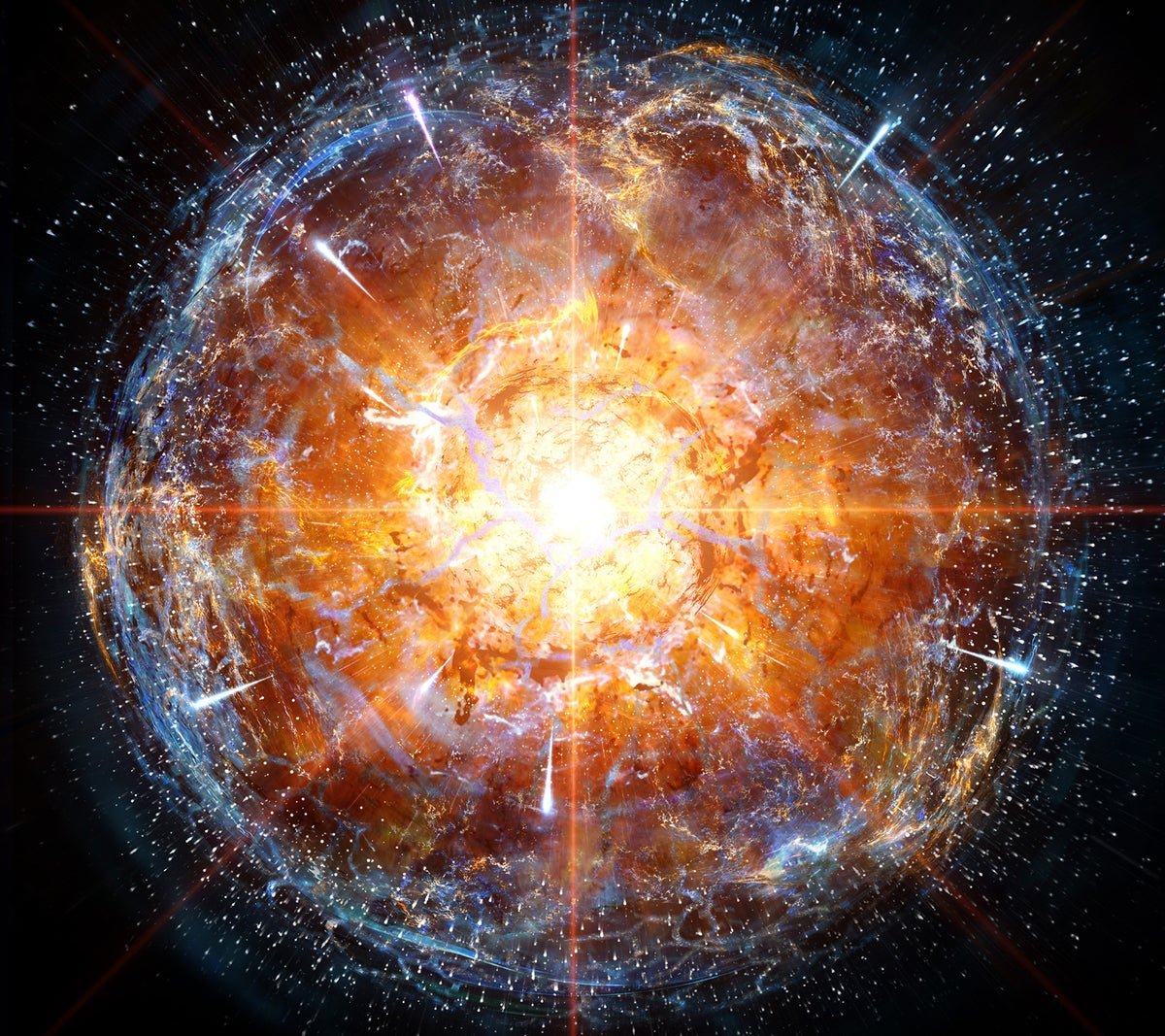
The big bang wasn’t a bang in the traditional sense—but it was nonetheless the start of important things: for one, space; another, time. Thirdly, it began the conditions and processes that eventually resulted in us humans, who can sit here and wonder about space and time. The big bang was, effectively, the beginning of the universe. According to the logic of human brains, it seems like there must have been something before the big bang, even if “before” is the wrong word because there was no time until after.
The good news for us is that physicists do have ways of thinking about—and even empirically studying—the origins of the origin of the universe. Counterintuitive and impossible as it may seem, cosmologists are even making progress in determining which wild ideas might peel back the veil on that early era, even though it remains inaccessible to telescopes.
For millennia, what happened before and at the beginning of the universe was not a question scientists could even scratch at. Cosmological queries were the dominion of philosophers, says Jenann Ismael—herself a philosopher of physics at Johns Hopkins University. The most fundamental query, of course, is where we come from—a question as popular among philosophers as it is with the rest of us. Other questions, Ismael says, include doozies such as “What are space and time? Does time have a beginning? Does space have boundaries?”
On supporting science journalism
If you’re enjoying this article, consider supporting our award-winning journalism by subscribing. By purchasing a subscription you are helping to ensure the future of impactful stories about the discoveries and ideas shaping our world today.
Even after cosmology became a hard science, the field was a bit sketchy, Ismael says. “The science was one-and-a-half facts,” she adds. The sentiment, she says, is usually attributed to physicist James Jeans. But that has changed in the past century or so as the philosophers’ musings have wandered into the realm of theory, experiment and data. “These old conceptual questions are arising in ways that have new angles, a new spin and a new framework,” Ismael continues.
It’s unclear whether science as a discipline—and scientists as people—will ever be able to answer some questions definitively. After all, no one can “see” before the big bang, and no one will ever be able to—at least not directly. But the current and future universe, researchers are learning, may contain clues about the distant past.
And as scientists push the boundaries of what can be known, they are testing their theories about the before before—the only way to get closer to potential truth. “I’m happy to listen to any framework, but I only start taking it seriously when it produces a clean observational target that a real instrument can go after,” says Brian Keating, a cosmologist at the University of California, San Diego. “If there isn’t a discriminant you can measure, you’re doing metaphysics with equations.”
Here are three ideas that he and other scientists take seriously about the cosmos’s ultimate origins.
The No-Boundary Proposal
Quantum mechanics is the physics of the extremely small, ruled by statistics and uncertainty. It’s also what may have shaped the early universe. To understand the quantum cosmos, scientists calculate the probability of a given output from a certain input.
In cosmology, the “output” is the universe as it looks today. “The question is: What should the input be?” says Jean-Luc Lehners, former head of the Theoretical Cosmology group at the Max Planck Institute for Gravitational Physics (Albert Einstein Institute) in Germany.
Physicists can break up the problem into chunks of outputs and inputs. If they consider the modern universe to be the output, they can try to figure out what input might have produced it. Then they can step backward by taking that input as a new output and determine what conditions earlier in the universe might have produced that state, and so on. They can theoretically (if they have a lot of time on their hands) do that forever, going in steps to reach the before before—and even before that.
That infinite regression, however, didn’t make sense to physicists Stephen Hawking and James Hartle, who worked on the question together in the 1980s. They decided to eliminate the universe’s ultimate input—its “beginning.” Instead they formed a model of the universe called the no-boundary proposal. They suggested time and space form a closed, rounded surface: a four-dimensional hemisphere of spacetime.
Does that not make sense? Try this: imagine the universe like the globe of Earth. The big bang is the North Pole. There is no “before” it, just as there is no north of north. Before becomes irrelevant as a concept. “It’s almost like a Zen idea,” Lehners says. And it’s one he’s toying with in calculations to see if he can re-create the universe we see today from a round place with no north of north.
“The no-boundary proposal has a decent amount of support, or at least interest, within the physics community,” says Sean Carroll, a professor of natural philosophy at Johns Hopkins University. He notes that some scientists worry about how well-defined the idea is, but he finds it to be a “natural starting point,” given what we know about quantum gravity.
A Bouncing, Cyclic Cosmos
Paul Steinhardt, a physicist at Princeton University, has another idea about what happened before the universe as we know it began. It stands in opposition to an idea that he helped shape: this concept suggests that, after the big bang, spacetime expanded very quickly for a very short period of time called inflation. The inflation scenario is meant to explain why the universe looks flat and similar in every place our telescopes can look.
After helping to establish inflation theory, however, Steinhardt started doubt the idea—in part because it has required constant tweaking to keep it consistent with our measurements of the cosmos. “It’s really hard to think of a historical example where that actually led to what turns out to be the right answer,” Steinhardt says. “Almost always, that’s a sign that the Titanic is sinking.”
Time to get in a lifeboat, he thought. So he came up with a cyclic universe: one that balloons significantly in size, as ours seems to be doing now, then shrinks a little and then starts expanding all over again. “When people think about contracting universes, they’re usually thinking about things coming to a crunch,” Steinhardt says—the cosmos collapsing back down into an infinitesimally small point. That’s not what Steinhardt is talking about: he thinks the universe perhaps contracts slowly—to a smaller fraction of its size but not to nothing. That shrinking smooths things out in ways inflation fails to explain, he says, while still producing a cosmos that appears flat and the same in all directions.
Steinhardt adds that what looks like a big bang is actually not: the universe expands, then slowly contracts and then quickly goes back to expanding. The fast transition between contraction and expansion is not a bang but a “big bounce.”
Steinhardt hopes to test this idea not just by examining the past but also by taking data from the present and watching the future carefully. “It makes an obvious prediction, which is that the current phase of accelerated expansion can’t continue forever,” Steinhardt says. “It must end.” This idea, in turn, raises a new question: “Could it already be in the process of ending now?” he asks.
Our measurements about how the universe is expanding come from relatively faraway objects that emitted their light a long time ago. Things could have changed, and we might not know yet because the effects would be hard to measure. “We’d have to look at objects very close by in order to detect it,” Steinhardt says. That’s not cosmologists’ forte, and they would have to develop new techniques and instruments to look nearby for such effects.
Even more intriguingly, Steinhardt says that because “nothing bad happens to space” during the contraction and bounce, information—even objects such as black holes—can pass from before the bounce to after. “There might be things in our observable universe which are from before,” he says. Keep an eye out.
Mirror Universe
Another big idea about the before before is of interest to Latham Boyle, a researcher at the Higgs Center for Theoretical Physics at the University of Edinburgh, who was formerly Steinhardt’s graduate student. Like the big bounce concept, Boyle’s favored proposal is pretty simple conceptually—and it similarly eschews inflation. “There’s the universe after the big bang and the universe before the big bang,” he says, “and they’re kind of mirror copies of one another.”
Picture this, Boyle says, like the points of two ice cream cones touching each other, with their contact representing the big bang. “Time marches away from the big bang in both directions,” he says. On our side, it goes forward; on the mirror side, it goes backward. What happened before the big bang is the reflected opposite of what happened after. And that doesn’t just include time: here, there is matter; there, there is antimatter. Here, left is left; there, left is right.
Boyle has ideas for observations that could support (or nullify) his theory, which is called the CPT-symmetric (charge-parity-time-symmetric) universe. For one, a CPT-symmetric universe wouldn’t have sent gravitational waves shimmering through space from the beginning of the universe, as classical cosmology theories predict. Astronomers have been hunting for such signals. If these waves are eventually detected, that would rule this idea out.
Boyle’s hypothesis also predicts that dark matter could be explained by a particular kind of neutrino. He hopes cosmological instruments will reveal more information about neutrinos soon. The model’s connection to particle physics, among other aspects, makes this idea intriguing, Carroll says.
“What I like here is the economy,” Keating says, “and the fact that it sticks its neck out,” focusing on the kinds of specific, physical predictions experimentalists like him need.
The Test of Time
Each of these scientists is attached to their own idea. But Lehners, interviewed late last year, isn’t confident any of them will stand the test of time—whatever time is. “I think it’s completely preposterous that, in the year 2025, we should understand the beginning of the universe,” he says. “Why not in the year 2,000,025 or whatever?”
And even if researchers think they are getting close, they could be approaching a false summit: that frustrating place that looks, when you’re hiking, like the top of the mountain but is actually a mere bump blocking your view of the true peak—or your view of what you think is the true peak but is, in fact, just another bump. “In general, I think that it’s extremely plausible that there was something before the big bang,” Carroll says, “but it’s also very plausible that the big bang was truly the beginning. There’s too much we’re just unsure about, and I am a bit skeptical that the state of the art is good enough to allow us to draw any firm experimental or observational conclusions out of any of these models.”
But cosmologists aren’t studying the ultimate origins because they think the mystery will be resolved in their lifetime. Lehner imagines himself as part of an intergenerational project helping humanity trek closer and closer to a truth we may never find.
Studying such a physically and philosophically inaccessible topic is fundamentally different from other types of science—those quests at least exist in our plane of space and time. It almost seems like the question isn’t actually within the realm of science. But science often involves probing things we cannot access, at least at the start, philosopher of physics Ismael says. Scientists predicted atoms before we could see them, and black holes and dark matter still lie beyond our ability to detect directly—yet investigating them is clearly scientific. “I think the benchmark for what counts as science has moved,” she says. And it will continue to—including, perhaps, backward to the before that may not be a before.
