

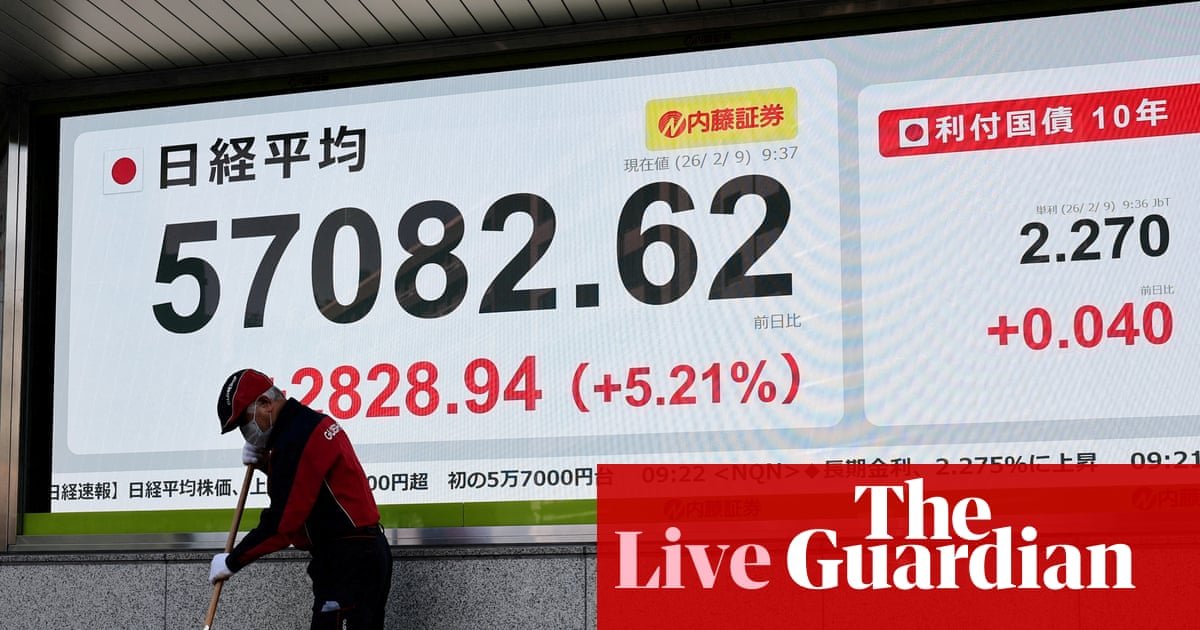
Introduction: Japan’s Nikkei hits record high and yen strengthens after Takaichi’s election win
Good morning, and welcome to our rolling coverage of business, the financial markets and the world economy.
Political drama will be on investors’ minds today, as they react to a landmark election in Tokyo and mounting pressure on UK prime minister Keir Starmer.
The yen has strengthened after Japanese prime minister Sanae Takaichi won a sweeping victory in Sunday’s election, ending a six-day run of losses.
The Japanese stock market has rocketed to a new high too, as investors welcome the prospect of more stimulus.
Takaichi’s Liberal Democratic party (LDP) has won an absolute majority in Japan’s lower house, and with her coalition partner, the Japan Innovation party, Takaichi now has a supermajority of two-thirds of seats.
This will smooth the way for Takaichi to push through a 21tn yen (£99bn) stimulus package, and her pledge to suspend Japan’s 8% sales tax on food for two years.
Those plans had rattled financial markets and caused currency volatility during the election campaign, but there’s now relief that Japan’s political uncertainty appears to be over.
ING say the LDP’s landslide victory in Japan is positive for risk assets, even though her policies could raise Japan’s borrowing levels even higher:
Prime minister Takaichi’s decision to leverage her popularity for her party turned out to be successful.
The landslide victory will reinforce her responsible but expansionary fiscal spending and a more Japan-focused foreign policy. Risk-on sentiment will dominate the market for now.
Japan’s Nikkei share average surged to a record high on Monday, after the election results, surpassing the 56,000 level for the first time at the start of trading. It quickly pushed through the 57,000 point mark, before closing up 3.9% at 56,363 points.
Stock markets like extra fiscal stimulus. After Sanae Takaichi secured Japan’s largest postwar election victory, Nikkei 225 surged over 5% at Monday’s open. Equities had already outperformed in the four months since she took command of the LDP, even accounting for the weak yen pic.twitter.com/uH2AMA7WrS
— Rymond_Inc (@rymondIncKenya) February 9, 2026
The agenda
Noon BST: European Central Bank chief economist Philip Lane gives lecture at Maynooth University
4pm BST: ECB presidnt Christine Lagarde participates in plenary debate on the state of the EU economy and ECB activities in Strasbourg, France
Share
Key events
Show key events only
Please turn on JavaScript to use this feature
UK bond yields rise further, with Scottish Labour leader to call on Starmer to stand down
UK borrowing costs are pushing higher, as pressure continues to mount on Keir Starmer.
The yield, or interest rate, on 10-year government bonds is now up 7 basis points (0.07 percentage points) to 4.59%, as gilt prices continue to drop.
That’s close to the two and a half-month high touched last week.
30-year bond yields are now up almost 8 basis points to 5.41%. That’s the highest level since mid-November, just before Rachel Reeves’s budget.
Yields have pushed higher following news that Anas Sarwar, the Scottish Labour leader, is to call on Keir Starmer to stand down as prime minister and Labour leader.
Share
The yen is continuing to strengthen against a generally weaker US dollar.
Japan’s currency is now up 0.7% at ¥156.1 to the US dollar, up from ¥157.2 on Friday night.
That’s despite predictions that Japan’s fiscal policy will now become more looser and more expansionary.
Daniele Antonucci, chief investment officer at Quintet Private Bank, explains:
Japan’s snap election delivered one of the largest parliamentary majorities in decades, sharply reducing near-term political uncertainty.
The scale of the mandate increases the likelihood that fiscal policy will become more expansionary over the coming quarters.
Unlike past stimulus episodes, the focus is likely to be targeted, with spending aimed at strategic sectors such as AI, semiconductors and defence.
That raises the probability of higher public investment and stronger incentives for private-sector capital expenditure.
Japanese equities have reacted positively, particularly in technology, machinery and defence-linked names.
This adds to Japan’s relative equity outperformance we’ve seen over the past few months though at the same time valuations have now become more demanding.
At the same time, expectations of looser fiscal policy are putting renewed downward pressure on the yen.
Share
Today’s impressiver near-4% jump on the Japanese stock market follows some strong gains in recent months, points out Russ Mould, investment director at AJ Bell:
“Japanese shares rallied after Sanae Takaichi’s landslide election win. Investors are excited at the prospect of economic stimulus measures and the prime minister’s desire to drive corporate investment in the tech space.
“Japan’s Nikkei 225 has risen 68% since April 2025 amid a weaker yen, which makes the country’s exports more competitive from a price perspective, and a shift in the political backdrop. That’s an unusually large movement for an equity index in such a short period.
Share
Eurozone upturn begins as investor confidence rises
Encouraging news from the eurozone, where investor confidence has risen.
The Sentix index measuring investor morale in the euro zone, released this morning, rose for the third month running to its highest level since July 2025.
The index rose to 4.2 points in February from -1.8 the month before, beating forecasts by analysts polled by Reuters for a reading of 0.0.
Sentix says:
“The recession in the euro zone appears to have come to an end and an upturn seems to have begun.”
ShareMark Sweney
A top Warner Bros Discovery executive has said he is “confident” that Netflix will keep its HBO Max streaming service, home to hit content such as Game of Thrones and Succession, despite uncertainty about the future ownership of the US film and TV giant.
JB Perrette, who runs WBD’s global streaming and games operations, is forging ahead with the long-awaited launch of HBO Max in the UK & Ireland on 26th March as Netflix and Paramount Skydance continue to battle for control of WBD.
“The one thing that is very clear in public statements from Ted [Sarandos] and Greg [Peters, co-chief executives of Netflix] – and this is 15 to 20 years in the making – they have talked about HBO many years ago as ‘could they get to be HBO before HBO became them’,” he said, speaking at the launch event for HBO Max UK&I.
“They have an enormous amount of respect and appreciation for the HBO brand in exactly the way we are defining it. It is distinct, premium, must-watch, different from mass volume [models].”
WBD’s board of directors has unanimously backed Netflix’s $82.7bn (£61.5bn) all-cash deal, while rival Paramount is attempting to derail the agreement with a $108.4bn takeover offer that it is trying to win support for directly from shareholders.
In the US, critics of the Netflix deal argue that buying HBO Max, which has around 60 million US subscribers, would give it too much power.
However, in a number of key markets, notably the major European countries where WBD had to unwind longstanding HBO deals with Sky, the HBO Max streaming service has only just launched.
The UK – where the service will include TNT Sports content such as Premier League and Champions League football migrated from WBD’s Discovery+ app – is the last major world market to see the launch of HBO Max.
“These rollouts where someone could say ‘why are you rolling out, you are selling the company?’,” said Perette.
“The reality is Netflix want the brand to be vibrant, dynamic, to be stronger and to be visible. I can’t say exactly what they want to do with it. But I am confident… having it in this market and actually having a more broad following, not just an industry following which is where it has been residing in Sky, is very helpful to their strategic ambitions as opposed to something that is contradictory to that.”
Perette said that by the end of March, when the service has launched in the UK & Ireland, HBO Max will have been live in three of the big five European markets for less than 90 days.
In the UK the cheapest tier, Basic with Ads, will cost £4.99. However, WBD expects the most popular tier to be its £5.99 monthly subscription, Standard with Ads, which includes recent movies from Warner Bros.
Share
Bloomberg have spotted that hedge funds are betting on more pound weakness as UK Prime Minister Keir Starmer’s future hangs in the balance.
They say:
Trading volume of euro-sterling options was the most elevated since 2019 on Feb. 5, according to data from The Depository Trust and Clearing Corp. The volume of call options, which gain if sterling weakens versus the euro, was 50% larger than that of put options, which increase in value if the pound rises.
Hedge fund flows into “euro-pound remained one‑way, with heavy topside buying,” said Thomas Bureau, global head of FX option trading at Societe Generale, referring to demand for call options following the market moves on Feb. 5.
“The pound has traded with EM‑style volatility, driven by global dollar strength and hypersensitivity to geopolitical headlines.”
Share
The weakness in the UK bond markets today is arguably more to do with the Japanese election than Keir Starmer’s shaky-looking grip on power.
That’s because Sanae Takaichi is expected to turn to the bond markets to fund a new stimulus programme.
Economist Julian Jessop, a fellow at the free-market Institute for Economic Analysis (not a natural Starmer ally) explains on X:
Big LDP win in Japan’s elections already pushing up global yields in anticipation of even more borrowing).
Could be another rocky morning in the gilt market today, but this is more about Sanae Takaichi than Morgan McSweeney!
(Big LDP win in Japan’s elections already pushing up global yields in anticipation of even more borrowing)
— Julian Jessop (@julianHjessop) February 9, 2026
Share
Ooh, UK bond prices just fell a little more, as news broke that Keir Starmer’s director of communications Tim Allan has resigned.
That has pushed up the yield (or interest rate) on 10 and 30-year bond yields by four basis points (0.04 percentage points) – still a small move….
Share
“No panic on financial markets about the stability of the UK government” (yet….)
There’s some excitable reporting out there this morning about the market reaction to Keir Starmer’s shaky grip on 10 Downing Street.
To reiterate, UK government borrowing costs are slightly higher, and the pound is marginally lower against the US dollar, and down about 0.4% against the euro (a more meaningful move, see earlier post).
But a two-basis point (0.02 percentage point) rise in UK gilt yields suggests investors are basically shrugging at the turmoil in Westminster.
Russ Mould, investment director at AJ Bell, says:
“Politics were front of mind for investors in the UK after the resignation of chief of staff, Morgan McSweeney.
Movement among government bonds and the currency suggests there is no panic on financial markets about the stability of the UK government.”
Share
Updated at 05.45 EST
Back to Japan…. and Neil Newman, managing director and head of strategy at Astris Advisory Japan, has summed up the importance of Sanae Takaichi’s achievement in winning an absolute majority in Tokyo’s lower house:
“Overall, as the LDP has gone from a very weak government that really couldn’t do anything to an extremely strong government now with the supermajority of the lower house, they really could call the shots.”
Share
Greggs’ shares hit by fears weight-loss jabs could hit spending
UK bakery chain Greggs is under pressure, as analysts warn that the boom in weight-loss products could hit demand for its pasties, pies and sausage rolls.
Stockbroker Jefferies suggested last weekend that drugs such as Mounjaro and Wegovy may create an “enduring challenge” for Greggs and hamper growth (The Times have the story here).
Greggs are the top faller on the FTSE 250 index of medium-sized companies, down 4.2% this morning a 16.09p, down 72p.
Victoria Scholar, head of investment at interactive investor, says:
Greggs is suffering today, falling sharply after Jefferies cut the stock from a buy to a hold. The broker said that weight loss drugs like Mounjaro could create an ‘enduring challenge’ for the company.
Share
Updated at 04.59 EST
InPost shares jump after takeover by FedEx and private equity-led consortium
Shares in parcel locker group InPost have surged by 13.5% after a consortium led by FedEx Corporation and private equity firm Advent has agreed to buy the company for €7.8bn (£6.8 billion).
The bidders have offered €15.60 a share for Polish-headquartered InPost, and have plans to expand further across the UK and Europe.
In the UK, the group is looking to more than double the locker points to 30,000 from 14,000 currently, while it also has 5,500 pick-up and drop-off points.
InPost’s shares have quickly jumped over the €15 mark.
Share
European stock markets are also making a positive start to the new week.
The pan-European Stoxx 600 index has gained 0.27%, as last week’s fears over the impact of AI on software and data companies appear to ease off.
Share
Updated at 04.34 EST
Japan’s election result is likely to encourage more selling of the yen, predicts Lee Hardman, currency expert at MUFG bank.
Hardman told clients this morning:
Yen weakness following the election result has been constrained by the heightened risk of intervention as USD/JPY moves back into the high 150.00s. Japan’s top currency official Atsushi Mimura warned that they are watching market moves with a high sense of urgency.
It followed comments from Finance Minister Satsuki Katayama who said after the election victory that she will communicate with financial markets on Monday if needed. She reiterated that “Japan and the Us have signed a memorandum of understanding, which stated that we can take decisive measures against rapid movements out of line with fundamentals. That certainly includes intervention”.
The ongoing threat of intervention has helped to dampen further yen selling after the lower house election although it remains vulnerable to further weakness if market participants remain concerned over policy direction going forward under Prime Minister Takaichi.
Share
Updated at 04.05 EST
NatWest shares fall after buying Evelyn Partners
Shares in banking group NatWest have dropped over 5% after it agreed to buy Evelyn Partners, one of the UK’s biggest wealth managers.
NatWest will pay £2.7bn for Evelyn Partners, a move which will boost its wealth management arm
Evelyn Partners, formerly known as Tilney Smith & Williamson, controls about £69bn of client assets and offers financial planning and wealth management across the UK and Ireland.
The company traces its roots back to 1836 when Thomas Tilney created his eponymous stock brokerage in the City of London. Tilney was bought by Permira in 2014, before acquiring the 145-year-old Glasgow-based investment company Smith & Williamson in 2019, and rebranding to its current name three years later, my colleague Alex Daniel reports.
Share
Updated at 04.19 EST
