

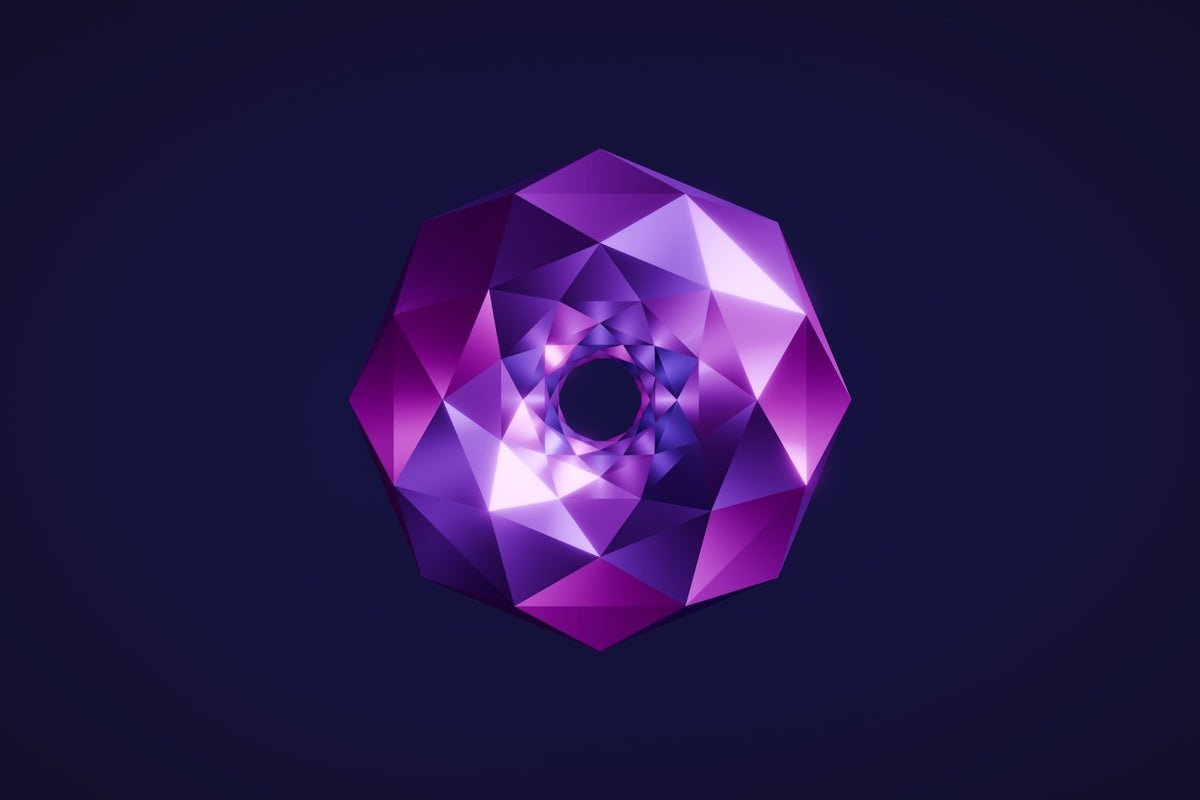
Imagine that you want to know the most efficient way to make a torus—a doughnut-shaped mathematical object—from origami paper. But this torus, which is a surface, looks drastically different than the outside of a glazed bakery doughnut. Instead of seeming almost perfectly smooth, the torus that you envision is jagged with many faces, each of which is a polygon. In other words, you want to construct a polyhedral torus with faces that are shapes such as triangles or rectangles.
Your peculiar-looking shape will be trickier to construct than one with a smooth surface. The complexity of the problem only grows if you decide that you want to envision constructing something similar but in four or more dimensions.
Mathematician Richard Evan Schwartz of Brown University tackled the problem in a recent study by working backward from an existing polyhedral torus to answer questions about what would be needed to construct it from scratch. He posted his findings to a preprint server in August 2025.
On supporting science journalism
If you’re enjoying this article, consider supporting our award-winning journalism by subscribing. By purchasing a subscription you are helping to ensure the future of impactful stories about the discoveries and ideas shaping our world today.
Schwartz was able to find a solution to a long-standing question: What’s the minimum number of vertices (corners) needed to make polyhedral tori with a property called intrinsic flatness? The answer, Schwartz found, is eight vertices. He first demonstrated that seven vertices aren’t enough. He then discovered an example of an intrinsically flat polyhedral torus with eight vertices.
“It’s very striking that Rich Schwartz was able to entirely solve this well-known problem,” says Jean-Marc Schlenker, a mathematician at the University of Luxembourg. “The problem looks elementary but had been open for many years.”
Schwartz’s finding essentially provides the minimum number of vertices that a polyhedral torus needs so that it can be flattened. But one detail—what it means to be “intrinsically flat” rather than simply “flat”—is a bit complicated to parse. The notion is also central to connecting Schwartz’s results to the question of building polyhedral tori from scratch.
Since the 1960s mathematicians have known that intrinsically flat versions of mathematical objects exist. Actually finding those objects is a different beast, Schwartz notes. Describing polyhedral tori as intrinsically flat isn’t quite equivalent to simply saying that they’re flat like a piece of paper. Instead it means that these surfaces have the same dimensions as (or, as mathematicians say, “are isometric to”) tori that are smooshed flat. “Another way to say it is that if you compute the angle sums around each vertex, it adds up to 2π everywhere,” Schwartz says.
According to Schlenker, Schwartz’s finding is very on-brand for his expertise. Yet for many years, Schwartz was so stumped by the problem that he set it aside.
He first heard about the quandary in 2019, when two of his mathematician friends—Alba Málaga Sabogal and Samuel Lelièvre—brought it to him. “They thought I would be interested in this because I had solved this thing called Thompson’s problem, which was about electrons on a sphere,” Schwartz says. “They thought [Thompson’s problem was] about searching through a configuration space and trying to see which configuration was best amongst an infinite number of possibilities, and these origami tori have a similar kind of flavor.”
But Schwartz wasn’t initially convinced. “Basically, they shoved it in my face, and at some point, years passed. I actually thought it was too hard of a problem,” he says. The difficulty stemmed from the large dimensions that seemed to be involved. “Even for just seven or eight [vertices], it seems that you would have to look at 20-some-odd-dimensional space,” he says.
But when the three mathematicians reunited in 2025, Schwartz learned that Lelièvre’s roommate, Vincent Tugayé,had found an example that worked with nine vertices. “It was a really pretty thing” that Tugayé, a high school teacher with a Ph.D. in physics, exhibited at math outreach fairs in Paris, Schwartz says. “I thought, ‘Well, this one’s got to be the best,’” adds Schwartz, who then set out to settle whether his intuition was correct.
To approach the question of whether the cases with seven or eight vertices would work, Schwartz focused on answering “How do I cut down the dimension?” He generated a lot of ideas about how to do so for the seven vertices case. Yet he ultimately stumbled upon a mathematical gift of sorts: a little known 1991 paper that “goes about 80 percent of the way to proving that you can’t do it with seven vertices,” he says. “Then I just finished it off.”
Still thinking that the eight vertices case also wouldn’t work, he then tried to use a similar approach to prove that claim. When he found he couldn’t rule out some cases, he decided to figure out what properties an eight-vertex torus would need to have to be intrinsically flat. Using an approach that he describes as “heavily supervised machine learning,” Schwartz then found an eight-vertex example that did work.
“What’s most striking, I think, is that it’s another example of the specific skills that Rich Schwartz has developed, blending traditional mathematical investigation with computational methods,” Schlenker says. “He finds beautiful geometric ideas to prove some results but also writes elaborate programs to search for and find examples. Very few mathematicians are capable of bringing those two strands together so harmoniously.”
It’s Time to Stand Up for Science
If you enjoyed this article, I’d like to ask for your support. Scientific American has served as an advocate for science and industry for 180 years, and right now may be the most critical moment in that two-century history.
I’ve been a Scientific American subscriber since I was 12 years old, and it helped shape the way I look at the world. SciAm always educates and delights me, and inspires a sense of awe for our vast, beautiful universe. I hope it does that for you, too.
If you subscribe to Scientific American, you help ensure that our coverage is centered on meaningful research and discovery; that we have the resources to report on the decisions that threaten labs across the U.S.; and that we support both budding and working scientists at a time when the value of science itself too often goes unrecognized.
In return, you get essential news, captivating podcasts, brilliant infographics, can’t-miss newsletters, must-watch videos, challenging games, and the science world’s best writing and reporting. You can even gift someone a subscription.
There has never been a more important time for us to stand up and show why science matters. I hope you’ll support us in that mission.
