

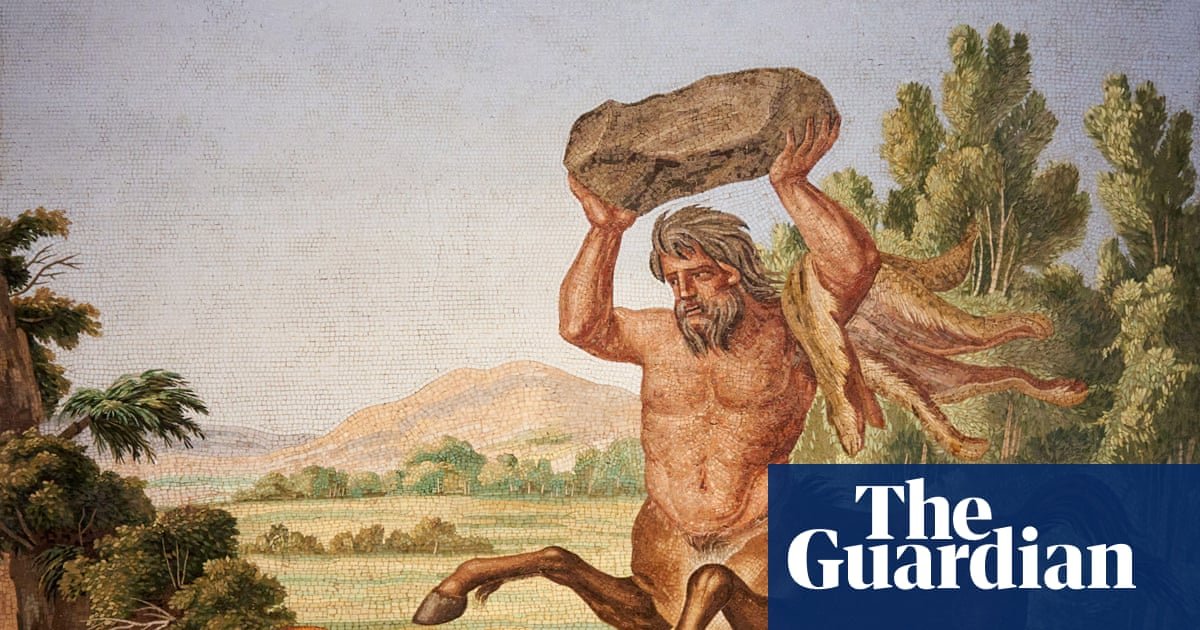
The prophet Ezekiel once claimed to have seen four beasts emerge from a burning cloud, “sparkling like the colour of burnished brass”. Each had wings and four faces: that of a man, a lion, an ox and an eagle. Similarly, a creature called Buraq, something between a mule and a donkey with wings and a human face, was said to have carried the prophet Muhammad on his journeys; while the ancient Greeks gave us the centaur, the mythical human-horse hybrid recently rebooted by JK Rowling in the Harry Potter books.
“The impulse to blend the anatomical traits of other species with those of humans appears to be hardwired into our imagination,” notes Adrian Woolfson in his intriguing and disturbing analysis of a biological revolution he believes is about to sweep the planet. Very soon, we will not only dream up imaginary animals – we will turn them into biological reality.
According to this forecast, species shaped by billions of years of natural selection will soon have to share their world with artificial versions designed and constructed by humans, with dramatic consequences. “Synthetic species could be harnessed to produce biofuels, medicines, biosensors, drought-resistant crops and countless other innovations,” he writes. “We may grow houses rather than build them.”
This is the stuff of science fiction. Nevertheless, London-born and Oxbridge-educated Woolfson – founder of the San Diego genetics company Genyro and author of two previous popular science books – is adamant that the nature of life on Earth is about to be transformed. He styles his book as a wake-up call. We are facing “a second Genesis” that could bring great benefits but also have profoundly grim, unsettling consequences.
So what has happened in recent years to bring us to the edge of such a revolution? How exactly will it manifest? And how can the upsides be maximised and the dangers minimised?
In answer to the first question, Woolfson points to two key inventions. The first involves technologies, such as the Sidewinder method developed at Caltech, that can build DNA fragments “of unprecedented size and complexity, rapidly and efficiently”. Entire genomes can now be synthesised in record times. The second comes courtesy of artificial intelligence, which has helped scientists solve previously intractable scientific problems, in particular those concerning the shapes of proteins.
Proteins are the building blocks of life. They make up our hair, bone, skin and muscle and are constructed of folded sequences of amino acids. Scientists knew how to create one-dimensional chains but were unable to predict how the resulting strings of amino acids would fold up to form three-dimensional proteins, whose shape determines their function. This greatly restrained their ability to generate new proteins.
Then, in 2020, AlphaFold2, drawing on neural-network technology also used in systems like ChatGPT, cracked the folding code. The structures of complex proteins can now be predicted with confidence, and as a result we are able to create novel ones for use in medicine or elsewhere.
How will creatures crafted through billions of years of natural selection exist in a world populated by synthetic newcomers?
And if we can make new proteins, we can also contemplate bringing into being new forms of life, writes Woolfson. “Biology now stands at the threshold of transitioning from a largely descriptive science into a generative one. In the future, we won’t just catalogue species, we will create them.”
It is not hard to imagine that problems might occur when this happens. How will creatures that have been shaped by evolution over aeons exist in a world that also includes synthetic newcomers? Will the latter have the same legitimacy as natural species? Woolfson thinks not, but warns that the distinction between natural and artificial life forms will become increasingly blurred.
There might also be opportunities to improve existing Earthly creatures. We are the end products of the haphazard forces of heredity, chance and natural selection – and bear the scars. Take the human spine. “It’s a design disaster,” writes Woolfson, who points out that it evolved in a quadruped and is hopelessly ill-suited for an animal that walks on two legs. So could we now improve it? Why not? Life could be “guided into uncharted landscapes, endowed with entirely new properties that would reinvent the way organisms function”.
Woolfson’s descriptions can become overelaborate and laboured. He has a tendency to exaggerate the impact of the so-called second Genesis. But his arguments are compelling and his prose generally clear and straightforward.
Of course, many aspects of the coming biological revolution look far less rosy or comforting, and Woolfson catalogues these pitfalls too. Arsenals of human-made pathogens could be assembled with ease by bioterrorists. As benchtop DNA synthesisers and AI tools become ever more accessible, it will become harder to keep track of what is being created and by whom.
Fiddling with bacteriophages – viruses that infect bacteria – could inadvertently destabilise the ocean’s carbon cycle and accelerate climate change. And then there are the ethical consequences of humans tinkering more and more with mammal genomes – for example, to make mice more humanlike and therefore better models on which to test drugs. But where do you stop? Could we end up with half-human hybrids worthy of Ezekiel?
Woolfson thinks not, and insists we are compelled to proceed. Though he backs a ban on designer babies and parentless humans, he argues that a moratorium on AI-led genomics research simply would not work, while the benefits for humanity, the planet and for the animal kingdom are simply too great to contemplate applying brakes to the science. In this, he is probably too complacent about the dangers that lie ahead. The risks of unintended consequences appear all too real.
On the Future of Species: Authoring Life by Means of Artificial Biological Intelligence Hardcover by Adrian Woolfson is published by Bloomsbury (£25). To support the Guardian order your copy at guardianbookshop.com. Delivery charges may apply.
